
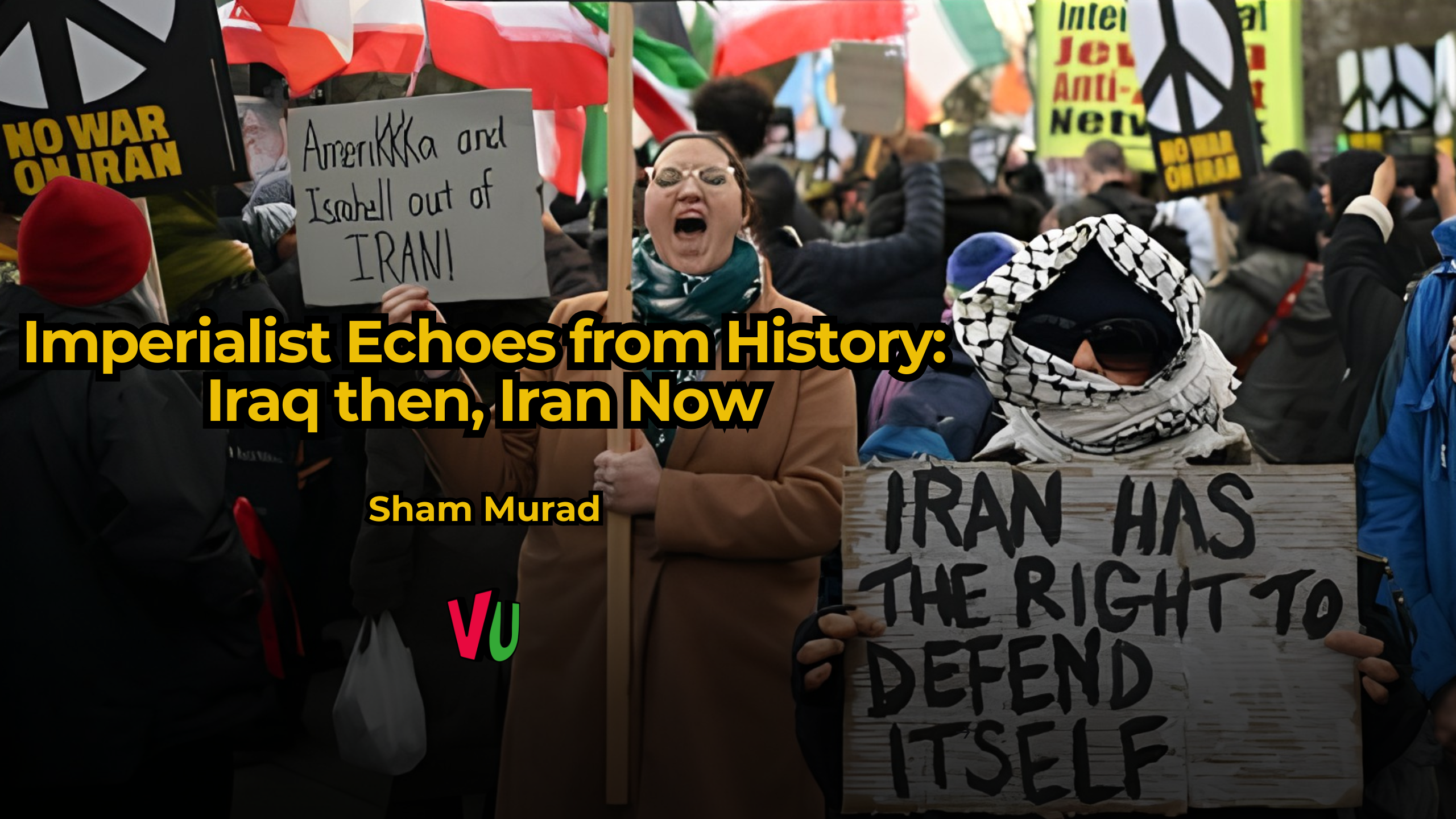
Sham Murad
As a born and bred Baghdadi, the American occupation of Iraq is something that I think about every single day. The sheer magnitude of suffering that followed the war not only haunts me but catapulted me into radical politics. For Iraqis, the invasion is not an abstract geopolitical event discussed in think tanks or television studios, but a distant historical memory. It is something that shaped our childhoods, our families, and our sense of safety in the world.
What is even more daunting is that it seems the world has learned nothing from the lessons of Iraq. Twenty-three years later, we have witnessed the same war drums, propaganda, and rhetoric being amplified across the United States to justify the most recent aggression on the Islamic Republic of Iran.
The illegal invasion and subsequent occupation of Iraq stretched for over a decade, resulting in a million dead. Iraq’s resources were captured and privatised to give profit to the hands of the elite few, opened a power vacuum for a religious fundamentalist group to ravage the country, and an illegal prison was used as a testing ground to carry out torture tactics on Iraqi men. It has been twenty-three years since the invasion, but the tragic impact of the war continues to remain clear today.
The parallels between Iraq and Iran are not accidental. They follow a pattern from a propaganda playbook that has defined modern imperial warfare: the manufacturing of consent through propaganda, the strategic use of sanctions and regime-change narratives, and, finally, the transformation of war into a mechanism for capitalist profit.
The Bridge Between Iraq and Iran
In the early 2000s, the public was inundated with stories about Iraqi weapons of mass destruction. Government officials appeared daily on television, repeating the same claims until they hardened into public “truth”. Today, the same strategy is visible in coverage of Iran. Nuclear fears are invoked constantly despite the absence of evidence that Iran possesses nuclear weapons. The aim is not accuracy but repetition; once fear takes root, war begins to appear inevitable.
The media played a crucial role in preparing the ground for the aggression against Iraq. Major news outlets repeated government claims with little scrutiny, often inviting the same military analysts, former officials, and “regional experts” (often reactionary diaspora) to reinforce the narrative of danger. This relationship between state power and media institutions is not accidental. Corporate media operates within the same economic system that benefits from war. Before the invasion of Iraq, the public was told that war was necessary, defensive, and humanitarian. Today, the same language is being recycled in discussions about Iran. Imperialism rarely invents new justifications; it simply repackages old ones.
In the age of monopoly capitalism and American hegemony, Marxists view US-imposed war as an instrument of imperialism. The wars launched against Iraq and Iran are not about “security” or “democracy” as the U.S. government and its media stenographers proclaim, but about imperial power preserving the conditions for capital accumulation. Iraq holds some of the world’s largest oil reserves. It was also insistent upon its sovereignty, refusing the spread of Israeli influence in the Arab world, which is an arm of American imperialism. After the invasion, Western oil corporations gained access to Iraqi fields, whilst U.S. and UK firms dominated reconstruction contracts, and private military companies continued to expand massively. Weapons manufacturers raked in billions of dollars, and through the elimination of the Iraqi working class and its infrastructure, the ground was prepared for American takeover of a once-sovereign country.
Regime Change
Regime change is a core imperial strategy. Capitalist economies such as the U.S. are not driven by the interests of its people but rather by monopolies, banks, and corporations. Foreign policy within the framework of imperialism can only become a tool of expanding capital accumulation. Wars, or as the capitalist media frames it, “interventions,” are conducted with the goal of restructuring foreign economies to serve global capital.
Regime change, therefore, happens when governments restrict access to their capital and resources to American interests. For example, they can decide to nationalise resources, align with rival geopolitical blocs, and/or refuse to be part of the global capitalist order in some form. The U.S. is not motivated by humanist goals or by a wish for freedom and liberation – this is always deployed as a ruse to manufacture consent for the war drive. We can see that as they continue to ally themselves with repressive, sectarian governments such as Saudi Arabia, which killed journalist dissident Jamal Khashoggi and exports sectarian ideology across the Muslim world. So long as the political interest of the U.S. is upheld, then the drums of regime change will not be beaten.
The hostility toward Iran did not begin with nuclear tensions. It can be traced back to the 1953 overthrow of Prime Minister Mohammad Mossadegh, when the CIA and British intelligence orchestrated a coup after Iran attempted to nationalise its oil industry – “Operation Ajax”. With the launch of the CIA’s first regime change operation, the message was clear to the rest of the world: control over natural resources must remain within the orbit of Western capital. The US and England installed the Shah, who restored Western access to Iranian oil.
The Iranian Revolution of 1979, in response to imperialism’s neocolonial agenda, insisted on Iran’s sovereignty and thus adopted an anti-imperialist framework and policy. Iran expelled the Western corporations that previously dominated its oil industry and nationalised it for its own use.
As Iranians understand the US plan for control over their country, Iran operates outside the US-led security architecture of West Asia, an architecture that relies on US bases on host countries’ soil. This arrangement is not for the protection of the host country, but rather to protect American private interests in the region and investor confidence in those private entities. Iran’s economy does not need to rely on the West for its survival, as it sits on major energy reserves and key shipping routes. Rather than integrating – more precisely, rather subordinating itself – to the American hegemonic global economy, the Islamic Republic of Iran insisted on sovereignty and resistance to domination.
Because of this, Iran represents a state that resists integration into Western capitalist dominance, making it a target of sanctions, pressure, and potential regime-change narratives. Iraq faced similar hostility when it attempted to maintain control over its oil resources and regional independence. States that attempt to exercise economic sovereignty quickly become framed as threats to “international security.”
The pattern is as follows: demonize the government, sanction the country, and destabilise it internally to then justify military action. Sanctions in Iraq killed half a million children in the 1990s, to whom Secretary of State Madeleine Albright called “collateral damage”. There have been decades of sanctions on Iran now. War doesn’t start with bombs; it starts with economic strangulation.
Permanent War Economy
A few months ago, I was exploring the streets of Bali when a notification glared on my phone: “Dick Cheney dead at 84.” Instantly, I was overcome with joy. I wish I could pretend I was above it, that I could forgive my enemies or those who caused harm to my people or to me, and move on. But I was over thrilled.
If you are unaware of Vice President Cheney’s conflict of interest during the Iraq war, allow me to make it clear now. Cheney was the former CEO of Halliburton, an oil company that also provides “construction” and military support services. This, for Iraq, was the trifecta of wartime spoils. Halliburton made $36.9 billion from lucrative contracts given during the Iraq war.
Marx warned us that the state serves only the interests of the ruling class. The war functioned as a transfer of wealth owned by the Iraqi public into private hands, accumulation by dispossession.
My friend and I went to the strip that night and partied away. For maybe a few hours, it felt like some twisted victory in the hands of an Iraqi; he is dead, I kept repeating to myself. I returned to the villa I was staying in once the night was over, which faced the beautiful rice terraces Bali had to offer, and reality struck me: Cheney lived to 84. The rage began to consume me, “How could he not have answered for his crimes?”
Odes and tributes were plastered all over media publications, as if he were never responsible for these deaths. A sympathy that was never extended to the Iraqi people. Mainstream accounts treated the deaths of civilians as if they were mere tragic side effects of the war, not capitalism in its most naked forms. The violence against Iraqis was systematic, not accidental. Entire populations become a mere obstacle to resource flow. This is what Marx meant when he wrote that capital “comes dripping from head to foot, from every pore, with blood and dirt.”
The military-industrial complex continues today. Companies such as Halliburton, Lockheed Martin, and Raytheon, which profited from the war in Iraq, are the companies today that design the drones, surveillance, and aircraft systems used against the people of Iran. New to this equation is the use of artificial intelligence: AI targeting systems generating target banks of Iranian infrastructure, such as hospitals, bridges, fuel depots, and more. The AI is marketed as being used against Iranian military targets, but just like Iraq, a different story occurs on the ground – contrary to the claims of the US State Department.
The war on Iran is not a mistake; it is an attempt to continue to stabilise the capitalist economy through military spending. War is an incredibly successful business model. Defense contractors, private security firms, reconstruction companies, ,oil corporations, and now tech companies specializing in AI all profit from prolonged conflict. The invasion of Iraq demonstrated how war can function as a massive transfer of public wealth into corporate hands. Which is why, 23 years later, US senator Lindsey Graham can boldly proclaim “we are going to make a ton of money” through the war on Iran.
Conclusion
Processing war is never easy. It is something that seeps into your DNA, it dictates your every movement, insecurities, your fears, even decades after the matter. But it impacts a lot more than that; war makes you blisteringly aware of the world around you. I cannot look at the schoolgirls killed in Minab, Iran, and not imagine them as my younger self.
The tragedy of Iraq is not only that it happened, but that the machinery that made it possible still exists, almost unchallenged, and even more sophisticated, adapting to the psyche of the imperial core’s public. The same political elites, corporate interests, and propaganda networks remain firmly in place.
When the drums of war beat for Iran today, they echo the same rhythms that preceded the destruction of Iraq. For those of us who lived through that catastrophe, the pattern is impossible to ignore. Iraq was never meant to be the end of imperialist war in the region. It was merely one chapter in an ongoing struggle over power, resources, and the right of nations to determine their own futures.
Imperialism relies on short memories. The victims of imperialism do not have that luxury. It is our duty, for those of us who live in the relative safety of the metropole, of the imperial core and its partners, to not only understand that but ensure the same mistakes are not repeated.
Sham Murad is a Baghdad-born refugee, activist, and community organizer. She holds a BA in International Relations and Development and an MA in Law, and works with A is for Activism, supporting immigrant and refugee children.
