
Shabbir Rizvi
Calling for civility in the face of anti-colonial violence has always been the reflex of the liberal bourgeoisie. When the oppressed, the colonized, the downtrodden react to systemic violence imposed on them with their own violence, a chorus of voices from the oppressing class blankets the media-sphere and dominates the conversation.
Posturing themselves as the enlightened class, the arbiters of civilization, the defenders of democracy against the forces of barbarism, the liberal bourgeoisie deploys the usual tactics and talking points: why can’t the colonized and the oppressed subject engage in peaceful protest and discussion? What happened to dialogue? How can one negotiate with such violence?
Ignoring the material conditions of history and sweeping aside the very real historical injustices imposed upon the colonized subject, the talking points injected into discussions around national liberation and self-determination by the bourgeoisie seek to demonize the oppressed and prevent any solidarity in the face of brutal colonialism, all while obfuscating the historical roots of the colonial relationship imposed upon the colonized.
When the Palestinian resistance launched Operation Al-Aqsa Flood on October 7th, 2023, the world watched in awe as resistance from the largest open-air prison broke free and shattered the alleged invincibility of their colonial captors. The concept of “Decolonization” soon entered the general public’s vocabulary, a term once limited to the academic realm. But decolonization now had a modern event to describe what it means, and looks like: resistance breaking the fences of occupation, destroying tanks and occupation soldiers at point-blank range, lobbing rockets into the settlements and cities, and forcing the region to acknowledge their heroic operation.
Mainstream media was activated to control the narrative: fake stories regarding resistance atrocities were published in order to suspend sympathy and solidarity, and the colonial concept of “peace” (capitulation) was forced into conversations that infected even seasoned anti-war organizers within the imperial core.
Similarly, liberal and even some “socialist” philosophers weighed in on the resistance operation by towing the bourgeois line of capitulation, demonstrating how deeply colonial ideology is embedded in academic circles and even “progressive” forces.
However, the Israeli Occupation’s reaction to Al Aqsa Flood, in the form of an ongoing genocide (pre-October 2023) accelerated, demonstrating that peace was never an option within a colonial relationship. The Israeli occupier’s side is dedicated to the eradication and destruction of an entire population (different than the traditional exploitative relationship of the colonizer and colonized), and the oppressed Palestinian side is dedicated to resistance and liberation. There can never be dialogue between these two, as the root of this confrontation is colonization and ethnic cleansing.
In 1970, when Popular Front for the Liberation of Palestine (PFLP) spokesperson and revolutionary theorist Ghassan Kanafani was pressed on why he did not engage in dialogue with the Israeli occupation, effectively engaging in capitulation, he answered that such a conversation would be “a conversation between the sword and the neck.”
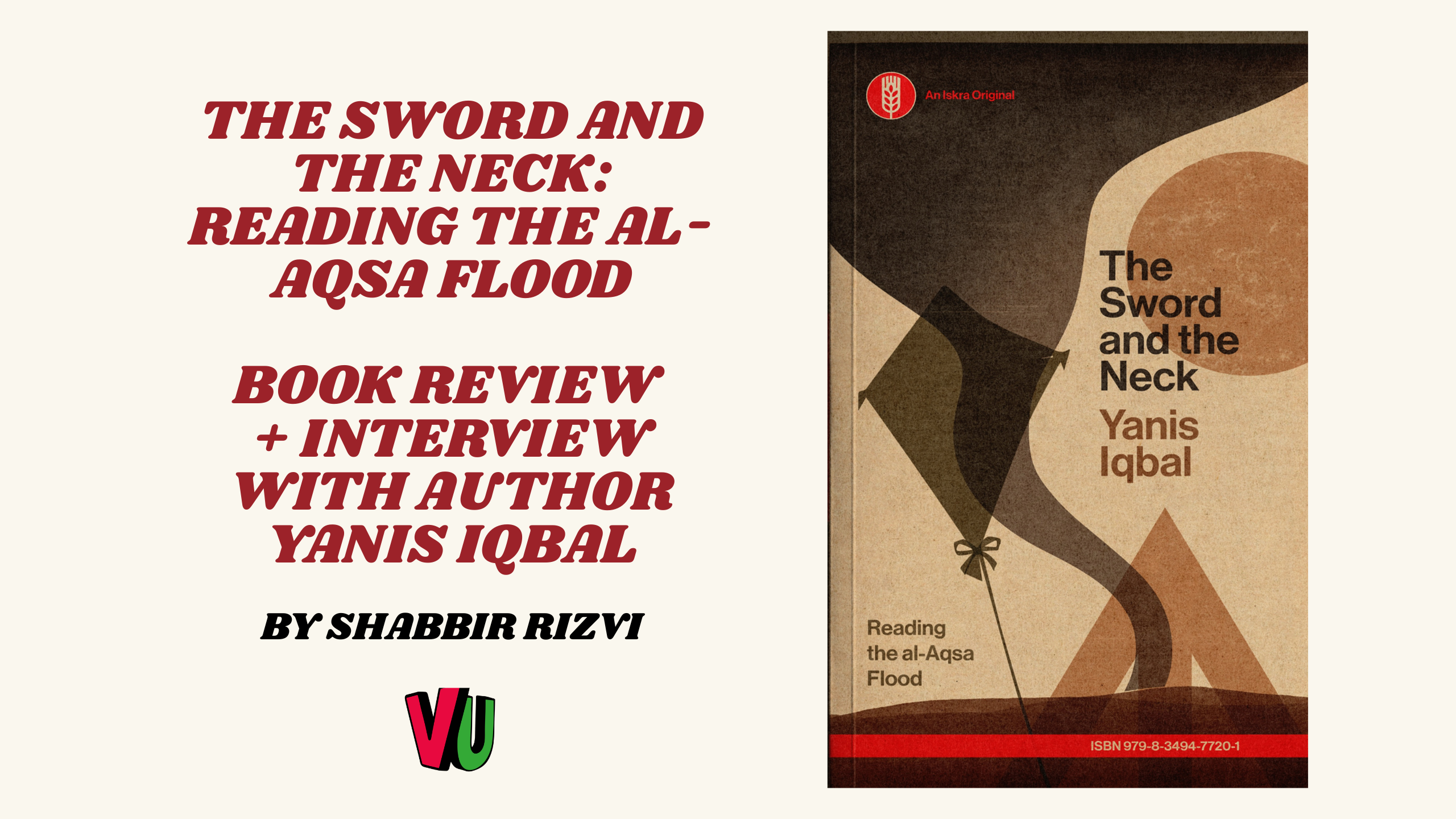
Which brings us to Yanis Iqbal’s timely book “The Sword and the Neck: Reading the Al Aqsa Flood.” Published through the revolutionary Iskra Books, The Sword and the Neck tackles and viciously shreds the liberal-bourgeois arguments that aim to obfuscate and dismiss the anti-colonial struggle of the Palestinian resistance.
The book is a quick read (about 130 pages), but it must be read carefully. Beginning with the very first chapter, it examines the “metaphysics of dominant narratives versus the physics of the oppressed” – placing the narratives that dominate the mainstream conversation around Al Aqsa Flood under the critical lens of historical materialism, tracing support for the colonial plan to dominate Palestine to the basic roots of liberalism: rights for a “community of the free” that are in confrontation with the “backwards,” “barbaric” hordes of the oppressed.
The chapters that follow confront dominant narratives imposed on the psyche of the masses, critiquing philosophers who condemn Palestinian resistance, such as Slavoj Žižek, and breaking down the false narrative that “peace” is but a conversation and “peace” conference away.
Furthermore, throughout the book, Iqbal attacks abstract idealism in concepts such as “justice” and “peace” by drawing on historical materialism to analyze the relationships between oppressor and oppressed. By doing so, Iqbal is able to deconstruct the narratives used to demonize Palestinian resistance and equip readers with talking points and investigative thinking, grounded in historical materialism, to properly defend the just resistance operation, Al-Aqsa Flood – and of course, any subsequent development of resistance to occupation.
After reading the book, one should be able to understand the dynamics of oppression and legitimize the reaction of the oppressed, and not find themselves on their back foot when defending the heroic actions of the Palestinian resistance. In fact, the book equips readers with the historical analysis needed to instead go on the offensive, and deconstruct the dominant narratives that seek to demonize resistance and stifle solidarity with anti-colonial forces. The Sword and the Neck rejects any argument for capitulation with the Israeli oppressor and roots the rejection in the reality of colonialism, staying true to the reference of the title.
The Sword and the Neck is a must-read for anyone who wishes to speak on the Al Aqsa Flood operation. It is a must-read for any organizer who stands in solidarity with Palestine, especially within the imperial core and its junior partners in the Global North. And of course, it is a must-read for those who struggle to defend, or perhaps understand, the legitimacy of armed resistance in the face of colonialism.
After reading the book, I reached out to the author, Yanis Iqbal, who was kind enough to take some time to answer questions regarding the book. Below is the full interview, unedited.
1. Thank you for taking a moment to speak with us. We would love for you to give us a short introduction: who you are, what you are up to, and what revolutionary influences guide your work and political development.
I am a student of political science and philosophy at Aligarh Muslim University in India. My interests span radical political theory, philosophy, cultural criticism, poetry, and film.
My political formation began early through my father, whose doctoral research at Jawaharlal Nehru University focused on Israel-Lebanon security politics. His engagement with anti-imperialist questions shaped the atmosphere in which I grew up. I remember, as a child, being shown images of Hugo Chávez during his illness and being asked to pray for him. That moment created an affective link with anti-imperialist struggle that has remained with me.
Among theoretical influences, Vladimir Lenin has been decisive. His insistence on the relation between revolutionary theory and revolutionary movement continues to orient my work. It compels me to produce forms of theory capable of confronting the forms of subjectivity generated by capitalism and imperialism.
2. Your book The Sword and the Neck challenges bourgeois liberal perspectives on the Palestinian resistance operation “Al-Aqsa Flood” through historical materialism and class analysis. Why did you choose the arguments you responded to?
I focused on bourgeois liberal perspectives because they function as common sense across both dominant discourse and much of what presents itself as radical theory. These frameworks circulate widely and shape how political events are interpreted, even within Marxist spaces.
The book engages figures such as Slavoj Žižek and Étienne Balibar in order to show how their philosophical positions can operate as rationalizations for pro-imperialist alignments. For many of us, theoretical formation takes place through academic infrastructures located in the Global North. Engaging these figures therefore becomes part of a broader effort to intervene in that structure.
The aim is to open space for forms of knowledge grounded in the Global South, capable of grasping capitalism as a global system whose dynamics are inseparable from imperialism.
3. When writing your critiques, did you have a specific audience in mind? Who stands to gain the most from this book?
I wrote with two audiences in view.
First, readers in Euro-Atlantic contexts who are undergoing political radicalization in response to the genocide in Gaza. For such readers, theoretical clarity becomes crucial, especially on contested questions such as the character of the “Axis of Resistance,” which is often dismissed through labels like “sub-imperialist” or “authoritarian.” The book seeks to clarify these issues at the level of political ontology, showing how the US-Israel axis encounters limits within the material structures of state sovereignty.
Second, readers in the Global South whose theoretical horizons are frequently shaped by Northern academic production. The book attempts, in a modest way, to unsettle this hierarchy and contribute to alternative trajectories of knowledge production.
4. Many on the left adopt positions grounded in abstract ideals such as “justice” or “equality,” without engaging in historical materialist analysis. How can progressive forces move beyond this tendency?
Moving beyond abstract idealism requires philosophical work. Much of contemporary left theory in the West remains tied to foundational assumptions at the level of ontology. Concepts such as Žižek’s negativity, Balibar’s “incompressible minimum,” or Ayça Çubukçu’s multiplicity introduce an excess that is presumed to guarantee emancipatory potential. These ontological guarantees then underpin appeals to ideals like justice or equality.
If such guarantees are set aside, politics appears as a field of construction, where emancipatory outcomes emerge through practices that actively produce new realities. Refaat Alareer articulated this rupture with exceptional clarity in his final interview, situating the limits of academic reflection within the immediacy of colonial violence. As he put it, “I am an academic. Probably the toughest thing I have at home is an Expo marker. But if the Israelis invade us… I am going to use that marker, throw it at the Israeli soldiers, even if that is the last thing I will be able to do.” What appears here is a displacement of philosophy from the security of ontological guarantees into a terrain where survival and resistance reconfigure the very conditions of thought. The point lies in how even the most minimal object becomes available for struggle once practice ceases to rely on abstract assurances and instead takes shape through concrete confrontation.
5. The chapter discussing “the politics of impotence” describes the importance of sovereignty via anti-colonial struggle, which is of course armed and violent. What can progressive forces do to normalize and legitimize the idea of armed resistance without using “international law” which is law written by bourgeois governments – as a reference point?
Contemporary uses of juridical language often reduce the colonized to passive victims, figures defined by vulnerability and in need of rescue. This framing obscures their role as active political agents engaged in struggle.
At the same time, international law has carried a different meaning in earlier moments. Comrade Majd Darwish, whom I met at the 2024 Annual Palestine Forum, has written about how international law helped in the legitimization of Palestinian armed struggle during the height of decolonization. From the 1960 Declaration on the Granting of Independence to Colonial Countries and Peoples, through resolutions in the 1970s affirming the legitimacy of armed struggle, international law briefly functioned as a codification of anti-colonial praxis.
Re-legitimizing armed struggle will require breaking with all a-historical framings of the colonized as mere victims. Philosopher Seyla Benhabib, for instance, describes the situation in Gaza as a “cruel cycle of violence”: by presenting colonial domination and anti-colonial resistance as mutually reinforcing repetitions, this narrative absorbs the agency of the colonized into a generalized condition of suffering. In doing so, it recasts Palestinians as figures trapped within an endless loop of injury, where action appears only as reaction, and resistance loses its political specificity.
Breaking with this framework requires affirming the colonized as active subjects who strategize, and intervene in the conditions imposed upon them. Armed struggle, in this sense, emerges as a deliberate and historically grounded practice through which new political realities are constructed. The emphasis shifts from generalized suffering awaiting recognition to collective capacities that confront and transform structures of domination.
Shabbir Rizvi is the Political Director of Vox Ummah. He is also a contributor to Sovereign Media and has been featured on PressTV, Al Mayadeen, and Orinoco Tribune.
