
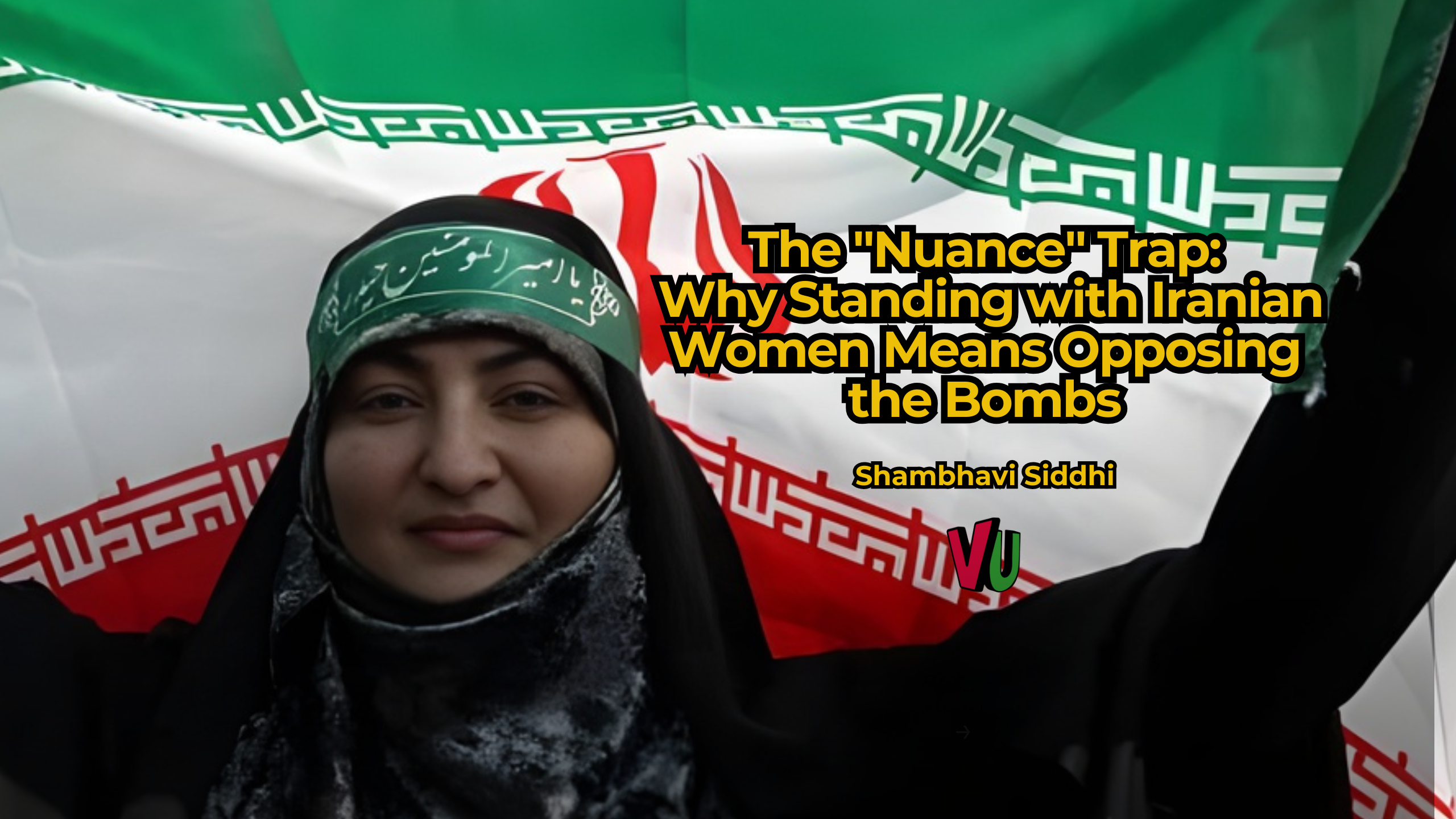
Shambhavi Siddhi
In the days following the United States and Israeli strikes on Iran, a familiar pattern reemerged on Indian segments of Twitter and Instagram. As the international community grappled with the escalating turmoil in West Asia, a specific group of Indian feminists, influencers, and self-proclaimed progressives utilized their platforms not for a principled analysis of imperialism, but to perpetuate imperialism itself. Equipped with rhetoric centered on “women’s rights” and “liberation,” they readily embraced Western imperialist rhetoric, employing the deaths of Iranian women as a means to criticise not only the Iranian state but also the perceived “backwardness” of Muslim political expression in India. This phenomenon represents a severe case of feminism-washing: a neo-Orientalist endeavor aimed at rescuing brown women from brown men, whilst inadvertently aligning with the very imperialism responsible for the bombings.
The most illustrative case in this phenomenon involves a publicly recognized Kashmiri feminist and academic. Her participation in this discourse is particularly instructive, as it exemplifies how even voices asserting to represent marginalized perspectives within Indian state oppression can be effortlessly incorporated into the imperialist agenda when the focus is on a Muslim nation beyond India’s territorial boundaries. On March 4, 2026, a tweet from this individual dispelled any semblance of an anti-imperialist stance. concern for Iranian women, revealing the nakedly militaristic core of this position:
“Iranian regime is reckless, desperate, extremist, and wants to hang on by using escalation as prompt to deescalation. Should never have nuclear. Allowing them survival and regrouping will be a big mistake.”
This statement is striking for its total lack of feminist or humanitarian framing. There’s no mention of Iranian civilian safety, or peace—just direct endorsement of regime change and warfare. Using terms like “allowing them survival” mimics military language that reduces a nation’s existence to a strategic error. This is not feminism; it reflects foreign policy consensus in Washington and Tel Aviv, repackaged for an Indian audience by an academic leveraging her conflict-zone identity.
The irony is as thick as it is bitter. This figure, who has built a significant part of a public profile on critiquing the Indian state’s actions in Kashmir, finds no contradiction in endorsing the wholesale destruction of another Muslim-majority nation. The framework used for Kashmir, which emphasizes self-determination, opposition to military occupation, and civilian protection, is entirely abandoned when the US-Israeli axis is the perpetrator, and Iran is the victim. This selective solidarity is characteristic of imperialist feminism. The Kashmiri cause is valuable mainly as a moral argument against India, but that support is rapidly used to back a far more severe imperial effort targeting another Muslim “other.”
The tweet elicited swift, pointed responses, with many accounts blocked for questioning the academic’s ties to Israel. She has previously taken part in conferences there, which bolsters her academic standing and her role as a “Kashmiri” voice. However, it is crucial to reiterate that Israel is among the most violent settler colonial states. The Kashmiri feminist who urges the world to listen to Kashmir’s voices has no trouble speaking in Tel Aviv, supporting a state that refuses to allow Palestinian refugees the right of return. list-This exemplifies the imperialist feminist: she criticizes her own government’s oppression but also plays the role of a supportive native for imperialist powers, endorsing their existence and military actions. It is crucial to recognize the historical and ongoing similarities between Kashmiris and Palestinians. Their shared experiences of occupation, Islamophobia, and settler colonialism highlight the struggles faced by both Kashmiri and Palestinian communities
It is also important to acknowledge the Indian state’s crackdown on Shi’a Kashmiris who are mourning and protesting the assassination of Ayatollah Khameini. In this context, the tweet merely exposes the writer’s limitations of decolonial praxis.
The “False Binary” as a Sophisticated Shield
Amid open militarism, subtler arguments appeared, claiming to be nuanced and anti-imperialist while supporting imperial agendas. For example, one social media post read:
“At this point people on this app desperately want you to be pro-militarism so that they can shít on your feminism sans guilt. Unfortunately for them, the idea that standing with the rights of Iranian women somehow makes you support the military action on Iran is a false binary. These are not your only choices. You could totally condemn the imperialist action on Iran while supporting the Iranian women’s bid to freedom. Refusal to hail Khamenei as a hero is not being pro imperialism.”
On the surface, this argument positions itself as “nuanced” and “principled.” It poses itself as balanced and intellectually sophisticated. But it is precisely this veneer of sophistication that makes it so dangerous. This formulation is not a critique of imperialism; it is the new, improved, and infinitely more insidious face of imperialist apologism. It is imperialism dressing itself in the guise of anti-imperialist solidarity, but functionally towing the imperialist line.
The primary concern with this “false binary” argument is its use as a straw man fallacy. It caricatures the anti-war stance, portraying it as extreme and unreasonable. By establishing this exaggerated straw man, the author presents themselves as a rational centrist capable of understanding both perspectives. However, in the context of an ongoing imperialist bombing campaign, such “centrism” constitutes a luxury that only the privileged can afford. This also completely ignored 47 years of hybrid warfare against Iran, strangling its economy and depriving it of basic resources such as medicine.
When a nation is subjected to bombing, the fundamental political action is to oppose the bombing. Investing effort in tweets claiming opposition to the Iranian state’s supposed treatment of women is not a courageous stance against a “false binary”; rather, it is a performative gesture of distancing oneself from anti-imperialists who are often discarded as “campists.”
The second, more pressing concern concerns prioritization. This formulation considers “condemning the imperialist action” and “supporting the Iranian women’s pursuit of freedom” as two parallel and equally urgent political objectives. Such a perspective constitutes a significant misrepresentation of reality. Currently, imperialist actions are underway; bombs are being dropped, and children are being rescued from rubble in real time. Meanwhile, the “Iranian women’s bid for freedom” remains a heavily propagandized issue, historically used to “save Muslim women” by the same perpetrators who are currently committing some of the most violent crimes against them in Iran. To equate the two amidst a crisis effectively diminishes the urgency of an anti-war stance. It permits the so-called “anti-imperialist” to feel justified in their condemnation of the war, while concurrently reassuring their liberal followers that they have not “gone native” and continue to uphold the “correct” “modern” views regarding Islam and gender.
The Universal Sisterhood Trap: Erasing Geopolitics with Sentimentality
Alongside the militarists and the purveyors of “nuance,” a third, seemingly gentler strain of imperialist feminism emerged. This is the discourse of universal sisterhood, which deploys sentimental platitudes to erase the brutal realities of geopolitics. A prime example of this is the following tweet:
“As a woman, you should remember that women have no homeland, and every woman should be your homeland, & standing for them should be your patriotism first.”⁴
At first glance, this seems to be a bold appeal for transnational feminist solidarity. It resembles Virginia Woolf’s well-known statement: “As a woman, I have no country.” However, like many slogans taken out of their original context, this phrase can serve more to obscure than to liberate.
The expression “women have no homeland” is employed as if territories, nations, states, and borders do not exist as tangible forces wielding significant influence over women’s lives. The assertion that “every woman should be your homeland” reduces the intricate, often contradictory relationships among women globally to a matter of personal sentiment. Such a perspective exemplifies an emotional politics that neglects historical context and power dynamics, and raises uncomfortable questions about acts of violence and warfare. In an era marked by the displacement of numerous women and men in Gaza and the destruction wrought upon Muslims through “bulldozer justice” in India, this statement appears tone-deaf and fundamentally devoid of substantive political and material significance.
The tangible reality is that women indeed possess homelands, which are being systematically obliterated by bombs made in the United States and Israel. This is not a mere theoretical concept; rather, it is a documented pattern of imperial warfare that has persisted across decades and continents. To inform a woman that she has no homeland while her residence is being destroyed by a US-produced missile is not an act of solidarity; it is an act of erasure.
In Iran, the material reality of this war is visible in the destruction of civilian infrastructure. Reports from Tehran describe a city under siege, where ‘homes, hospitals and schools’ have been hit, and residents are forced to sleep in communal areas for safety. The very fabric of women’s lives, the hospitals where they give birth, the schools where their children learn, the stadiums that are part of their public life, has become a target. This is not collateral damage; it is the deliberate destruction of the material conditions of existence.” And of course, who can forget the US-Israeli terrorist attack ona girls’ school in Minab. The brutal murder of girls at the hands of US-Israel strikes isn’t worthy of “feminism” perhaps.
These sites are not military objectives but homes, hospitals, and the core of women’s lives. When a US missile destroys an Iranian woman’s house, she does not see it as a gesture of sisterly solidarity from American feminists; rather, she perceives it as the destruction of her life, her family’s security, and her future. Telling her that women have no homeland is to wipe out the very foundation she is fighting to protect.
But the pattern extends far beyond Iran. The history of US and Israeli military action in West Asia and South Asia is, in large part, a history of the destruction of civilian homes. In Gaza, after 21 months of relentless bombing, more than 80 percent of buildings and infrastructure have been destroyed. The UN has estimated that at least 92 percent of homes in Gaza have been damaged or destroyed. The homes of Palestinian women have been systematically obliterated, not as collateral damage, but as a matter of policy.
In Afghanistan, the US military adopted tactics directly from the Israeli playbook. During the Kandahar offensive, American forces systematically destroyed hundreds of homes and farm buildings, either because they were booby-trapped by insurgents or because searching them was deemed “too dangerous.”
In Iraq, the US military employed “roof knocking” tactics—firing non-lethal projectiles at civilian homes to warn occupants before bombing—a technique explicitly modeled on Israeli practice in Gaza. In Libya, NATO’s bombing campaign, led by the US and backed by European powers, destroyed civilian infrastructure. The aftermath left the country shattered, with women bearing the brunt of the chaos, violence, and economic collapse that followed. Their homes were destroyed by bombs, and their country was destroyed as a functioning state.
In Yemen, the US has provided bombs and logistical support for the Saudi-led coalition’s campaign, which has relentlessly targeted civilian areas, destroying homes, schools, hospitals, and markets. Yemeni women have seen their neighborhoods reduced to rubble, their children starved by a blockade, and their future stolen by a war that the US has actively fueled.
This is the tangible reality that the rhetoric of “universal sisterhood” fails to recognize. Women in Afghanistan, Iran, Iraq, Libya, Palestine, and Yemen all had homes. These homes were not just symbols; they were where women raised their children, kept their belongings, and built their lives. Yet, these homes were destroyed by bombs produced in the USA, dropped by US forces or by allies equipped and supported by the US.
The danger of this sentimentality is that it actively depoliticizes the audience. It trains the eye to look away from the bomber and toward an abstract “sister” in need. It replaces the difficult work of understanding imperial strategy, military supply chains, and historical context with the easy comfort of a retweet and a broken heart. The woman who posts “every woman is your homeland” feels herself to be a deeply moral actor, but she has done nothing to stop the bombs. She has, however, done everything to ensure that the conversation remains safely within the realm of feeling, never straying into the dangerous territory of naming the enemy: the US-Israeli war machine and its apologists.
In the end, this is not feminism; it is sentimentality as a form of counter-insurgency. It pacifies the potential for genuine solidarity by redirecting it into a sterile, apolitical empathy that demands nothing and changes nothing. The women of Iran, Palestine, Afghanistan, Iraq, Libya, and Yemen do not need your tears; they need you to oppose the bombs. They do not need you to make them your symbolic “homeland”; they need you to fight the very real imperialism that is destroying their actual homes.
The Imperial Subject Speaks: Policing Patriotism from Within the Empire
This digital spectacle is coordinated under the watchful gaze of the “white savior” or, in this instance, its Indian counterpart. The clearest example of this was shown by Shilpa Chaudhary, an Indian-origin woman serving in the US Army.
“What I want to ensure is that I don’t want the people of India to be made a mockery of, which is happening worldwide. Maybe you don’t realise it while sitting there (in India), but I can see a lot from where I am now.”
This is the core anxiety of the colonized mind: the fear of how the Western authority might perceive us. It reflects the desire to demonstrate that “we”—the progressive, modern, liberal Indians—are distinct from “them”—the protesting, grieving, religious Muslims. Chaudhary, speaking from within the US military, an embodiment of imperial control, exemplifies the ideal imperial subject: she has absorbed the master’s gaze, along with doing the master’s dirty work, and now uses it against her own community, scrutinizing them for any signs of unity that could harm “India’s” image globally.
But Chaudhary is not merely a passive recipient of the imperial gaze. She is an active agent of it. She does not just feel shame; she dispenses commands. Her message is not a request; it is an instruction: “Please don’t destroy that respect… Love the country where you live.” She is policing patriotism from within the empire, using the authority she has gained as an imperial soldier to discipline dissent at home. She has become the perfect intermediary: she does the master’s dirty work abroad, and she polices the natives’ behavior from afar, ensuring that no “embarrassing” displays of solidarity with other oppressed peoples disrupt the flow of imperial power.
Chaudhary highlights an underlying truth about imperial feminism. The same reasoning that enables an Indian woman to join the US military while telling Indian Muslims to “love the country where you live” also permits Indian feminists to mourn Iranian women and yet celebrate the bombs that kill them. This reasoning creates a distance: between the bomber and the victim, the speaker and the listener, the one who defines “civilization” and the one who must be “civilized.”
Iranians who love Iran
In stark contrast to the performance of imperialist solidarity, a genuine feminist analysis must begin by listening to the material reality of women on the ground in Iran. While the Twitter intellectuals were busy crafting “nuanced” (imperialist) condemnations of the Islamic Republic of Iran and universal sisterhood platitudes, a different truth was emerging from the streets of Tehran and the voices of the Iranian diaspora who reject the imperialist framing of their country.
The video by Iranian Screenshot, which shows scenes of daily life and defiance, is accompanied by a caption that poses a searing question: “Is the blood of civilians on the hands of the Iranian opposition sitting in the West?” This question cuts to the heart of the imperialist feminist lie. It forces a confrontation with the material consequences of cheering for regime change from the safety of London, New York, or South Delhi. The “opposition sitting in the West” does not feel the bombs; they do not rush their children to shelters; they do not wonder if a morning goodbye will be the last. The blood of civilians killed in US-Israeli strikes is on the hands of the imperialism that drops the bombs, and on the hands of every intellectual, feminist, or influencer who provides moral cover for those strikes.
The comments on the reel amplify this materialist perspective, offering a direct rebuke to the Indian digital commentariat. One user writes: “Some of us out in diaspora are not supporting this war. We respect the sovereignty of our country!!” This is a critical intervention. It reminds us that the desire for national sovereignty is not a masculine or reactionary impulse; it is a precondition for any genuine liberation. A country under constant military assault, its infrastructure destroyed, its economy shattered, and its people living in a state of perpetual trauma, is not a country under conditions where women can exercise their rights. Sovereignty is the ground on which all other struggles are fought. To dismiss it as mere nationalism is to reveal a profound ignorance of what it means to live under the shadow of empire.
Another comment paints a vivid picture of the chasm between the comfortable consumer of war news and the people living through the war: “They wake up in the morning after a peaceful sleep, take their children to school, go to their jobs, and spend their day happily watching the news of this war. But in Iran, people do not know whether this is their last goodbye or not.” It names the fundamental inequality that the “universal sisterhood” rhetoric obscures: the inequality of safety. The Western or Indian liberal who posts about “standing with Iranian women” from a café, while US and Israeli bombs funded by their tax dollars fall on Tehran, is not a sister; she is a spectator at an execution. Her “solidarity” costs her nothing. It requires no risk, no sacrifice, and no change in her comfortable life. It is the spectator’s solidarity, not the participant’s.
The reel’s content also implicitly challenges the idea that the diaspora is a reliable barometer of Iranian women’s will. One commenter notes: “Diaspora that only not more than 2% of mainland population is not the representative or Iranian’s willing. So ignore them just like a fly.” This is a crucial point often lost in Western and Indian liberal discourse. The loudest voices calling for regime change and military intervention are often those furthest from the consequences. They have the luxury of advocating for a war they will never have to live through. The 98% of Iranians inside the country, including the vast majority of its women, are the ones who will bear the cost. To take the diaspora’s voice as representative of “Iranian women” is to engage in a profound act of epistemic violence, erasing the majority in favor of a convenient, Western-facing minority.
This is the anti-imperialist feminism that the Twitter “intellectuals” refuse to acknowledge. It begins not with a theory, but with a question: who benefits, and who dies? It recognizes that the bombs falling on Tehran are not an abstraction; they are a material force destroying the lives of real women, children, and families. It understands that the “freedom” offered by an F-35 is the freedom to be buried under rubble. It respects the sovereignty of nations not as a fetish, but as the necessary condition for any people to determine their own future. And it listens, truly listens, to the voices of women inside Iran who are pouring their love for their nation and their government, not out of blind obedience, but out of a fierce determination to survive and resist the erasure that empire demands.
To stand with Iranian women is to oppose the forces that are actively trying to annihilate them. It is to recognize, as Iranians in the video do, that the enemy is an imperial system that treats their lives as expendable in the pursuit of strategic dominance.
Conclusion
The tragedy of this moment is that it squanders a genuine opportunity for feminist solidarity. A true feminist movement in India would look at the strikes in Iran and see the hand of the same imperialism that has destabilized Afghanistan, Iraq, and Libya, turning them into graveyards for women’s rights. Instead, the Twitter feminists chose to don the mantle of the civilizing mission. They chose the bomb over the banner, the tweet over the truth.
From the Kashmiri feminist who endorses the destruction of another Muslim nation from the comfort of the Tel Aviv conference circuit, to the “false binary” that lets the liberal feel good while doing nothing; from the sentimental platitudes of universal sisterhood, to the vicious mockery of grieving Shias/Muslims, each of these figures contributed to a discourse that ultimately serves imperial power.
They disclosed that their feminism functions merely as an additional ornament—imported, costly, and ultimately serving as an instrument of the very patriarchy that finances the origins of conflict.
Shambhavi Siddhi is a PhD candidate and Graduate Teaching Assistant at Gender, Sex and Women’s Studies (GSWS)- University of Western, Ontario, researching the epistemic resistance of Kashmiri women in Indian Occupied Kashmir. Drawing on the work of Sarah R. Farris and Lila Abu-Lughod, Shambhavi’s research further examines the femo-nationalist discourse that the Indian State formulates to further its occupation in Jammu and Kashmir. Shambhavi holds a master’s in French literature from Jawaharlal Nehru University, New Delhi, India.
