
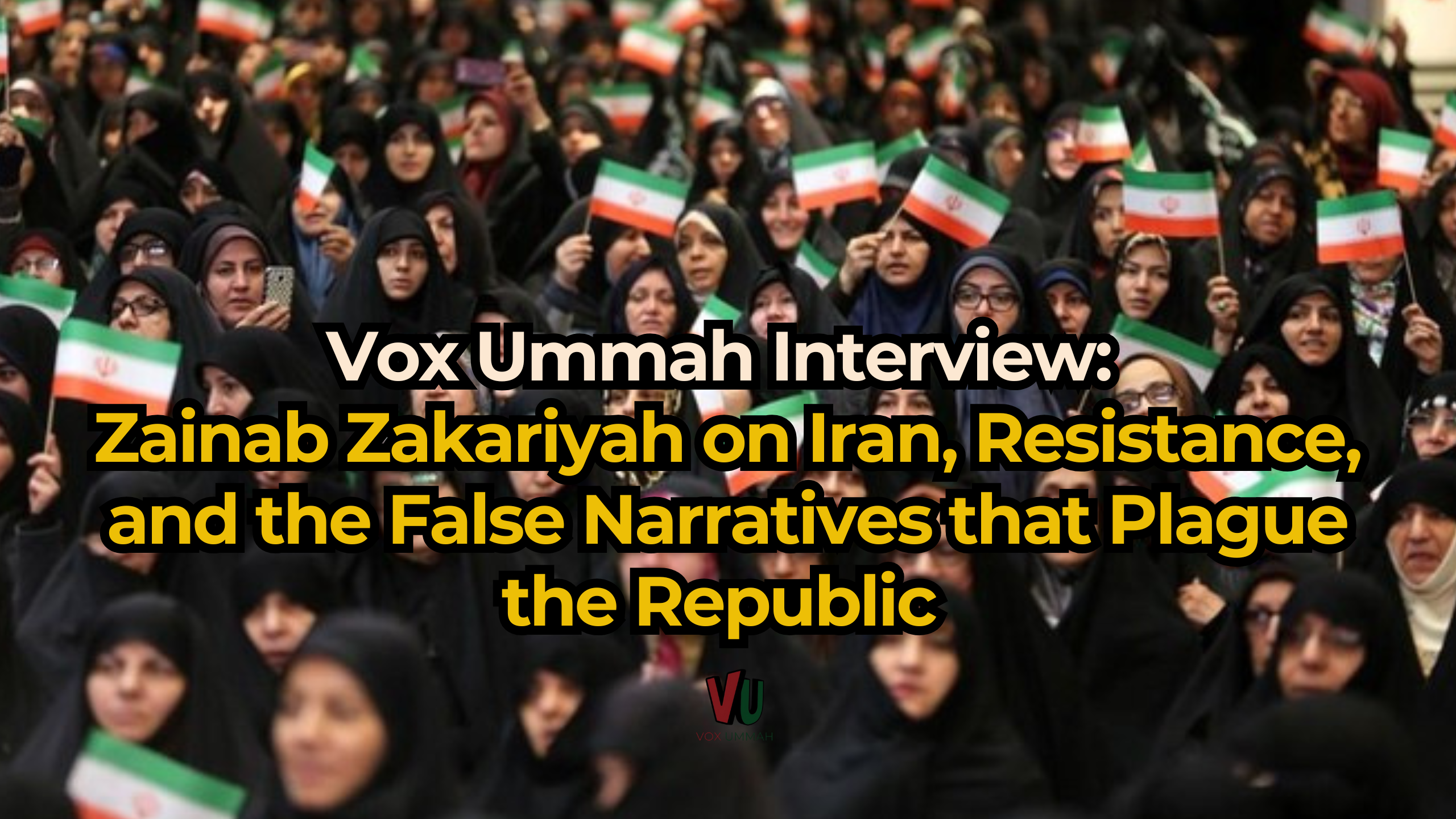
Conducted by Qasim Ansari for VoxUmmah
In the wake of Israel’s war on Gaza – and the subsequent escalation across the region – Iran once again finds itself framed as both instigator and threat. The narratives are familiar: the Islamic Republic as an oppressive regime that must be dismantled and resistance as proxy warfare. But beneath these headlines lie deeper questions: about sovereignty, theology, memory, and power. What does it mean for a nation to remain defiant in a world that demands submission? What price does resistance carry when shaped by faith?
To explore these questions, VoxUmmah sat down with Zainab Zakariyah, a Nigerian journalist, analyst, and activist based in Tehran. Born into the scholarly Zakariyah family, Zainab grew up between bookshelves and battlegrounds – raised on centuries-old Islamic scholarship in Sokoto and scarred by the modern brutality of externally backed violence in her homeland. The Nigerian Army’s massacre of members of the Islamic Movement in Nigeria marked a turning point in her life, catalysing her shift from witness to participant. From independent media houses to the PressTV anchor desk, Zainab has spent years challenging imperial narratives.
In this interview, she speaks candidly about Iran’s economic struggle, the theological roots of its resistance, and the deeper motivations behind the West’s campaign to fracture the Islamic Republic.
Qasim Ansari: Assalamu Aleykum, Zainab Zakariyah. My name is Qasim, and I want to thank you sincerely for taking the time to sit down with us during these perilous moments. I appreciate the care and courage it takes to speak while so much uncertainty surrounds daily life.
These questions have been shaped by ongoing conversations, as well as messages sent to the VoxUmmah inbox and our direct messages. They reflect genuine concerns, confusions, and hopes shared by people trying to understand Iran beyond headlines and pressure narratives.
Qasim: How does the role of the Ayatollah provide guidance or stability in daily life across law, social order, and public responsibility?
Zainab: Waleykum assalam, Qasim. Thanks for having me. I’d like to start by saying that Iran is – and has always been – a deeply religious country. This began formally with the Safavids, of course, but even before that, the Iranian people had long practised a form of humanity rooted in their historical values and day-to-day life. When the Safavid dynasty introduced Shia Islam to the population here, it was widely accepted because it aligned with what was already being lived publicly, and Islam only elevated it.
So the role of the ayatollah, if you want to call it that, is to serve as a guide for society. And that’s the role Islam places on religious scholars in general: they are meant to be role models from whom people draw direction – whether in their political alignments, social reconstruction, or moral recalibration — all based on Qurʾānic values. That’s always been the case. And in Iran, most of the Marājiʿ are like that.
In Shia Islam, everyone must have a Marjaʿ – a scholar among the many within one’s society who is deeply respected, who has written extensively, who is an expert in the Qurʾān and its tafsīr, as well as in ḥadīth. Based on that depth of knowledge, a scholar is awarded the title of Ayatollah. And as they continue their scholarly journey – through research, teaching, and propagation of Islam – they may attain marjaʿiyyah, a status not self-declared, but awarded through consensus by other scholars who vote to recognise their authority. It’s not common… only a few marājiʿ exist in the Shia world today. And from them, people seek guidance on everything: social conduct, religious rulings, daily practices, and ethical dilemmas.
Ayatollah Khamenei, for example, is not the “supreme leader” in the way Western media frames him – a title that deliberately paints him as a dictator. He is, in reality, the leader of the Islamic Revolution – and, more accurately, a Marjaʿ. His website lists books he has authored, based on questions from everyday people. These questions cover everything from what to eat and how to eat, what to wear and how to wear it, what to spend and how to spend – all the way to political and ethical questions like how to navigate living in the US, whether it is permissible to work for the US government, and how to engage with western power structures. These aren’t just surface-level questions – they’re deeply philosophical.
So within Shia Islamic tradition, the Ayatollahs in any society are meant to be exemplars, just as Islam commands of anyone placed in a position of influence. As for the corrupt ones, human beings are human. In whatever station they occupy, there is always a choice: to grow and ascend spiritually, or to descend into the traps of base desires and the whisperings of shayṭān and his allies.
Qasim: How do people hold faith in times of panic?
Zainab: Obviously, not everyone has faith. Those without it are mostly liberal Iranians who benefited heavily under the previous regime – and they’re having a terrible time. They’ll do anything to see the Islamic government fall. But the Muslims, both Sunni and Shia, remember the pain of living under a repressive regime like the Pahlavi – and they will not return to it.
Faith plays a massive role in protecting the people, the society, and the government. That’s why the paid terrorists target mosques, religious and cultural sites, and burn the Qurʾān. But these are people who say: if we are sanctioned, we are the people of Ramaḍān. If we are bombed, we are of the school of ʿĀshūrāʾ.
Since the beginning of Islam, there have always been those who gave everything to preserve the dīn of Allāh.
Qasim: What narratives about Iranian women circulate abroad, and how do they differ from lived realities?
Zainab: From what I’ve seen, Iranian women are among the most liberated and free groups of women in any society. While men in Iran may be the head of the household, it’s the women who run it. Historically, it was quite uncommon for women to work – but as financial pressures increased, and with the rise of social media, liberal discourse, and access to books, many Iranian women began adopting more liberal ideas.
And yet, Iranian women are leaders in every sector of society. They’ve gone from an 86% illiteracy rate before the revolution to over 90% literacy today.
Qasim: Many outside observers struggle to understand the day-to-day economic reality inside Iran – especially how sanctions translate into lived experience for ordinary people. Can you help us understand how the economic situation has changed in recent years, and how both internal and external pressures have shaped that?
Zainab: The economy and people’s buying power have been steadily declining over the past few years, especially as sanctions have grown more brutal.
Before the JCPOA, Iran had developed a system to bypass sanctions by working through individuals, government institutions, and independent organisations – these actors were known as trustees. They didn’t necessarily support the Islamic Republic, but they were patriots who loved their country and helped keep its economy afloat. During the JCPOA negotiations, however, the liberal-led government gave up the names of these trustees in exchange for the promise that sanctions would be lifted. But when Trump pulled out of the agreement, not only were the sanctions reinstated, they became even more aggressive. The U.S. sanctioned all the identified trustees, froze most of their assets, and launched the so-called maximum pressure campaign.
This time, the sanctions hit hard. Unlike previous rounds that had limited effects on daily life, these ones crushed the average citizen. And we can’t ignore one of the Islamic Republic’s biggest mistakes: its revolutionaries focused too narrowly on securing the state, leaving the economy and education systems in the hands of old-regime loyalists and quiet saboteurs. These embedded elements have since built a chokehold around the economy –ensuring that while sanctions kill from the outside, internal corruption and economic monopoly kill from within. The goal is psychological: to make people believe the Islamic Republic cannot save them.
As for why the system hasn’t fully dismantled these internal networks, it has tried, within its capacity, without triggering societal fragmentation. Still, the damage these elements have done is severe. And with the ever-present threat of war looming, real economic growth remains out of reach.
Qasim: Looking back at the decades since the revolution, how do you think perceptions — both inside and outside Iran — have shifted? Especially in terms of what people expected versus what actually unfolded?
Zainab: In my opinion, one of the mistakes people made after the revolution was assuming that America would simply move on – that it would no longer interfere. After the revolution, there was an expectation that things would stabilise. And to be fair, they did. The Iran you see today was built from the ground up. In terms of infrastructure, it stands shoulder to shoulder with many Western countries. The same goes for its educational standards.
But over 250 Western-funded, Farsi-speaking channels have convinced large sections of society that they are living in ruins. People have been conditioned to see only what doesn’t work – never what does.
Still, the religious portion of the population understands – based both on reason and Islamic principles – that sacrifice is often necessary. Whether financial, physical, or otherwise, they know that compromise is part of holding the line.
Qasim: You’ve spoken before about the theological foundations of Iran’s politicalidentity. For many readers unfamiliar with Shīʿa Islam, can you explain how faith andresistance are linked – and how that shaped the revolution and its aftermath?
Zainab: Shia Islam is deeply intertwined with resistance – resistance to corrupt authority, to occupation, to any form of dominance that contradicts lā ilāha illa allāh. As Muslims, we believe that the only legitimate power and authority is Allāh’s. So anything or anyone claiming authority without divine legitimacy must be rejected – whether through action, through speech, or, at the very least, internal condemnation. This is from the ḥadīth of the Prophet (PBUH): “Whoever among you sees an evil, let him change it with his hand; if he cannot, then with his tongue; and if he cannot, then with his heart – and that is the weakest of faith.”
This spirit of resistance is exactly how many Iranians have understood the role of the United States and its hegemonic grip, ever since the victory of the Islamic Revolution – a revolution that was, in many ways, a miracle.
Some now dismiss it, call it a mistake, but it wasn’t. The Iranian people had endured decades of hardship, particularly during and after the world wars. The Pahlavis were not chosen by the people. Reza Shah was a military man who overthrew the Qajar dynasty and declared himself king. But it was the British and the Russians who installed him – and later removed him in favour of his son, the last Shah of Iran. Under both father and son, repression was rampant, poverty was widespread, illiteracy was the norm, and the people’s basic welfare was neglected.
What carried them through that darkness was faith. And if you want to understand the backbone of that resistance, read 100 Years of ʿulamāʾ Struggles – it documents over a century of relentless effort by scholars who stood firm against the Pahlavi regime. They led, they taught, they reminded people that there is another path. Democracy alone wouldn’t save them – but a system built on divine guidance with elements of democracy could. And that’s what the revolution gave the world: a third way. Before, it was either submission to U.S.-led imperial control or alignment with Soviet Bloc domination. Iran offered a third option – one rooted in belief, dignity, and independence.
Qasim: You’ve described Iran’s global position as one of principled resistance – and you’ve also said it’s precisely because of this that it faces unrelenting external pressure. Why do you think there’s such an intense campaign to collapse it, especially by the West? And what do people miss when they buy into that narrative?
Zainab: It is obvious that the Western world wants the downfall of the Islamic Republic. And one has to ask: why have they activated their most powerful assets to smear Iran? To desecrate Iran’s name? To make it look like this government that is not beloved by its people, that has no public support… You know, they keep calling it “regime, regime, regime”
Why?
Because if it’s about human rights, there are countries all around Iran that are some of the worst violators, and they are the closest allies of the United States. Erdoğan orchestrated – or at least capitalised on – a coup, and went on to jail, exile, or silence hundreds of thousands who even smelled like they were opposition. No one blinks an eye. Syria is literally being run by a former al-Qaeda head who once had a bounty on his head from the U.S. government. Afghanistan. Iraq. Saudi Arabia… you know, the kingdom that famously murdered a man, dismembered his body, and got away with it. So if it’s about human rights, then it just doesn’t make sense. So it has to be something else. What is it that Iran is guilty of that is so unforgivable?
It is its unwavering support for Palestine.
Iran supports Palestine not just in name, but materially, morally, politically and through that, supports every resistance group that stands against Israeli occupation. And let’s be clear: the resistance existed long before the Islamic Republic – because they were under Israeli occupation and they were being killed by Israel. Resistance already existed. Iran just supported it.
Qasim: You’re making the case that Iran’s global isolation isn’t really about human rights — it’s about its refusal to fall in line. What do you think would happen if that resistance were finally broken?
Zainab: Whether it’s the resistance in Palestine, which existed long before the Islamic Republic, Iran only supported it as a religious duty and also as part of its foreign doctrine. Whether it is the support of resistance groups in Iraq, who came to be because of the unleashing of Daesh, which was a result of the weakening of the central government and the support and arming of terrorist groups by the United States and Israel in order to destabilise another Islamic country.
So Iran’s policy, since the Islamic Republic, has been to support Muslims wherever they are and to firmly resist the United States and Israel, to resist the expansion of Israel, to resist the global domination plan of Israel, and to resist American hegemony.
That position is born out of the lived experience of Iranians when it comes to Western governments and Western policy – whether it was the USSR, whether it was Britain, or whether it was the United States. And after the Islamic Revolution, when people came out and deposed the imposed ruler over them and decided to take control of their own country, Iran has been under constant economic, political, and propaganda campaigns to cage it, crush it, and contain it. For the past 46, 47 years. And yet it has emerged – repeatedly – from all of that. Mainly because of the support of the people. Because it’s on the right. And because of the help of God. Because frankly speaking, some of the things that have been unleashed against Iran… it boggles the mind that it’s still standing.
Why should people support it? At this point – after what has happened in Gaza – I don’t know why people wouldn’t. Anyone who isn’t there politically still needs to be fixed. Still needs to be shaped. Still needs to be checked. Because, as I mentioned, the main reason Iran is under attack right now, the main reason it is being attacked is because of its support for the resistance. It’s because of its opposition to Israel. That’s all. Plain and simple. Nobody knows what awaits this government. What awaits this country?
Qasim: In light of everything – Gaza, sanctions, separatist interference – what do you think will transpire if the Islamic Republic is dismantled?
Zainab: If, God forbid, they are successful in dismantling the Islamic Republic… it will be a bloodbath. Because, like I told you, there are millions of people in this country who are ready to lay down their lives for the Islamic Republic. What that means is: we’re going to witness another Syria. Syria promax.
Because you will find loyalists to this system – loyalists to this government – who are ready to fight to the last. Because they will not just be fighting for the system, they will be fighting for their country. Because we know for a fact that the Israelis are arming and also supporting separatist groups within Iran – whether they are Kurdish groups, whether they are Arab separatist groups, whether they are, you know, other types of ethnic groups within Iran – trying to separate them, arm them, and fragment the state. Because again, we know the Israeli plan is to divide all the countries across this region. And make all of them into small minorities – whether it is Shia minorities, Sunni minorities, Turkish minorities, Persian minorities, Kurdish minorities. Just to keep everyone divided. Because that is far better for Israel than a united country.
So if anyone finds themselves on the same side as Israel, the United States, and Western governments – and they believe that… I mean, it’s not our job to convince them because I don’t know if those people can be saved.
Qasim: Lastly, what message would you give to people who are still unsure about supporting Iran?
Zainab: I would like to say, you don’t have to support every single thing about the Islamic Republic. It’s a government made of people, so obviously, it has flaws. The system itself doesn’t have flaws, but the people within it obviously do. And you have to understand that it is the last hope against the plan of the enemy. We saw over 500,000 people killed within two years, and nothing was done. The same Israeli entity that bombed Syria, occupied Lebanon, destroyed Gaza, has the same plan: to occupy all of the Middle East and extend into Africa. We see what’s happening now in Somalia.
This is the last government, the last system that is against that.
And people need to understand that, unfortunately, Iran has been under 40 years of a propaganda campaign. Different campaigns have been used: one is Shia versus Sunni. Another is Persian versus Arabs. Another is pointing to Iran’s support for resistance and saying Iran is only trying to protect itself. They’ve used many layers of propaganda about Iran.
But one single fact remains: It is the only government that’s willing to bet not only the life of its people, but also the existence of its country, to fight the Israeli cancer that has the plan to take over the world. And just as Gaza has proven to us who is on the right and who is on the wrong… Iran has as well.
[The interview has been lightly edited for clarity and structure.]
