
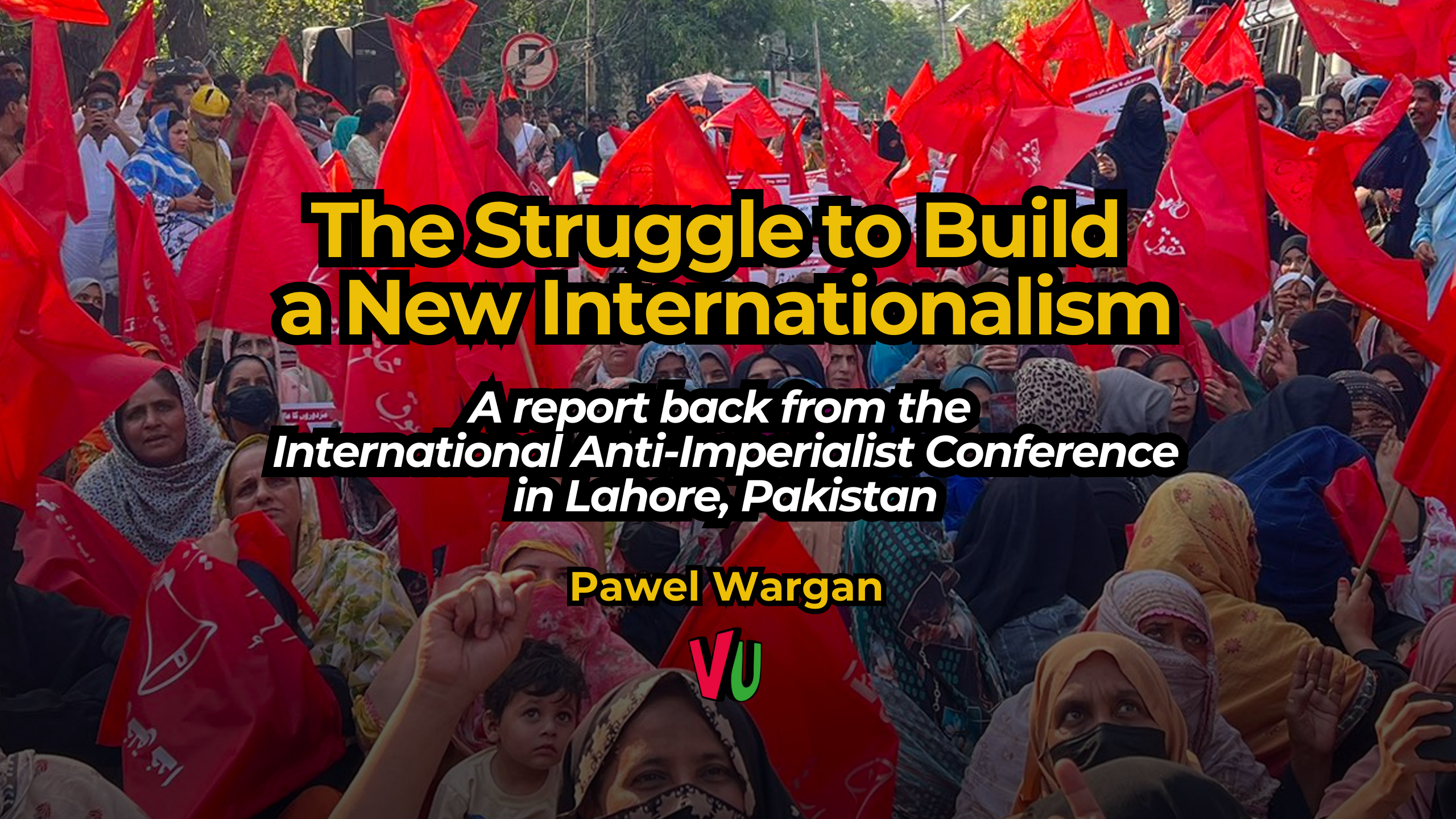
A report back from the International Anti-Imperialist Conference in Lahore, Pakistan
Pawel Wargan
Why do the people of Tehran take to the streets in their millions under bombardment to defy their attackers? Why do the people of Gaza City refuse to surrender in the face of genocide? Why do the people of Sanaa greet attacks on their city with raised fists? These are not thought experiments or curiosities to tickle the mind. That breathtaking resilience is the key to our century. Whether we are able to find its source, awaken it, and nurture it in our own struggles will determine whether the human project succeeds or if it is swallowed by an imperialism that has outlived its day. After Gaza, no one can claim ignorance of the monstrosity that confronts us; if we surrender the historical task that has been laid out for us, we leave the road towards our demise wide open. These are the stakes of us absorbing the lessons of the moment we live in.
This resilience of the people of Iran, Palestine, or Yemen is not incidental. It is the product of political organization — a historical and conscious process whose beginnings are necessarily humble and fragile. Someone, somewhere, set out to build an organization of the oppressed. They understood that the organization must engage the people in its construction. They learned that people must be conscious of the contradictions they face to correctly identify their allies and enemies in the struggle. They learned that this unity and consciousness cannot arise spontaneously, but has to be cultivated through institutions built to organize, educate, and mobilise, activating greater numbers of people in the political process. They learned that this, in turn, requires a vehicle equipped to contain the subjectivity of the popular classes and to direct it towards contesting the political terrain — a vanguard party. And they learned these lessons at the right moment, preparing their forces for the convergence of historical contradictions they knew would open the way to a new order. These, again, are not thought experiments. The Communist Party of China, now representing more than 100 million members and commanding the world’s most powerful state, held its First National Congress a little over a century ago, with 13 delegates from a total of 50 members. The lesson, thoroughly trialled in the laboratory of history, is clear: there is a pathway to liberation, and it runs through the people.
And yet the shame and dejection that defeat has bred in our movements has foreclosed the horizon of victory in large parts of the world. Many do not think through their struggles historically. Many do not build organizations determined to win, or with the conviction that winning is possible. Many do not ground their theories in the lives of the oppressed. As a result, they succumb to frenetic activity that responds only to the here and now. But there are no shortcuts to building a mass political project. Much of that work is invisible. It will never be featured in the pages of The Guardian or The New York Times except as a target of derision. And yet it is necessary. When imperialism arrives at the doorstep — and it will — the path of building popular power is the only one capable of bending the arc of history from destruction towards progress. As Hasan Nasrallah said in 2024, the Zionist genocide in Gaza offered a lesson for all humanity:
“If you are weak, the world does not recognize you, the world does not protect you, nor does the world defend you, nor does the world weep for you… What protects you is your strength, your courage, your fists, your weapon, your missiles, and your presence on the battlefield. If you are strong, you command the world’s respect.”
This is why the inaugural International Anti-Imperialist Conference (IAIC) held in Lahore, Pakistan, on 3 May 2026 holds such great weight in the history of the internationalist struggle. So many left-wing gatherings fail the basic test of addressing the real questions of our time. The calendar of left summits and conferences is full of discourses that do little to orient our struggles, as they remain abstracted from the practical work of building our organizations. These events mass-produce policy proposals without the power to implement them. They advance theories divorced from the movement of history and abstracted from its subjects. They arrive with generic schemes for how governments should manage their affairs. And, in many cases, they arrive with pro-imperialist agendas carefully nestled in the language of the left: anti-state, anti-developmental, idealist, moralizing, or outright fatalist discourses that confuse and disarm our movements. In these spaces, ideas emerge as intellectual consumer products to be traded in the ‘marketplace of ideas’. Since these theories lack grounding in popular struggles, they are not reabsorbed into our organizations and therefore fail to acquire a material force. Their sheen fades as soon as the speakers fly home. These are elements of what Gabriel Rockhill, who spoke at the inaugural IAIC, identifies as “imperialist Marxism”.
The conference brought together leading thinkers in the anti-imperialist struggle to develop a comprehensive analysis of the current moment. Taimur Rahman explored the meaning of imperialism and contested the claim of ‘competing imperialisms’. Farwa Sial analysed finance capital and debt as instruments of imperial de-development. Matteo Capasso contrasted the US and Chinese developmental models. Helyeh Doutaghi looked at the impact of sanctions on Iran’s economy. Bikrum Gill discussed Iran’s role in creating a ‘post-imperial international order’. Fadiah Nadwa Fikri showed how counterinsurgency techniques — from colonial Malaya to today — seek to discredit movements of resistance. Radhika Desai argued that Western Marxism has produced a tradition unable to theorise imperialism as structurally necessary to capitalism. Gabriel Rockhill exposed imperialism’s role in the creation of a ‘compatible’ left. Max Ajl spoke about the importance of the postcolonial state. And Ali Kadri argued that war, not commodity production, is capitalism’s principal industry. (I also spoke at the conference, tracing the century-long imperialist assault on the Soviet Union and its continuity with the wars in Ukraine and Iran.)
But the IAIC was not simply a gathering of scholars and organizers. It was a strategic intervention in the construction of a vanguard party of the working class. The Haqooq-e-Khalq Party (HKP), the co-convenor of the IAIC, began many years ago as a small student study circle in a park in the city of Lahore. It has since built an apparatus of popular organization capable of mobilizing thousands, winning historic victories for workers, and cultivating leadership among Pakistan’s masses. It has established institutions to train the working people and elevate them to positions of leadership within the party. It has entered into a tactical coalition with the country’s major opposition parties. And it now contends with the tectonic transformations underway in the region, from the genocide in Gaza to Iran’s war of resistance, which have opened deep fissures within Pakistan’s left, just as they have elsewhere. The Conference was therefore an intervention in the process of consciousness-formation within the party. It arrived at a critical juncture that demands clarity on imperialism, Pakistan’s relationship to the world, and the orientation of progressive forces in the 21st century.
The IAIC was co-convened by the People’s Academy, a political education process launched by the Progressive International. The People’s Academy is now working with the HKP to translate the theoretical insights developed within the IAIC into a national process of cadre formation tasked with awakening the slumbering power that will one day rise to build and defend the nation’s sovereignty. A core premise of the People’s Academy methodology is that theories must both be derived from political practice and recycled into it. Just as sovereign control over the productive forces allows surpluses to be reinvested in development, sovereign control over intellectual production enables theories to be reabsorbed by the movement. This is the metabolism of theoretical production and the practice of intellectual sovereignty. It demands openness to self-critique — the capacity to issue correctives to currents of thought tainted by liberal ideology. And it demands humility. A party of workers and the oppressed must be grounded in the real lives of the people it serves; it cannot forge its politics in ideals and abstractions.
One example concerns the question of political Islam. Much of the left rejects Islam as a progressive force compatible with Marxism — a view that also taints the Axis of Resistance in West Asia, which orients its praxis around its faith. And yet the vast majority of Pakistani society is Muslim, and that is one of the reasons for its unshakable support for the resistance forces in Palestine, Yemen, or Iran. Is that not progressive? Should it be abandoned because the secular tradition of the left rejects it? The HKP contends that it should not, and the conference gave theoretical force to that contention. It showed how the vilification of Islam is one of the strategies designed to sever us from the vanguard of our struggle. “When their struggle is rooted in Islam, they are labelled as extremists,” Fadiah Nadwa Fikri argued in her intervention:
“They are called terrorists, traitors — the moment they forge alliances with different people. The ideological functions of all these racialised narratives are to create political division between communists and nationalists; to delegitimise the broader anti-colonial movement by obscuring the fact that national liberation movements consist of various alliances building a united front; to create suspicions as to the genuineness of the struggle among the general population; and to vilify Muslim nationalists as purveyors of violence — a narrative useful for obscuring the fact that the violence was already initiated by the [colonizers].”
The HKP begins with the people. People of faith are not inherently reactionary. Belief systems, too, are subject to class struggle. They can be interpreted to serve oppression or liberation. Discovering and advancing the progressive character of working-class beliefs is also the work of political organization. It requires the party to interpret and systematize the views of the masses, before bringing them back to the people as theories they can call their own. One of the HKP’s working-class leaders, Baba Latif, a religious and labor activist from a humble background, came to redefine his understanding of struggle by engaging with the party, recasting “jihad” as justice on the factory floor. This delicate process of interpretation, systemization, and reabsorption is the methodology of the ‘mass line’ as elaborated by Mao Zedong. It is the only way to build a party that is genuinely rooted in the popular classes — and is therefore resilient in the face of external attacks. At the end of the day, because it is a recipe for seizing state power, the construction of a mass party is also the only path to transforming the international order beyond the state’s borders. Part of our generation’s historical task is to reclaim the view of the path that leads from local acts of political organization to tectonic changes in the world system — and the Axis of Resistance shows us the way.
Building a new international order
What do we mean, concretely, when we speak about the emergence of a new world order? To answer that question, we must think historically about the current system and materially about the balance of forces that exists to contest it. Systems are not static or natural. They are historical and reflect dialectical processes of struggle. The current global order was formed in the crucible of the colonial encounter. Its very legal architecture was designed to scaffold colonial exploitation and shield the exploiters from opprobrium or accountability. When we speak of that system in its undoing, we begin our analysis with the forces capable of establishing and enforcing a new system.
The experiences of the 20th century showed that possibilities for systemic transformation at the international scale emerged in spaces that were liberated through revolutionary struggle from colonial and imperial control. These were not attempts to rescue an imperial international order; the builders of revolution were not nostalgic, as many seem to be today, for a return to a “rules-based international order” that never existed. They were attempts to establish systems of post-imperial international law. “What do we mean by post-imperial international law?” Bikrum Gill asked in his intervention at the IAIC. “It is an international law rooted in a polycentric world of actual sovereign equality — a world order in which the surplus generated from a territory recycles back into that territory. That is what is at stake today, and that is the stand being made at Hormuz.”
Yet Iran is absent from most debates about the transformations underway in the international system — or, indeed, is treated as the violator of its norms and laws. This is true across the West. But it is also true for left currents outside the West that have adopted Western political epistemologies, with their distrust for the state, their antipathy to religion, and their reliance on NGO-ified narratives about rights. Gill analyzed the tendency within Western human rights discourse — represented by figures like Francesca Albanese — to impute neutrality to the system of international law, which in fact functions to sustain sovereign inequality. He called this the “Las Casas paradigm”, named after 16th-century Spanish lawyer Bartolomé de las Casas, who was an early thinker in the field we now call human rights. Las Casas, Gill said, “mourned indigenous pain and celebrated indigenous culture”, but “never called for the relinquishment of Spanish sovereignty over indigenous lands.” Much in the same way, while Albanese has mourned Palestinian lives, she has condemned the forces advancing Palestinian liberation. In the days after the United States slaughtered school children in Minab, she began a speech with a condemnation of the Islamic Republic. In doing so, she recast the Iranian people — united by their revolutionary state in struggle against imperialism and Zionism — as disempowered. And, by rejecting the authority of the state capable of implementing the new system, Gill argued, she also opposed the emergence of the post-imperial international legal order. Instead, she implicitly called for a return to the law of the oppressors, which the human rights discourse treats as natural and eternal rather than historically constituted. “What triggers the suspension of the law is the irrational character imputed to Iran on account of its refusal to relinquish the material power through which it alone can reassert its sovereignty,” Gill said. “Albanese is undermining the very force that can bring the international law she wants into being.”
Iran’s transformation of the world order has not been confined to the military domain. War is the dialectical extension of the political terrain, and Iran’s very existence as a sovereign state has chiselled away at the apparatus of imperialist accumulation in the region. Helyeh Doutaghi joined the IAIC from Iran, where she witnessed the war and reported on the popular mobilizations in defence of its sovereignty. She addressed the impact of sanctions on the country. “Sanctions do not merely punish states,” Doutaghi said. “They produce a new economic order, restructure entire societies and class formations in line with global capitalist imperatives.” She showed how sanctions subvert sovereign development by targeting the state’s revenue streams, entrenching austerity, and deepening neoliberal restructuring. In doing so, they impose an imperialist economic arrangement on target states.
Although this process has been deeply corrosive to Iran’s revolutionary institutions, it has also been resisted. Iran has developed a fully sovereign chain of production, built a system of higher education where more than half of enrollees are women, and established a “resistance economy” whose very existence undermines the US apparatus of economic war. Much like robust air defence systems, economic sovereignty is a form of “area denial” — effectively limiting imperialism’s freedom of action. The war, several speakers argued, was triggered precisely by the failure of the US to force Iran’s surrender in the political and economic domains, which enabled Iran to continue arming the working class across the region.
Pakistan is no stranger to this global order. It is on its twenty-fifth IMF loan package, with seventy conditionalities imposed in the last three years alone. The effects, as Farwa Sial showed, have been devastating. Gas prices have risen five hundred percent, the economy has undergone systematic de-industrialisation, and the government is unable to plan beyond the next review cycle, regardless of who holds office. Debt, Sial said, functions as an “imperial artifact”. It reverses developmental progress, entrenches dependency, and empowers comprador classes that serve the creditor rather than the people. In fact, sanctions and structural adjustment are part of the same toolkit. Both subordinate the state’s revenue and expenditure to external dictates, prevent the accumulation of sovereign productive capacity, and ensure that the working class pays the cost. That is why only the organized working class can end this state of dependency and bring a new system into being.
This is the basic logic of our world. Iran has inaugurated a new international economic order in the only way such advances have ever occurred: through strategic, patient, and firm resistance to imperialist encroachment underpinned by sovereign productive capacities that are bulwarked by the unity of its popular classes. It is this that ultimately enabled Iran to enforce new policies in the space opened up by imperialist retreat. As the IAIC’s closing declaration emphasised, Iran’s resistance was unlike previous struggles. In his remarks, Gill distinguished colonialism, which denies sovereignty over a territory, from imperialism, which denies sovereignty over the flow of capital between territories. By challenging imperialism’s entire regional circuit of accumulation — the flow of oil revenues, the petrodollar architecture, the recycling of southern surpluses into northern treasuries — Iran has mounted an unprecedented structural challenge to imperialism. It has exhausted US interceptors and Tomahawks, forced its warships into retreat, and destroyed its bases and irreplaceable strategic radars. It has demonstrated that resistance is possible — and that it can generate progressive outcomes for humanity as a whole. This is why workers across the region — including in Pakistan — have stood unequivocally with Iran. The Islamic Republic has emerged as the vanguard of the internationalist struggle and the tip of the spear in the construction of a new world order.
Imperialism remains absent from left discourses — self-sanctified as ‘serious’ — that are reproduced and incubated in the NGO-industrial complex. By ignoring the primacy of the contradiction of imperialism, these discourses elevate subsidiary or outright deceptive frameworks that serve imperialist agendas. Issues like human rights, democratic freedoms, or gender issues are weaponised to transform grievances that may be imagined or legitimate — no state project is without its faults or contradictions — into weapons to dismantle the very possibility of progress. In the hands of left revisionists, the displacement of the primary contradiction paves the way for secondary contradictions to be seen as the only sites of struggle. This produces fragmentary and fantastical policy proposals — for ambitious environmental action, new international financial institutions, or reforms to the UN system — with no prospect of implementation because they are abstracted from politics and strategies of building popular power.
As Radhika Desai emphasized in her intervention, the question of anti-imperialism is critical not only for the peoples of the Global South. The strength of the imperialist ruling class is also deployed against the workers of the North. The rejection of anti-imperialism is rooted in Western distortions of Marxism that deny the necessity of a subordinated periphery to capitalism. This distortion also prevents the emergence of a political force capable of expressing and leading the growing radicalism of the Northern working class. And it denies the people of the South the basic right to enjoy lives free from imperialist violence. “We ought to remember that there is nothing as anti-progress as imperialism,” Max Ajl said in his presentation:
“Imperialism is a system of permanent violence, famine, income suppression, subjection to war, napalm, white phosphorus, and the explosive destruction of infrastructure and steel plants, as we are now seeing in Iran. It may too often be forgotten that freedom from imperial and colonial violence is a working-class interest.”
Defending the state
The people of Iran did not seek to overthrow their state while it was under assault. To the contrary, they sought the strengthening of the state and the instruments of national sovereignty that would defend their lives and impose costs on their aggressors. They stood behind the armed forces and security institutions, maintaining stability amid external efforts to collapse the country. In doing so, they challenged one of the key vectors of the imperialist propaganda apparatus, which has sought to cleave the Iranian ‘people’ from the state. In his intervention, Gill referred to an interview with an Iranian mother who had lost two children in the US slaughter at Minab:
“She said what gives her peace is knowing that their martyrdom will awaken the world. But listen to her very carefully: she is not asking you to come save her. She is not asking for justice from imperialism. She is imposing justice. She is saying justice will come. There is a difference between seeking recognition from the violators of the most sacred laws of life and imposing justice upon them. The power she draws on is the power of the Islamic Revolution in Iran. That is the source through which she will impose justice for her children. It is that power that Albanese wants to undermine.”
The state is central in the process of resistance. It is precisely the erosion of the state — a process that culminates in the colonial arrangement, which Ajl argued represented the absence of a state — that most fundamentally harms popular interests and undermines development. When the Soviet Union was defeated and its state architecture systematically dismantled, millions died, and tens of millions more were cast into abject poverty. The same is true of non-socialist states like Iraq, Afghanistan, Libya, and Syria — all destroyed through wars that found their cheerleaders among the ‘left’. All had devastating consequences for their local populations and, by securing the extension of imperialism into new territories, were profoundly detrimental for the global working class.
Strong states, as a general rule, deliver at least some progressive outcomes for their societies. “Few political movements took state power without an impact on social reproduction,” Ajl said. “The drain ended. Famines often ended. Infrastructure development occurred.” Indeed, the consequences of a weak state are plain to see in Pakistan. There is very little public provision in the country. The best hospitals, schools, or universities are private, and the infrastructure is deeply neglected. The effects are clear to see: widespread misery and grotesque levels of inequality. To take on these injustices, as the HKP intends to do, it will need to build the capacities to advance an agenda of popular development — and it can only do so by building a mass base powerful enough to push the state in that direction.
The defence of the state — married with the strategic contention of rights within it — is therefore critical to the process of party formation. The widespread distrust of the state — inherited from anarchist, Trotskyite, and liberal political tendencies — operates not only as a ceiling to the pursuit of political power at home. It also truncates solidarity with states facing imperialist aggression abroad. Why contest the state or defend it if the state itself is the source of all conflict and corruption? But it is precisely the state, especially when it is commanded by a party of the working class, that delivers the most powerful progressive outcomes for society. Matteo Capasso showed how the development of a people-centered political project in China, where the state directs capital rather than serving it, enabled deep transformations in its people’s lives — including the most rapid and extensive poverty reduction in human history. Such changes would not be possible without a powerful state, and it is impossible to build a project of liberation without a clear orientation towards state power.
Conclusion
This essay includes, in a fragmentary way, some of the insights shared throughout the Conference. Perhaps the key takeaway is not substantive, but strategic. The IAIC was carefully calibrated to intervene in a real process of class organization and consciousness-formation in Pakistan. It is in this light that the closing statement of the Conference — the Lahore Declaration — must be read. It is a condensation of answers to questions that preoccupy the global left, but which demand clarity if we are to move past the reformist impulses that see us default to the imperialist political order again and again. If we insist on tinkering around the margins of the imperialist system, we will be swallowed by it. Iran and the resistance in Palestine, Yemen, Lebanon, Iraq, and beyond have demonstrated both the stakes and opportunities of a new international order — and revealed the mechanisms by which such an order comes into being. They therefore constitute the vanguard of the global struggle. The fundamental calling of internationalism is to recognize them, acknowledge them as a source of knowledge, and ultimately to stand alongside them in their struggle.
The principal way of doing that is to build a deep, conscious national struggle that has the power — once it is activated within the totality of the international system — to make its own contributions to the struggle against imperialism. This is what Che Guevara meant when he called at the Tricontinental Conference for the creation of “two, three, many Vietnams”. And this is precisely the project that is being built in Pakistan. The HKP’s leaders speak in terms of five, ten, and twenty-year horizons. Their political vision extends to the middle of the century, at which point they believe they will be able to move the country as a whole.
This political confidence is alien in large parts of the West — and, indeed, in large parts of the world outside the actually existing socialist countries. But we must recover it if we are to have a chance at resolving the grave crises of our time. We can learn a lot from our comrades in Pakistan. The HKP’s is a project that is committed to winning, and by winning at home, it holds the capacity to remake our world. To achieve that, it is necessary to imbue the national project with the correct orientation — an anti-imperialist analysis grounded in the scientific methodology of historical and dialectical materialism. This braiding together of the national and the global is the fundamental task of internationalism in the 21st century.
As Frantz Fanon reminded us in The Wretched of the Earth, “It is at the heart of national consciousness that international consciousness lives and grows. And this two-fold emerging is ultimately only the source of all culture.”
We, the participants of the first International Anti-Imperialist Conference:
1. Recognize that we meet at a historic and perilous moment — an intersection of heightening imperialist belligerence and sharpening anti-imperialist resistance. US-led imperialism, which emerged after the Second World War, has entered a major crisis, and a new world order is emerging — one whose outcome is neither predetermined nor automatic.
2. Affirm the centrality of an objective, scientific analysis of history as the decisive precondition for the development of successful strategies against imperialism. There can be no revolutionary movement without revolutionary theory.
3. Commit to understanding the historical changes underway, and actively deploying that understanding towards the establishment of a polycentric world order of sovereign development in which economic surpluses remain among the territories, regions and peoples that generate them.
4. Celebrate the resistance of popular forces in Palestine, the Islamic Republic of Iran, Lebanon, Iraq, Yemen and the broader West Asian region, which have dealt a historic blow to imperialism and its agenda of encroachment through wars of aggression. This is a war without precedent — the first to be fought over the very structure of the imperialist order by directly challenging the circuits and technologies of accumulation at the international scale.
5. Acknowledge hot war as the extension of a political agenda of imperialist de-development that also includes diplomatic coercion, political threats, and economic warfare. In particular, sanctions are invisible weapons that operate gradually to restructure entire societies and class formations in line with the imperatives of imperialist accumulation — a means to impose dependency by targeting states’ key sources of revenue and the very livelihood of their peoples. They operate alongside debt and structural adjustment policies to advance the neoliberal agendas privileging comprador classes within targeted states.
6. Recognize that imperialism is in accelerated decline and deepening crisis. The US-Zionist wars in Palestine, Iran, and beyond are symptoms of profound weakness. These wars — fought to collapse states, deflate incomes and resource values, cheapen labour, and waste human lives — are attempts to re-constitute imperialism’s military and economic basis in the face of existential challenges represented by the regional resistance and the framework of sovereign development.
7. Recognize that imperialism can only gain a foothold in countries of the Global South when a national ruling class enables the drain of national resources, sacrificing the needs of the people and the national development of the country to imperialist diktats — and that therefore a political orientation serving popular development is a necessary component of sovereignty.
8. Affirm the centrality of the state as a bulwark against imperialism. The struggle for sovereignty cannot proceed without state-led efforts to develop productive capacities and generate forms of accumulation that can be recycled into development — including within the sphere of military production as the guarantor of other forms of sovereign development. That is why the principal target of imperialist intervention is the state and the state’s unity with the people living within it.
9. Recognize that states contend with internal class, ethnic, religious, or gender contradictions that may generate real and legitimate grievances — but assert that such grievances must not be allowed to serve imperialist agendas of regime change and destabilization.
10. Commit to sharpening our theories and developing our movements in the service of building anti-imperialist unity with forces across the region and the world. It is only through programmatic, principled unity that we can build the global front necessary to defeat an imperialism in decline.
Pawel Wargan is a researcher and organizer. He serves as Political Coordinator at the Progressive International and has published in Tribune, Monthly Review, Peace, Land & Bread and elsewhere.
