
Sara Larijani
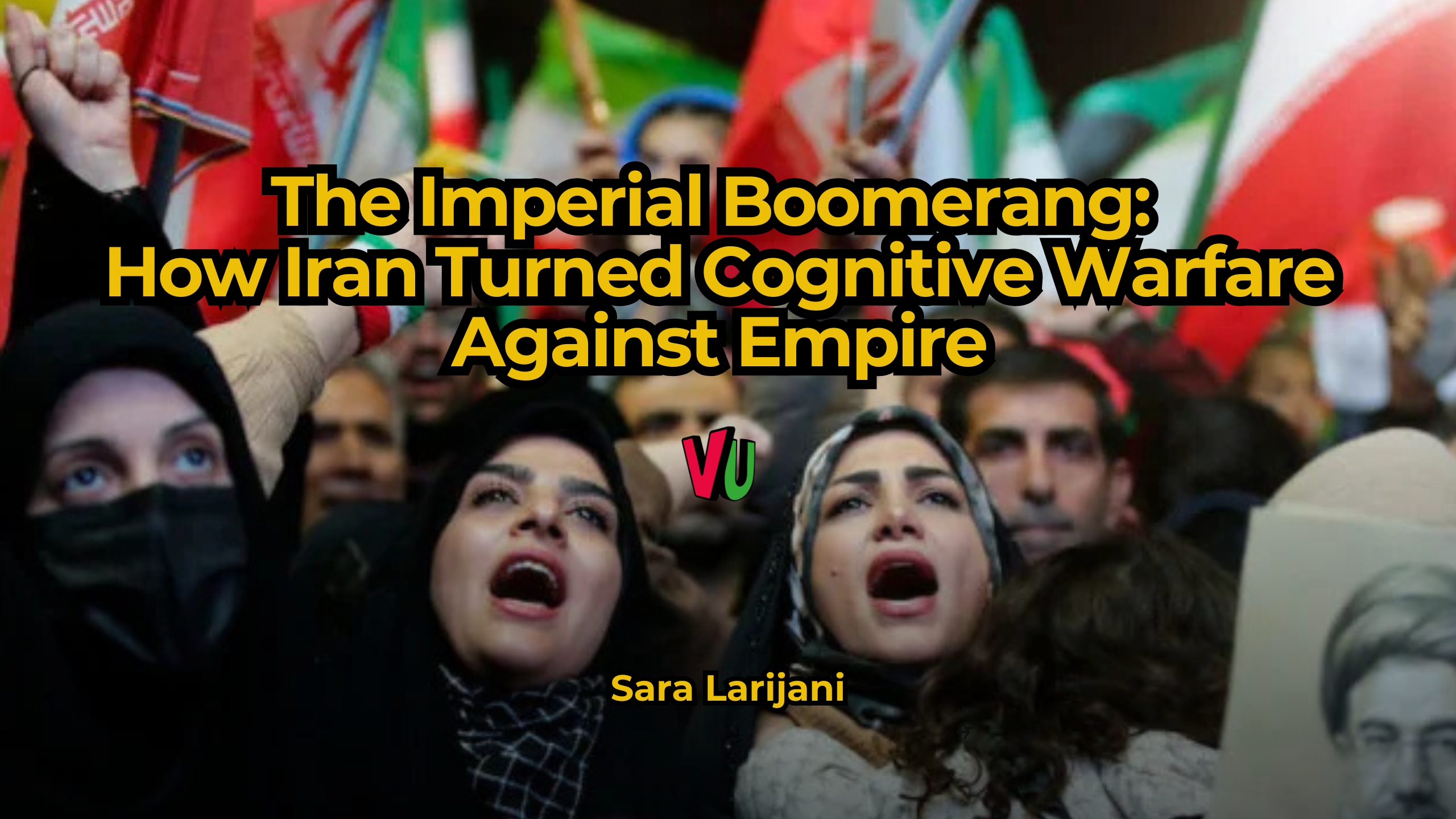
During the 2026 US–Israeli war on Iran, something extraordinary happened on the digital front. Iranian youth—long targeted by imperial cognitive warfare—launched campaigns on X and Instagram that pierced Western audiences with pro-resistance messaging. The result was a success, opening up Western audiences to a view of Iranian society hardly seen. Why did this work so well?
Over the last two years, televised scenes of imperial and settler-colonial atrocities during the genocide in Gaza have shattered global perceptions of Western morality and of the West as the guardian of human rights and custodian of a stable international order. On a world scale, the naked rhetoric of the White House about controlling the territory and waterways of other sovereign nations, as well as dominating and plundering their resources, has further unsettled the so-called moral legitimacy of Western interventions in other continents. Over the past decades, propagandistic discourses such as “The Responsibility to Protect” (R2P), “humanitarian intervention,” and the “War on Terror,” which legacy media have long recycled to legitimize wars in West Asia, have become far less credible in light of the horrific consequences of these invasions in Libya, Iraq, and Afghanistan – just to cite a few recent examples.
A central justification for imperial encroachments was the construction of images of “uncivilized,” irrational, violent, or inherently destabilizing others in West Asia. Edward Said shows how colonizers built an “imaginative geography” of the Orient through negative, static, and essentialist representations of the European Other to justify expropriation and imperial encroachment (Orientalism).
The rise of national liberation movements and the political independence of former colonies exposed the limitations and biases of Orientalist discourse and imaginative geography of the other. The arbitrary Orientalist images failed to capture the dynamic and transformative processes of historical change in the mid-20th century.
Likewise, Orientalism, rebranded under US-led imperialism since the dawn of the twenty-first century, cannot account for the televised realities of resistance by nations and groups in West Asia. As the gloss over imperial violence receded, especially after the genocide in Gaza, the imaginative geography that had long reduced resisting nations and movements to fixed stereotypes began to collapse. This created the conditions for Iranian social media campaigns to emerge and gain traction.
For decades, imperial powers and their regional allies invested heavily in cognitive warfare through Persian-language satellite channels, entertainment media, social platforms, and algorithmically amplified propaganda. Their aim was not only political destabilization but also epistemological transformation of Iranian society, normalizing Western consumerism and liberal individualism, presenting Western countries as sites of freedom and prosperity, and depicting Iran as backward, irrational, and historically failed.
The ultimate objective of this long process was to create a collective inferiority complex among Iranian youth and, whenever required, make them more willing to accept US solutions and actions as superior. Therefore, many are drawn into what Jalal Al-Ahmad, in the 1960s, called Westoxication (gharbzadegi), though most of its contemporary forms operate through digital infiltration. By presenting the West as superior to the Iranian public, this imaginative geography encouraged many young people, especially in digital spaces, to model their lives and self-presentation on the Western Other. The byproduct of this infiltration was the emergence of a generation deeply familiar with Western languages, values, aesthetics, and digital cultures.
The Israeli-US imposed war on Iran in June 2025 marked a decisive rupture among segments of this digitally “Westoxified” generation. The openly visible support or silence of digital space in the West regarding the unjust aggression against Iran made imperial violence difficult to conceal behind liberal rhetoric. For many Iranians, imperialism ceased to be an abstract slogan and became an immediate geopolitical reality. At the same time, Iran’s demonstrated resilience across military, technological, and social domains disrupted the long-cultivated image of a weak and irrational country. It was a historical moment in which political clarity emerged.
This re-evaluation did not remain in consciousness. When the US-Israeli war on Iran escalated again in February 2026, it found organized expression in digital space. The cognitive rupture translated into a practical intervention. Many Iranians accounts on Western digital platforms mobilized their linguistic, cultural, and technical skills to challenge dominant narratives and to communicate Iran’s case directly to global audiences. Their narratives were so powerful that platforms like X (Twitter) and Instagram found no solution but to shut down these accounts.
This phenomenon may be understood as an imperial boomerang in soft warfare. The “imperial boomerang” concept has often described the return of colonial methods of repression to the imperial core. But here the boomerang takes another form. Imperial efforts to Westernize the minds of resisting nations involved massive investments, but they failed to secure vital interests at the decisive moment. Instead, it equipped a generation in Iran with the cultural and technical capacities to counter the empire on its own terrain. Their familiarity with American lifestyles, Western humor, trends, and media cycles enabled them to craft culturally resonant messages for Global North audiences, boosting visibility and reach.
Westernization undeniably erodes cultural confidence, political autonomy, and historical consciousness—a critique that endures. Yet when the moral clarity of resistance crystallized with striking clarity, decades of investment in portraying Iran as backward ironically equipped a generation with the tools of cognitive warfare to fuel digital resistance. What imperialism cultivated as de-Iranization and de-Islamization became its digital undoing—an infrastructure of resistance built with its own tools.
Sara Larijani is a postdoctoral fellow and researcher at the Center for the Study of Resistance, Sovereignty, and Development (MOHAAT) at the University of Tehran.
