
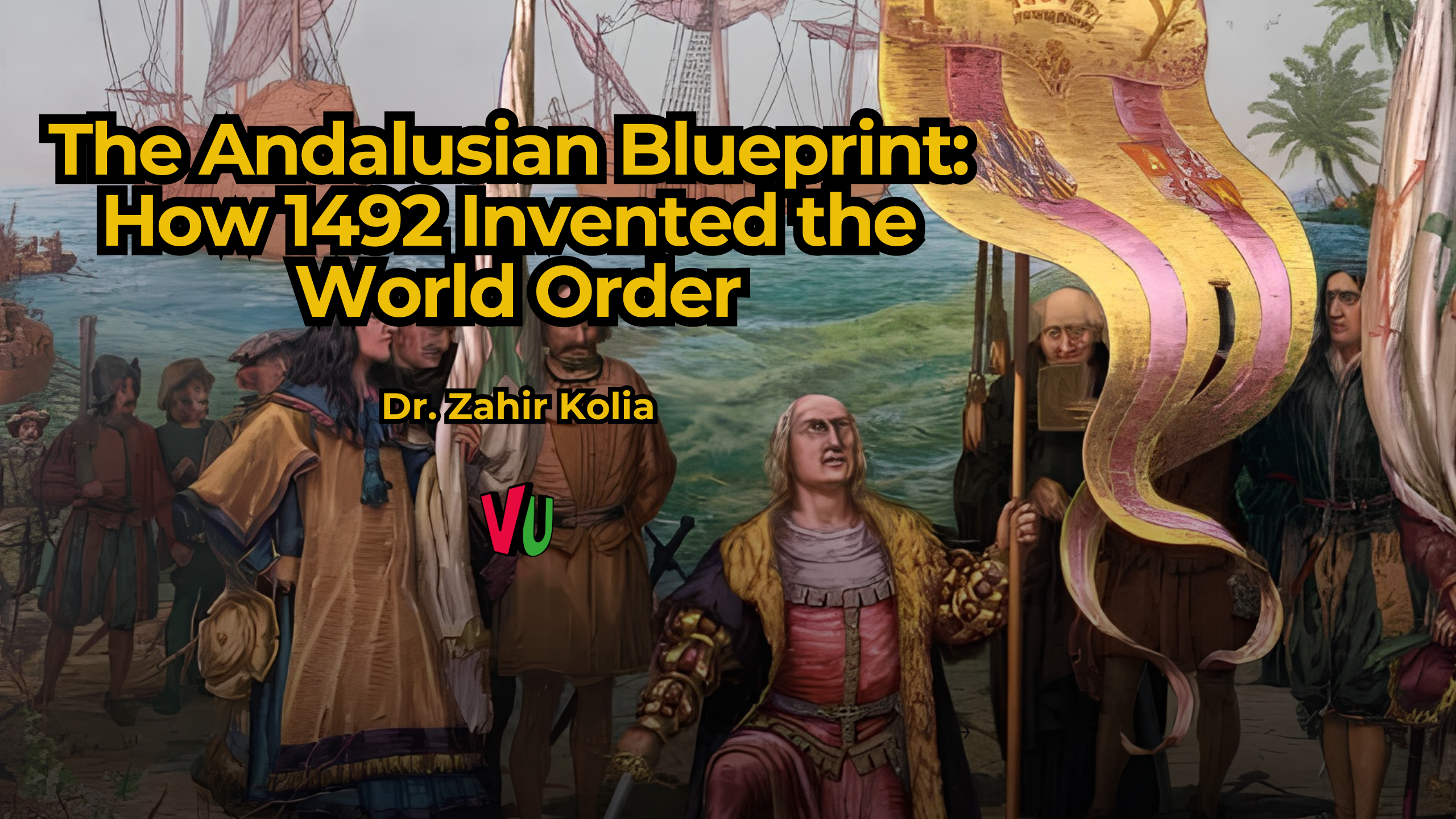
Dr. Zahir Kolia
In the standard Western history curriculum, 1492 marks the beginning of modernity. It is the year Christopher Columbus stumbled upon the Americas and inadvertently inaugurated an era of global trade and exploration. But if we shift our gaze from the Atlantic to the Mediterranean, 1492 signals something far darker and more foundational. It marks the fall of Granada, the final collapse of Al-Andalus, and the expulsion of Muslims and Jews from the Iberian Peninsula.
The conquest of Al-Andalus and the conquest of the Americas do not belong to separate chapters of history. Together, they form a single, continuous story of colonial-capitalist modernity.
This is not a story about “good” Islam versus “bad” Europe. It is a story about how imperial power reorganizes ethics, law, economy, and theology to produce a particular world order. To understand the modern world, including its economic disparities, its legal justifications for war, and its very concept of sovereignty, we must understand that the conquest of the Americas was an expansion of the conquest of Al-Andalus.
It was here, in the twilight of medieval Iberia, that Europe forged the theological grammar of world order. It was here that a unique form of militant Latin Catholicism fused with a crusading logic to help produce the structuring logic for the colonial-capitalist world-system.
For the Global South, and for the Muslim world specifically, unearthing this history is not an exercise in nostalgia for some lost golden era. It is an act of epistemic recovery oriented towards material transformation. By revisiting the economic tools Europe appropriated from the Islamicate and the legal theories they constructed to drive domination, we can see that the secular international order we live in today is, at its heart, a theological project of endless conquest.
The Myth of “Reconquista” and the Theft of History
To understand how the Global South was colonized, we must first dismantle the story Europe tells about itself. One of the most powerful myths at the foundation of Spanish national identity, and by extension Western imperial self-understanding, is the Reconquista.
We are taught that for eight hundred years, Christian kingdoms waged a heroic war to reclaim Spain from Muslim invaders. This story is a myth. The term Reconquista was coined in the nineteenth century, long after the events it claims to describe, projecting a modern nationalist myth of a unified Christian Spain backward into the medieval past. In reality, there was no Spain to reconquer.
Before the Muslim arrival in 711, the Iberian Peninsula was ruled by the Visigoths, a warrior elite that moved south through the ruins of the Roman Empire. They did not inherit a stable civilization; they seized territory through plunder, ruling as a narrow caste over a divided population. From their capital in Toledo, Visigothic kings relied on force and religious coercion to maintain control. This was not an ancient Spanish kingdom, but a fragile post-Roman regime.
That regime collapsed with remarkable speed. In 711, the Visigothic king and much of his army were defeated near the Guadalete River, and Muslim forces under Tariq ibn Ziyad advanced rapidly across the peninsula. Cities surrendered, resistance was fragmented, and within just a few years, the Visigothic polity had effectively disappeared.
What followed was Al-Andalus: a Muslim-ruled society that was not a foreign occupation imposed on a unified land, but a transformation of a land already fractured. Islam spread largely through gradual conversion and political integration rather than mass displacement or forced conversion. Andalusian society fused Arab, Berber, Visigothic, Jewish, and Hispano-Roman peoples through law, commerce, scholarship, and urban life, becoming the dominant political and cultural force in Iberia for centuries.
By framing the fall of Granada as a “reconquest,” Western history erases the reality that Al-Andalus was embedded in a wider Afro-Eurasian world of interconnected economies. Trade, knowledge, and finance flowed through regional exchange networks that linked the Mediterranean, North Africa, and beyond. Within this system, the northern Christian kingdoms of Iberia were not civilizational cores but economic peripheries.
The conquest of Al-Andalus was therefore not the recovery of lost land. It was the violent imposition of a new political project: the erasure of the Muslim character of the peninsula in order to invent a European Latin Christian one. This act of historical rewriting would later serve as a template for colonial conquest far beyond Iberia.
The Crusades: A Theology of Plunder
This Iberian project of conquest was not isolated. The conquest of Al-Andalus came to be aligned with a broader crusading logic of Christian expansion, rather than constituting a separate or anomalous conflict. Together, these campaigns consolidated a theological grammar of expansion – alongside military practices and economic orientations – that would later be displaced westward and reworked in the conquest of the Americas.
We should not approach the Crusades primarily as religious wars driven by fanaticism, nor simply as geopolitical conflicts between Christianity and Islam. Instead, we must view them as the moment where European Christendom, still largely feudal and economically peripheral, attempted to violently insert itself into an already existing Afro-Eurasian world-system.
At the turn of the eleventh century, much of Europe remained agrarian, locally oriented, and constrained in its ability to generate surplus. Long-distance trade existed, but it was limited largely to luxury goods rather than bulk production. The most dynamic centers of commerce, finance, and scholarship lay elsewhere: in the Mediterranean, across North Africa, in the Western Sudan, and throughout the broader Islamicate.
Europe’s internal agricultural expansion produced population growth and demographic pressure, but its feudal structures could not absorb this surplus through productive transformation. The Crusades functioned as a solution to this contradiction. They fused theological language, including holy war, pilgrimage, and salvation, with urgent material aims linked to access to trade routes, bullion, land, and strategic ports.
In this sense, the Crusades were not an interruption of economic life but an early attempt to reorganize it through conquest.
This process crystallized a pattern that would define colonial-capitalist modernity: religious categories were mobilized to expand into already existing world economies rather than to create something entirely new. The conquest of Al-Andalus, alongside this crusading logic, transformed from a sporadic military campaign into an adaptive imperial expansion strategy. It was here that the plunder of Islamic wealth provided the initial capital that allowed these peripheral kingdoms to fund their expansion across the Atlantic.
Beyond the “Carrier” Myth:
A persistent Eurocentric myth suggests that the Islamic world was merely a carrier society. This is the idea that Muslims were a passive conduit that simply transported goods and preserved Greek texts until Europe was ready to wake up and use them. This view is not only historically inaccurate but also obscures the extent to which the Islamicate functioned as a central driver of both knowledge production and the pre-modern global economy. It innovated the very financial and legal technologies that Europe would later appropriate for colonial-capitalist expansion.
Before the rise of European hegemony, the world-system was centered in the East. As Janet Abu-Lughod has documented, the twelfth-century Eastern Hemisphere was a vibrant tapestry of eight regional subsystems linking the Mediterranean to the South China Sea. Europe was a periphery: fractured, fervent, and locked in a feudal crisis with limited capacity for long-distance trade.
Africa, in particular, was central to this system. The western Sudan was home to vibrant trading hubs such as Gao and Awdaghast and served as the primary source of the gold that fueled the Mediterranean economy. At its height, more than a ton of Sudanic gold reached the Mediterranean annually. Before American silver, it was African gold that sustained European economies.
Europe’s early expansion was driven by a structural dependence on this wealth. The Afro-Eurasian oikumene – a shared civilizational space – had long integrated African production into global circulation.
Europe’s problem was not a lack of ambition but a lack of access.
The Portuguese Crusade for Gold
This dependence is clearest in Portugal’s early expansion. With a population of barely one million and limited exports beyond salt, wine, and dried fish, Portugal lacked the commercial depth of Castile or the Italian city-states. Its outward turn fused economic desperation with crusading ideology.
Like Castile, Portugal framed its expansion as part of the long struggle against Islam. Seeking favour with the papacy and legitimacy as a Christian kingdom, Portuguese elites imagined their voyages as an extension of the Crusades, an attempt to attack the Islamic world in a pincer movement. That is why the Cape of Storms, long known to Muslim sailors, becomes the “Cape of Good Hope” in Portuguese hands: rounding it meant reaching the Indian Ocean and outflanking Muslim trade networks.
Their first major move came in 1415, when Portugal seized Ceuta, just 160 miles from its coast. This was both a religious strike and a geopolitical play to break the power of Castile, Aragon, and the Genoese in the Strait of Gibraltar. And it was also about gold: Portugal wanted access to West African bullion by capturing the endpoints of the trans-Saharan trade.
An unpopular colonial outpost for troops, including crusading forces of the Order of Christ, an offshoot of the Knights Templar, Ceuta quickly revealed the limits of Portuguese expansion. Holding the city proved costly and strategically ineffective: gold flows remained embedded within Islamicate trade networks, while Ceuta itself was transformed into a dumping ground for prisoners, exiles, and other social undesirables. In this sense, Lisbon pioneered Ceuta as an experimental site of imperial containment – arguably Europe’s first penal outpost.
So in many ways, Portugal’s early Atlantic and African ventures were not the confident first steps of a rising power. They were the experiments of a small kingdom caught in a feudal crisis, trying to survive economically while waging a crusade against Islam.
Maritime Power and Imperial Intent
Nothing illustrates the distinctiveness of Europe’s colonial trajectory more starkly than Zheng He’s voyages.
Decades before Columbus, the Ming Dynasty dispatched Zheng He (a Muslim-born admiral serving the Chinese court) on seven massive maritime expeditions reaching Southeast Asia, the Indian Ocean, and East Africa. The scale of these voyages dwarfs the European efforts that followed. In his first expedition in 1405, Zheng He commanded nearly 28,000 men aboard over 250 vessels. His treasure ships were massive engineering marvels, spanning up to 400 feet in length.
By comparison, the ships that carried the first European explorers were microscopic. The flagship of Columbus was less than twenty yards long.
The difference was not one of scale or technical capacity, but of intent. Long before Europe’s Atlantic expansion, non-Western societies possessed advanced maritime knowledge and engaged in transoceanic travel. South Asian and Arab sailors mastered Indian Ocean navigation by aligning voyages with monsoon wind systems, sustaining dense commercial and cultural exchange across East Africa, the Middle East, and South Asia. Malay seafarers traversed the South China Sea and the Indian Ocean, reaching as far as Madagascar, while Indigenous navigators in the South Pacific undertook extraordinary open-ocean voyages linking peoples across Australia, New Guinea, and the wider Pacific through sophisticated systems of celestial navigation. In West Africa, the Malians engaged in long-distance Atlantic voyages, directly challenging the Eurocentric myth that Africa lacked technological or economic dynamism.
These expeditions were embedded in trade, diplomacy, and regional integration. The voyages of Zheng He were diplomatic and tributary in nature. The voyages of Europe were eschatological and extractive.
The Theft of the Engine: Appropriating Islamic Finance
European colonial empires were not built on autonomous financial innovation but through the appropriation and attempted erasure of non-Western forms of life. This is especially evident in the role of Islamic commercial law, which furnished many of the financial instruments that enabled imperial expansion, even as their origins were systematically obscured in European narratives of economic modernity.
In the eleventh century, as Europe looked outward, it adopted the commenda. This single-venture agreement became the dominant mechanism for capitalist trade expansion. However, the commenda was not a European invention. It was a direct appropriation of the Islamic qirad, specifically the concepts of mudarabah (trustee financing) and musharakah (joint partnership).
Developed in the eighth century by scholars such as Muhammad ibn Hasan al-Shaybānī, these instruments enabled investors and merchants to pool capital and risk for long-distance trade. But in their Islamic context, these tools operated within a specific ethical framework. They were based on suhba (companionship and a kind of relationship between two merchants), sadaqa (friendship and truthfulness), and mu’amala (cooperation). The relationships were horizontal and grounded in mutual trust and reputation rather than impersonal exploitation and profit.
When Europe adopted these instruments, it stripped them of their ethical foundations. By the thirteenth century, the commenda had become a vertical, impersonal mechanism for accumulation. Tools designed to connect the Ummah through trade were repurposed to finance its plunder.
Political Economy of Plunder
This appropriation requires us to rethink the origins of capitalism itself. Political economists Utsa and Prabhat Patnaik argue that capitalism cannot exist as a self-contained system. It fundamentally requires an external domain, a non-capitalist setting, to extract value from.
This theory applies equally to the roots of capitalism in Iberia. Europe did not just extract gold and silver. It sought to extract the intellectual value of the Islamicate. As the economist Ernest Mandel noted, the Crusades were an enormous plundering enterprise that transferred the wealth of the East into the coffers of the West. It was this stolen capital, managed by appropriated Islamicate financial tools, that laid part of the foundation for maritime capitalism.
Western capitalism did not arise autonomously but through a colonial relation with the Islamicate: a parasitic incorporation of Islamicate commercial practices that absorbed their technical capacities while stripping them of the ethical and juridical forms of authority that originally governed their use – a process that can be understood, in Marxian terms, as one of “formal subsumption.” In other words, capitalism took the tools it needed while leaving behind the moral and legal worlds that gave those tools meaning, casting them as belonging to an earlier, outdated time.
1453: The Geopolitical Trigger
If the Crusades provided the capital, the Fall of Constantinople contributed to the geopolitical impulse for Atlantic expansion.
In 1453, after a fifty-four-day siege, the Ottoman Sultan Mehmed II seized Constantinople. This was not just a symbolic blow to Christendom. It was a seismic economic shock. The Ottomans secured the Bosphorus and cut off the Genoese and Venetians from the lucrative Black Sea trade routes.
With the traditional routes to the East severed or heavily taxed by a powerful Muslim rival, Europe was forced to look for alternatives. The so-called discovery of the Americas was bound up with the rise of Ottoman power. As Ottoman control reshaped Mediterranean trade, the crusading gaze that had once been directed toward the Holy Land was cast elsewhere and would eventually fall on the Atlantic, transporting with it the same theological antagonisms and the same appetite for gold.
The modern world system emerged through a sustained reaction to Islamic power. It incorporated Islamic financial instruments, drew upon wealth extracted from Islamic territories, and was catalyzed by the reorganization of trade following the closure of long-standing Islamic routes. To tell the story of colonial capitalism without this political economy is to rehearse a myth.
The Theological Trap of Sovereignty
If the economy of colonial-capitalist modernity was assembled through the appropriation of Islamic tools, its secular legal order emerged through the reorganization of Christian theological concepts.
Modern international law is often imagined as neutral and secular. But sovereignty did not precede colonialism – it was produced by it.
Francisco de Vitoria, often called the father of international law, confronted the problem of justifying conquest in lands that were neither Christian nor previously claimed. His solution was to recognize Indigenous peoples as rational humans – then bind them to a European law of nations that granted Spain the right to travel, trade, and evangelize.
If the Indigenous peoples resisted this incursion, or if they tried to protect their borders or expel the Spanish, they were violating the law of nations. Their resistance became an act of war. This gave Spain the legal justification to defend itself and conquer them.
Crucially, Vitoria excluded Muslims from sovereign equality. If belief alone justified war, he argued, then Muslims too could wage just wars. By denying this symmetry, he ensured that sovereignty remained a Christian privilege.
Toward a New Horizon
So what does this mean for us today?
As we see with particular clarity in Palestine, the right to self-defense functions as a selectively granted privilege, reserved for those recognized within a legal order inherited from Iberia and Vitoria, while the resistance of the colonized is pre-emptively criminalized as disorder, terror, or illegitimacy.
Yet the legacy of 1492 is not only juridical or military; it is also economic. It calls for a retrieval of the economic principles that Europe appropriated and corrupted. The Islamic tradition offers a model of trade that emphasizes cooperation, risk-sharing, and social trust rather than vertical capital accumulation. In an era of rampant inequality and ecological collapse, these Islamic values offer a vital critique of colonial capitalism.
To grasp why such alternatives were foreclosed in the first place, we must shift from outcomes to structure. Reworking Patrick Wolfe, conquest must be understood not as an event but as a structure. It is not a moment that happened once and ended. The fall of Granada did not conclude in 1492; it persists in every policy that frames the Global South as a problem to be managed, a market to be exploited, or a threat to be neutralized.
Recognizing conquest as a structure, however, is only a beginning. If, as Talal Asad argues, modernity operates as a form of conversion that annihilates older possibilities in order to impose a singular secular-imperial reality, then critique alone is insufficient. Our task must be to force open new possibilities that modernity has worked to foreclose.
It is here that Frantz Fanon intervenes most forcefully. Fanon reminds us that such horizons are not given but must be made through struggle, confrontation, and ultimately what he calls love. This is not the passive love of affection or liberal tolerance. It is a radical ethic of mutual recognition forged through confrontation and an absolute responsibility to the Wretched of the Earth.
Strikingly, this ethic of recognition finds resonance beyond the secular traditions that modernity claims as its own. As Allah reminds us in the Qur’an: “O mankind! Indeed, We created you from a male and a female, and made you into peoples and tribes so that you may come to know one another” (49:13). Here, difference is not a problem to be governed, erased, or dominated, but a condition for ethical relation itself.
To transform our world is to refuse the world as it is. It is to look past the theological traps of 1492 and, through the necessity of struggle, invent a future grounded in relations beyond the colonial frame. It requires a movement from the logic of conquest to the logic of Fanonian love, illuminated by the Qur’anic insistence that human plurality exists for knowing rather than domination – toward a humanity defined by mutual recognition, responsibility, and ethical relation.
Dr. Zahir Kolia’s research examines how coloniality and settler colonial formations are shaped by the secular using Postcolonial and Decolonial Theory, Indigenous Studies, Critical Race Theory, Post-Secular Studies and Decolonial approaches to World/Political Ecology.
