
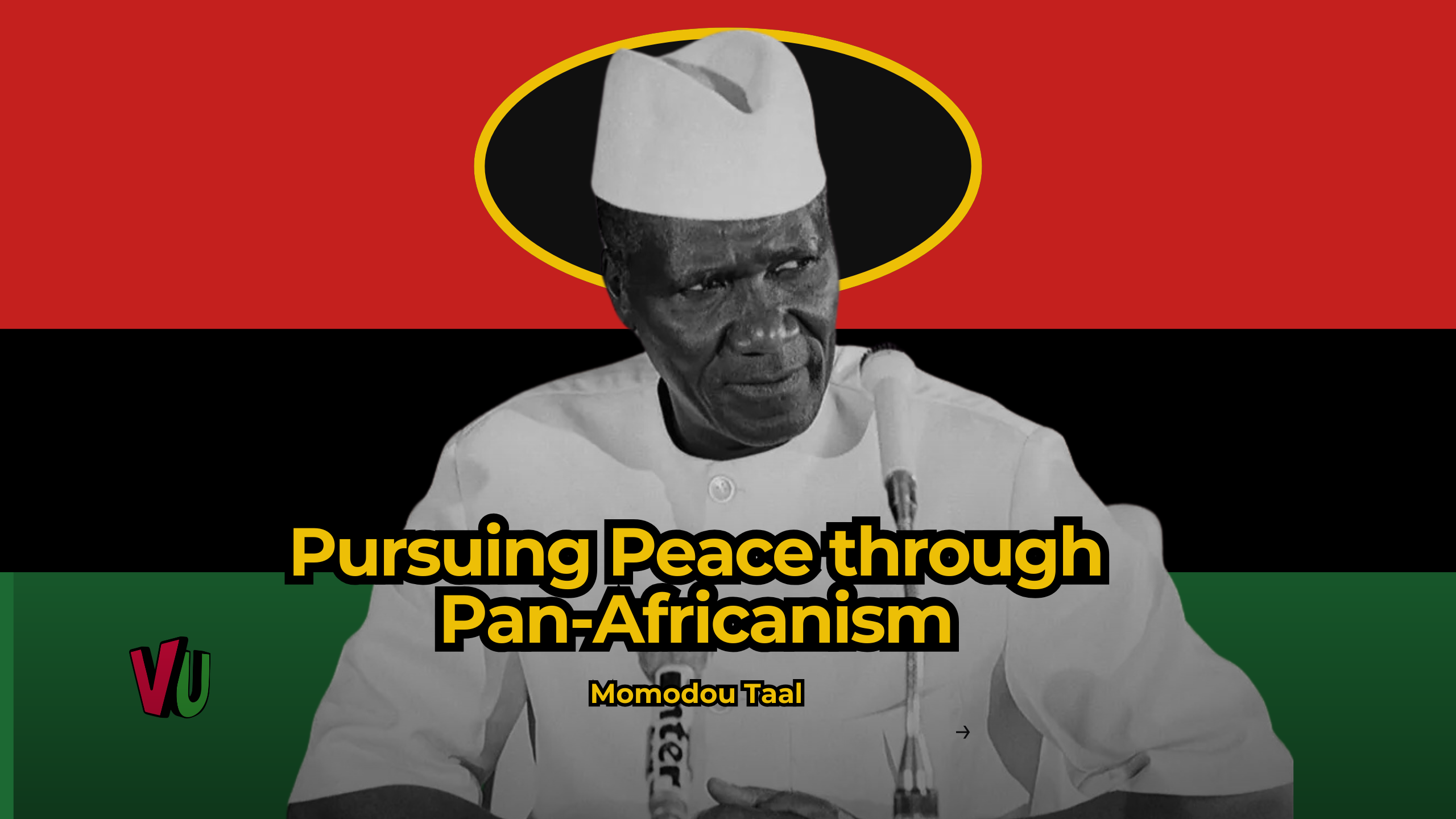
Momodou Taal
“Africa must be united in the struggle against colonialism and racism wherever they exist.” – President Ahmed Sekou Toure, speech at the Organisation of African Unity, mid-1960s
The Iran–Iraq War (1980–1988), which resulted in roughly half a million deaths and more than a million casualties, remains one of the bloodiest interstate wars of the late twentieth century. With the region once again engulfed in war, I turn to our revolutionary ancestors for guidance and understanding.
Pan-Africanism is commonly understood as referring to Black people and the African continent. Yet its internationalist dimension is often elided or forgotten. Ahmed Sékou Touré, Guinea’s first president and a revolutionary Pan-Africanist, remains a figure par excellence for understanding the relationship between a Pan-African project and the wider world. For Touré, Pan-Africanism was never confined to the African continent. It was part of a broader struggle against imperial domination wherever it appeared. As historians Hakim Adi and Marika Sherwood note, Touré consistently argued that African unity was necessary to resist imperial domination.
In the aftermath of the Zionist entity’s aggression against Egypt during the Six-Day War (1967) and the subsequent burning of Al-Aqsa Mosque in 1969 by the Australian Christian extremist Denis Michael Rohan, Muslim-majority countries banded together to establish the Organisation of Islamic Cooperation (OIC).
Founded in 1969, the OIC brought together Muslim-majority states across Africa, Asia, the Arab-Iranian region, and beyond. Today, the organisation consists of fifty-seven member states spanning four continents. Its charter states that its mission is: “to safeguard and protect the common interests and support the legitimate causes of the Member States and coordinate and unify the efforts of the Member States in view of the challenges faced by the Islamic world in particular and the international community in general.” This made the OIC the second-largest intergovernmental organisation in the world after the United Nations and represented the first time in modern history that Muslim-majority nations attempted to present a unified diplomatic voice. In many ways, it was the institutional expression of the ummah within the modern system of nation-states.
Shortly after the outbreak of the Iran–Iraq War in 1980, the OIC established the Islamic Peace Committee, tasked with finding a diplomatic solution to the conflict. President Ahmed Sékou Touré was chosen as its chair. Guinea’s distance from the region’s rivalries and its commitment to the Non-Aligned Movement made Touré a credible intermediary. A Muslim-majority African state with no stake in the territorial dispute between Tehran and Baghdad, Guinea was perceived as a relatively neutral actor capable of mediating between the two governments.
In 1981, Touré led a high-level OIC delegation to both Tehran and Baghdad to broker a ceasefire and begin negotiations. According to United Nations records, he “paid visits to the leaders of the two countries to urge the need for an immediate peaceful settlement.” The peace committee proposed a ceasefire, the withdrawal of Iraqi troops from Iranian territory, and negotiations over the long-standing Shatt al-Arab waterway dispute, which had been a central territorial issue underlying the conflict. Framing the war as a tragedy that is weakening the Muslim world, the committee sought to appeal to both governments through a language of justice, diplomacy, and Islamic solidarity.
Although the mediation ultimately failed and the war continued until 1988, Touré’s efforts reveal a different understanding of Pan-Africanism. For him, Pan-Africanism was not a narrow ethnic or geographic project; it was a form of revolutionary internationalism rooted in the shared condition of peoples subjected to colonialism and imperial domination.
Toure’s orientation against imperialism anchored his thought and praxis. Within this logic and understanding of Pan-Africanism, Touré’s attempt to broker peace between Iran and Iraq becomes internally consistent. His diplomacy reflected a broader political philosophy: that the struggles of Africa, the Arab-Iranian region, and the wider Global South were interconnected fronts in a single fight against imperial domination.
It is noteworthy that Guinea was, and remains, a Sunni-majority country. Yet Touré’s diplomacy implicitly recognised that the need for Muslim unity transcended theological and sectarian divisions. Against the backdrop of imperial power, such divisions become sites of exploitation and manipulation. The global capitalist system is not organised along the axis of Sunni versus Shia, but rather along the axis of imperialism versus anti-imperialism. Toure was said to encourage joint prayer, and he is pictured praying behind Ayatollah Khomeini. Although doctrinally Sunni, Toure understood the political moment demanded unity. This symbolic act of Sunni-Shia state leaders united in prayer can be read as a microcosm: Political unity must proceed from spiritual unity.
As imperialist aggression ravages the Muslim world once more, Senator Lindsey Graham, who is known to only be satiated by the blood of Muslims, recently declared that Iran “want[s] to destroy Saudi Arabia and Sunni Islam and replace it with Shia Islam.” The imperialists understand and exploit theological divisions, attempting to construct the familiar “good Muslim versus bad Muslim” dichotomy. The “good Muslims” are those who abandon the command for justice and align themselves with US-Zionist interests. The “bad Muslims” are those who refuse subjugation and surrender to Allah alone. Touré’s intervention reminds us that Pan-Africanism was never a parochial project limited by geography. It was an international political vision grounded in the recognition that the struggles of colonised and formerly colonised peoples are interconnected.
As committed Pan-Africanists, regardless of religious affiliation, we must return to a conception of Pan-Africanism that refuses narrow parochialisms and recognises that those of us who are the sons and daughters of colonialism across the globe are bound together by history. Pan-Africanists today must stand in solidarity with Iran as they face imperial aggression. Our struggles are interconnected, and our destinies are contingent.
A Pan-Africanism rooted in material struggle understands that resistance to imperial domination, whether in Africa, the Arab-Iranian region, or elsewhere, is part of the same historical process of liberation.
Momodou Taal is a PhD candidate in the Africana Studies department at Cornell University, and is also the host of The Malcolm Effect podcast. Momodou is a co-founder member of VoxUmmah
