
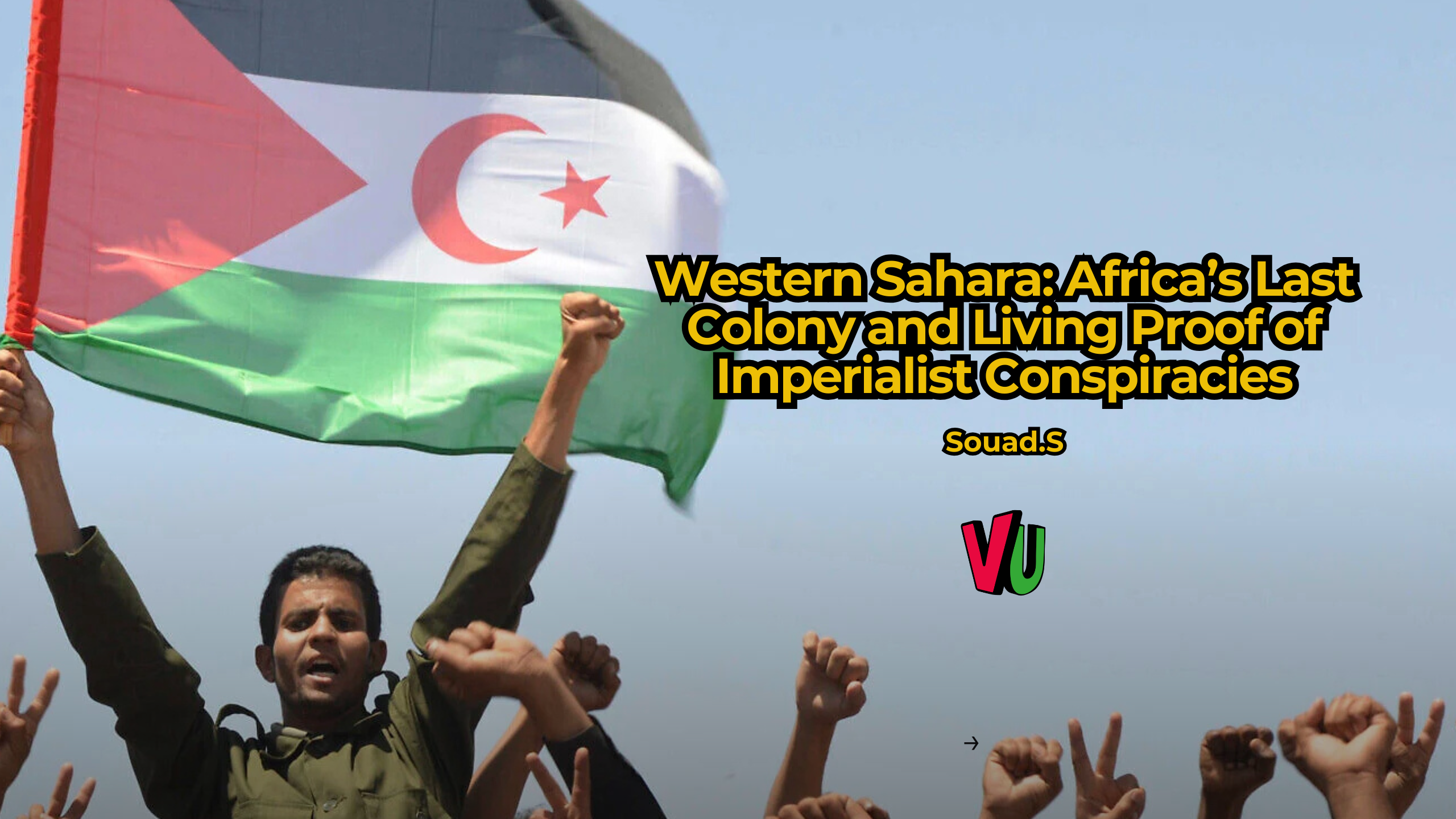
Souad.S
As imperialism sheds its masks, after decades of neoliberal deception and colonial performance, the African continent is confronting one of the most extreme expressions of imperial war. Many African countries remain subjected to neocolonial domination and external control, while others are caught in imperial proxy wars, capitalist extraction and monopoly, occupation, and renewed forms of colonial intervention. Western Sahara represents a clear case of imperial violence and highlights the role of local collaborators in undermining popular sovereignty and the right of peoples to self-determination.
Western Sahara: Between the Berlin Conspiracy and the Madrid Conspiracy
Western Sahara’s strategic position, as both a land and maritime corridor for commercial caravans moving to and from Africa, combined with its resource-rich coastline, made it a central incentive for colonial expeditions reaching African shores at the end of the fourteenth century and the beginning of the fifteenth. These expeditions were driven by the search for raw materials and new markets for consumption.
The rapid expansion of capitalism in Europe intensified colonial ambitions, as rival powers fiercely competed for influence and wealth. Through this process, imperialism emerged as the highest stage of capitalism, reshaping the world beyond Europe into a system of shared spoils divided among competing capitalist forces.
The Berlin Conference of 1884 marked the formal beginning of this expansion in Africa. Within its framework, Spain was officially granted control over Western Sahara, owing to the territory’s strategic importance for extending Spanish influence along the Atlantic coast and reinforcing Spain’s position at a moment when it faced growing challenges from France and Britain.
For the first fifty years of colonial rule, Spain maintained its presence in the territory through commercial agreements concluded between 1884 and 1887 with Sahrawi tribes. These agreements stipulated that Spanish presence would remain confined to the Saharwi coastline, specifically in Boujdour, Lagouira, and Dakhla, and that there would be no harassment of Sahrawis nor any penetration into the interior regions.
Spain continued to operate along the Sahrawi coast under this arrangement until 1934, when it decided to extend its authority over the entire territory through military invasion. This decision led to confrontation with the resistance, which mobilized Sahrawi society to engage in armed battles against the invasion. The resistance carried out raids and attacks on military patrols while simultaneously expanding operations against French colonial forces in the region, particularly in Mauritania and Algeria. Sahrawi tribes fought one of the most renowned battles against France in Mauritania, the Battle of Umm Tounsi.
These developments were rooted in the political and social relations connecting the peoples of the region, as well as in their uncompromising rejection of colonialism. Sahrawi resistance recorded heroic battles that posed a real threat to Franco-Spanish imperialism. In response, French and Spanish forces coordinated their efforts against the resistance in a joint military campaign, “Operation Broom,” in 1956, aimed at decisively ending the uprising. The operation failed due to the resilience of the tribes, resulting in the deaths of hundreds of martyrs, some of whose remains lie in the Martyrs’ Cemetery near the city of Dakhla.
As Sahrawi resistance gained momentum, Spain intensified economic exploitation of the territory’s resources while simultaneously resorting to strategies of impoverishment and siege aimed at breaking the will of the Sahrawi people. This included deliberately refusing to build cities or universities, as well as drawing borders with France to control the movement of nomadic populations. These policies entrenched widespread suffering and deprivation, giving rise to a new form of resistance increasingly marked by class struggle dynamics.
By the mid-1960s, groups of Sahrawi youth and workers began holding meetings to develop new modes of resistance in response to escalating colonial repression, economic plunder, and systematic impoverishment. These initiatives unfolded alongside a growing interest among Sahrawi youth in national liberation movements across Africa and the Arab world, in an atmosphere shaped by revolutionary awareness and deep anger toward colonial rule.
Within this context, the Vanguard Movement for the Liberation of Saguia el-Hamra and Rio de Oro (Western Sahara) emerged in 1969 under the leadership of the late Mohamed Sidi Brahim Basiri. Among its core objectives was mobilizing workers and the oppressed to organize protests, achieve the complete liberation of Western Sahara from Spanish colonialism, and establish an independent state.
On June 17, 1970, the movement organized a demonstration in Laayoune against Spanish colonial policy, known as the Zemla protest. The demonstration raised slogans rejecting integration, demanding the teaching of Arabic and Spain’s withdrawal, denouncing the displacement of Sahrawi youth, calling for a clear timetable for Spain’s departure, and opposing Spanish settlement policies and control over resources.
The demonstration was met with armed force by Spanish colonial authorities, resulting in the killing and wounding of large numbers of Sahrawis and the imprisonment of hundreds. Among those detained was the movement’s leader, Basiri, whose fate Spain continues to refuse to disclose.
Despite the brutality of the colonial response, which effectively dismantled the vanguard organization, the protest acted as a catalyst for rethinking and advancing resistance under new conditions. In this context, a group of Sahrawi youth and students prepared to establish a political-military movement capable of waging a liberation struggle against Spanish colonial rule and leading the Sahrawi masses toward freedom and independence. This process culminated in the founding of the Popular Front for the Liberation of Saguia el-Hamra and Rio de Oro (Polisario Front) on May 10, 1973, during its first congress, which decided to create both a military and a political wing and to adopt armed struggle as the primary means of resistance.
The Front defined itself as “a national liberation movement, and the outcome of a long Sahrawi resistance against various forms of foreign occupation, bringing together, on a voluntary and individual basis, all Sahrawis who believe in the principles of the May 20 Revolution and commit themselves to respecting its basic law and implementing its national program in their struggle for full independence and the restoration of the sovereignty of the Sahrawi people.”
The Polisario Front adopted the discourse of armed struggle and revolutionary violence. In its founding statement issued on May 10, 1973, it declared that, faced with colonial insistence on maintaining control over the territory, it would rely on revolutionary violence and armed action to lead the Arab-African Sahrawi people toward full liberation from Spanish colonialism and to strike at its conspiracies. This position was concretely expressed in its first military engagement, the liberation of the initiator of the revolution, the martyr El Uali, along with several comrades from prison. The first military cell, composed of 45 fighters, carried out its first operation on May 20, 1973, known as the El Janga Operation.
Although the armed struggle began with hunting rifles, the fighters quickly became skilled in guerrilla warfare tactics. Resistance grew rapidly, especially as more joined its ranks and as it acquired modern equipment seized from the enemy. By the end of 1974, it could carry out highly strategic operations, most notably the sabotage of the phosphate conveyor belt—a crucial economic artery for the colonial administration—executed on October 20, 1975.
Faced with these repeated attacks, Spanish forces were compelled to withdraw from several areas in the face of continuous strikes by the Popular Liberation Army. This pressure led Spain to enter negotiations with the Polisario Front on September 9, 1975, attempting to gauge the possibility of compromise. Sahrawi insistence on independence and full sovereignty over their resources marked the beginning of a new chapter in the Western Sahara conflict—one that continues to this day.
The Sahrawi revolution, grounded in the principles of socialism and African revolutionary thought, posed a direct threat to colonial interests and their regional allies. In the context of three attempted coups within the Moroccan monarchy, growing popular protests against economic marginalization, and the Mauritanian regime’s dependence on France, Spain, and the United States, and France reached an agreement with the Moroccan and Mauritanian governments to invade and partition Western Sahara while safeguarding Spain’s economic interests, in exchange for American and French support for these regimes.
Before this, there had been close security and military coordination between Spain, Morocco, and Mauritania, following the escalation of armed Sahrawi resistance. Targeted security operations and the physical elimination of Sahrawi youth and students in these countries constituted a major part of this comprehensive political and military coordination, which intensified significantly in the final months of 1975. The Madrid Agreement was the tangible expression of this collusion, signed between the Moroccan occupying state, the Islamic Republic of Mauritania, and Spain.
Under this agreement, on November 14, 1975, Western Sahara was divided into two parts: the north under Moroccan occupation, while Mauritania invaded the south. The agreement consisted of a document called the “Declaration of Principles,” which outlined the division of the territory— along with a series of agreements concerning fishing, economic cooperation, and industrial collaboration. It later became clear that Spain’s concession was in exchange for continued involvement in exploiting phosphate mines in Western Sahara, maintaining its fishing fleet in Sahrawi territorial waters, and guaranteeing the two American military bases off the Canary Islands.
Secret documents released by the CIA in 2016 revealed the pivotal role played by then-U.S. Secretary of State Henry Kissinger in orchestrating the Madrid Accords, which handed over Western Sahara to Morocco and Mauritania in exchange for full American political support for King Juan Carlos’s succession to the Spanish throne. They aimed at neutralizing the perceived communist threat posed by the Polisario Front, which refused to comply with Spanish colonial demands and threatened the interests of the United States and its allies, primarily Morocco.
Under this agreement, Spain attempted to evade its legal responsibility to complete the decolonization of the territory, which was supposed to be carried out that same year. Just months before the agreement was signed, in May 1975, a United Nations fact-finding mission visited Laayoune and Dakhla to assess the political, social, and demographic conditions in preparation for a self-determination referendum that the UN had been calling for since 1966.
The mission issued its report on October 15 of the same year, just days before the Moroccan and Mauritanian military invasion. The report documented how Sahrawi populations welcomed the mission with images of the Sahrawi flag and slogans such as “Fuera España” (“Spain Out”), calling for recognition of the Polisario Front as the sole representative of the Sahrawi people. The report also expressed the Sahrawis’ desire for independence and their refusal to join any neighboring state, noting that historical and political evidence collected by the mission demonstrated the absence of any sovereignty or governance ties between Morocco and the Sahrawi people.
In response to this agreement, and as an expression of the Sahrawi people’s determination for independence and rejection of subjugation and occupation, the Popular Front for the Liberation of Saguia el-Hamra and Rio de Oro, under the leadership of the martyr El Uali Mustafa Sayed, proclaimed the Sahrawi Democratic Republic on February 27, 1976—just one day after the departure of the last Spanish soldier. This declaration embodied the aspirations and hopes of the Sahrawi people and their martyrs for freedom. It also serves as a lasting reminder that Berlin, Madrid, and Washington do not hold the authority to determine the destinies of peoples.
Betrayal of Neighbors: How the Sahrawi Revolution Was Targeted
The Moroccan-Mauritanian invasion of Western Sahara in 1975 marked a period of escalated extermination and mass killings inflicted upon the Sahrawi people. This was a horrifying phase in which the Moroccan monarchy unleashed extreme violence against the population. Following the signing of the Madrid Accords, the campaign took on the character of systematic annihilation, manifested through kidnappings, mass arrests, and physical executions that often targeted entire families. Methods of terror included burning families alive, throwing people from airplanes, burying victims in mass graves, and the sexual assault of women in front of their husbands and fathers. Sexual violence was deliberately used as a weapon of war against Sahrawi women, who were also subjected to mutilation and torture. Those whom the invaders could not capture or kill were pursued, and their families faced retaliatory violence.
It is important to note that, in this context, Spain handed over to Morocco its entire intelligence archive, including lists and files on activists and members of the revolutionary movement, which served as critical guidance for tracking the organization’s members and carrying out mass extermination operations.
During the Moroccan-Mauritanian invasion, thousands of Sahrawis were forced to flee their homeland, seeking refuge in southern Algeria, which opened its borders to save their lives from the invading Moroccan and Mauritanian forces. These forces employed tanks, aircraft, and U.S. and French-supplied artillery. The Sahrawis fleeing the military assault were subjected to three days of bombing with napalm and white phosphorus, resulting in thousands of martyrs and hundreds of wounded across Sahrawi refugee camps—including Um Drega, Tifariti, and Aqtui—home to over 25,000 people, mostly women, elders, and children, according to Sahrawi Red Crescent sources in March 1976.
On October 16, 1975, King Hassan II announced the “Green March,” just days before the official proclamation of the Madrid Accords. This settler march was intended as a cover for the military invasion. On October 26, 1975, the organization began on Moroccan territory, planned and logistically coordinated by American technicians, with the participation and support of Saudi Arabia. In early November, the “Green March” entered Western Sahara under a secret agreement orchestrated between Henry Kissinger, King Hassan II, and King Juan Carlos I.
The war between the Polisario Front and Mauritania continued until August 5, 1979, when the two parties signed a peace agreement. This followed repeated attacks by the Sahrawi Popular Army, initiated by the leader of the Sahrawi revolution, the martyr El Uali, on June 9, 1976, targeting the Mauritanian capital. Ironically, this was also the day El Uali was assassinated on Mauritanian soil with French and Moroccan assistance. El Uali had become a revolutionary icon whose defiance struck fear into imperial powers, prompting his assassination in the same pattern as that of Lumumba, Cabral, Sankara, and other African revolutionaries.
However, the conflict between the Polisario Front and Morocco continued until 1991, when a ceasefire was signed based on organizing a self-determination referendum for the Sahrawi people. Since then, the UN mission tasked with overseeing the referendum in Western Sahara—commonly known as MINURSO—has been repeatedly delayed, and the Moroccan occupation continues to obstruct its implementation to this day.
The Moroccan occupying kingdom has controlled approximately 70% of Western Sahara, encompassing most of the territory’s valuable resources, which it seized by force starting in 1975. The occupying forces subjected Sahrawi civilian landowners to the most extreme forms of extermination, including being shot from airplanes, poisoning wells, kidnappings, enforced disappearances, extrajudicial killings, and torture in secret detention centers. These abuses have been documented by numerous international human rights organizations, which report that over 500 Sahrawi civilians remain missing, alongside the continual discovery of mass graves. Victims were regularly executed by gunfire at the hands of the Moroccan army during its invasion of Western Sahara.
Morocco has fortified Western Sahara with a heavily mined sand wall stretching over 2,000 kilometers. Construction of the wall began in 1980 to isolate the resource-rich portion of the territory and to prevent the advance of the Sahrawi Popular Liberation Army, at the height of the armed confrontation. The wall, divided into several sections, reaches approximately 2.5 meters in height and extends for 2,720 kilometers. It consists of stone walls and fences, reinforced with six to seven million anti-personnel mines, while simultaneously dividing the Sahrawi population into separate areas.
Today, many Sahrawi detainees remain imprisoned in Moroccan jails, arrested for their political positions on the Western Sahara issue and for their activism within the occupied territory and Moroccan university campuses. Some sentences handed down by the Moroccan judiciary reach decades or even life imprisonment, as retaliation for the role these activists have played in the peaceful struggle led by the Sahrawi population.
Meanwhile, nearly 300,000 Sahrawis continue to live in refugee camps in southwestern Algeria, with thousands more scattered across the diaspora, refusing to return to Western Sahara unless their inalienable right to self-determination and independence is recognized.
Normalization with Israel and the Extension of Control in Africa
In 2020, a new phase began in the history of Zionist-American domination over Arabic-speaking countries, particularly in relation to efforts aimed at liquidating the Palestinian cause. The so-called “Abraham Accords” played a central role in bringing collaboration and open betrayal of Palestine to the forefront, in an unapologetic and publicly assertive manner. Morocco occupied a key position within this shift. It had, in fact, normalized relations with Israel as early as the 1960s, contributing to the transfer of thousands of settlers to the occupation of Palestine, engaging in surveillance of Arab summits, and initiating military and technical cooperation with the Zionist entity during the early decades of its occupation of Western Sahara. Morocco was also among the first to pursue economic cooperation with Israel.
The Abraham Accords elevated this long-standing history of coordination and complicity to its highest point. What was presented as “normalization” with the Zionist occupation instead began pushing the region toward a new chapter of imperial domination. The United States, as the primary protector of the Zionist entity, stood at the center of this process, viewing the entrenchment of normalization as an irreversible step. For Morocco, this development also meant consolidating its occupation of Western Sahara, a territory described in the 1970s as « Palestine of Africa » in anticipation of its role as a gateway to U.S. and Israeli control over Northwest Africa. Within this framework, Morocco was positioned as a colonial proxy serving broader imperial interests in the region.
This dangerous trajectory reached a critical moment when the Polisario Front announced its return to armed struggle against Moroccan occupation following Morocco’s violation of the ceasefire. It became evident that three decades of what had been framed as a UN-led settlement process were, in reality, a mechanism designed to neutralize the Sahrawi revolution, pushing it toward concession, retreat from its revolutionary discourse, and the adoption of a conciliatory narrative that portrayed the UN process as the sole path forward. The resumption of armed struggle also exposed decades of Moroccan military cooperation with the United States and Israel, cooperation that altered the balance of power. During the first war, the balance had leaned in favor of the Sahrawi resistance, which managed to defeat the Moroccan army despite the extensive weaponry supplied by the United States. Today, however, the introduction of Israeli drones into the conflict has shifted the balance in Morocco’s favor. The Sahrawi army has been severely constrained in its ability to maneuver toward its targets due to drone warfare and the “wall of shame” built by Morocco with Israeli technology and assistance, reproducing within Africa the experience of walls imposed on occupied Palestine.
This new reality has been reinforced by sustained support from European powers such as France, Britain, and Belgium, as well as from the United States and Israel. This support has taken the form of recognizing Moroccan occupation as “sovereignty” over Western Sahara and mobilizing backing for the autonomy proposal. Such pressure has exposed the true nature of the Moroccan occupation as a colonial proxy acting on behalf of imperial interests in Africa. Control over Western Sahara provides Morocco with a strategic position oriented toward Algeria on one side and the Sahel and West Africa on the other, while also ensuring imperial dominance over key Atlantic outlets.
The latest U.S. decision to support the autonomy plan—originally engineered by France in Paris in 2007 in Morocco’s favor—signals a clear move toward fully entrenching this occupation. International momentum has been directed toward presenting autonomy as the sole solution to the conflict. For years, the United States has served as the “penholder” on all UN Security Council resolutions concerning Western Sahara, using this role to impose its vision and block any language that does not align with Morocco’s stance. Much as it has positioned itself as a central actor in shaping decisions related to Palestine, Washington now seeks to tighten its grip on the Sahrawi issue, transforming it into a file managed almost exclusively by the United States. This process can be described as a form of political privatization of one of the last remaining cases of colonialism in Africa. The U.S. approach to Western Sahara thus reproduces colonial domination through new mechanisms, replacing direct military force with an international legal framework controlled by dominant global powers.
History of U.S. Interventions in Western Sahara
Since the mid-1970s, Western Sahara has served as a central stage for American intervention in Northwest Africa, with Washington employing a range of strategies—including explicit diplomatic support, economic aid, military backing, and political maneuvering—to thwart any revolutionary national liberation project that could threaten imperial dominance in the region. This phase began with the Moroccan regime’s emergence as an expansionist power toward the Spanish colony. Western Sahara appeared to be an easy target due to its sparse population, vast territory, and rich resources, complementing Morocco’s expansionist agenda, which primarily sought to secure imperial influence in Northwest Africa. Since Morocco’s independence in 1956, it has laid claim to vast territories, including Algeria (the root of the historical dispute between the two nations, not Western Sahara), Mali, Mauritania, and Western Sahara. However, the socialist Sahrawi revolution declared by the Polisario Front posed a direct threat to this project.
At that time, the United States viewed Morocco as a strategic ally that could serve as a client force to ensure the continuation of American and French influence in the region and to contain any revolutionary developments, especially after the Polisario Front announced a national liberation struggle grounded in socialist-inspired policies and rhetoric, drawing lessons from liberation movements in Africa, Asia, and Latin America. The Front also adopted revolutionary violence as a legitimate means to combat colonial powers and their local proxies.
Between 1974 and 1977, the United States began providing direct diplomatic support to Morocco, while continuing arms sales under the 1960 agreement. Although these weapons were nominally classified for defense, they enabled Morocco to launch a large-scale attack on Sahrawi territories. Henry Kissinger, then U.S. National Security Advisor and Secretary of State, played a decisive role in shaping this policy. Spanish press outlets in 2016 published declassified CIA documents showing that in 1975, the United States feared a potential collapse of the Franco regime in favor of socialists, which could lead to Western Sahara’s independence and expand communist influence in Africa.
To preempt this, Secretary of State Kissinger engineered the Madrid Agreement on November 14, 1975, dividing Western Sahara between Morocco and Mauritania and aborting the creation of a Sahrawi state. He had previously laid the groundwork for the “Green March” alongside King Hassan II on November 6 of the same year, providing cover for the Moroccan military invasion and the perpetration of a war of extermination against the Sahrawi people, including their forced displacement. Kissinger also facilitated the restoration of the monarchy in Spain by supporting Juan Carlos’s ascension to the throne.
The United States provided both diplomatic and military support to shift the balance of power in Morocco’s favor during the military invasion. The goal was clear: protecting imperial interests in North Africa, maintaining strategic influence in the western Mediterranean, securing access through the Strait of Gibraltar, and utilizing Morocco as a tool to control revolutionary movements and national liberation governments across the continent.
Between 1977 and 1980, under the Carter administration, the White House pursued a relatively neutral policy, though it continued to provide partial support to Morocco. Washington viewed Moroccan failure to secure Western Sahara as a potential catalyst for the expansion of socialist movements in the region. By 1980, the U.S. decided to fully back Morocco, even as the Polisario Front increasingly reclaimed territory and established authority over most Sahrawi areas, demonstrating that the liberation revolution was not solely directed against Spanish colonialism but also against all agents of imperialism in Northwest Africa.
With Ronald Reagan’s inauguration in January 1981, American support for Morocco surged significantly, including extensive military aid, field advisors, and military engineers, aimed at ensuring Morocco remained the dominant force in Western Sahara and preventing any Polisario advances. During this period, Morocco employed the strategic sand wall, benefiting from French and Israeli expertise, to restrict Polisario’s operational capabilities, consolidate Moroccan hegemony, and safeguard Western imperial interests. This strategy enabled Morocco to control roughly 75% of Sahrawi territory—a situation that persists to this day.
Throughout the thirty-year ceasefire, the United States continued to pressure in Morocco’s favor, providing political support and obstructing any UN proposals or Security Council initiatives aimed at resolving the conflict. Morocco, with backing from France and tacit support from the U.S., sought to delegitimize the Polisario Front by branding it as a terrorist organization, ensuring that no revolutionary liberation project could succeed in reshaping the balance of power in Northwest Africa.
With Donald Trump’s presidency, Morocco violated the ceasefire, leading to the resumption of conflict on November 13, 2020. U.S. and Israeli military and diplomatic support persisted, including multi-billion-dollar arms deals and the consolidation of AFRICOM’s presence through the 2021 “African Lion 21” exercises, which involved both U.S. and Moroccan forces and reaffirmed Washington’s central role in Western Sahara.
The Need for Capitalist Plunder for Western Sahara’s Resources to Perpetuate Occupation
Western Sahara represents a unique model of ongoing colonialism and settler-colonial occupation, where the occupied territories are transformed into sites for the exploitation of natural resources in ways that serve global capitalism and reinforce the political and economic control of the Moroccan occupation. This explains the persistent efforts of global powers to impose this control at any cost.
The control and exploitation of Sahrawi resources did not originate solely with Morocco; it is a direct extension of Spanish colonial history, which focused on extracting resources such as phosphates and fish, transporting them directly to the metropolis while depriving the indigenous population of any real economic benefit. This historical pattern explains why the Polisario Front conducted most of its military operations against Spanish colonialism by targeting phosphate transport chains and fishing vessels.
Following Spain’s withdrawal, the Moroccan occupation deepened this domination, leveraging an international network of economic interests that sees the occupied territories as profitable zones for investment and resource plunder, positioning Morocco as the primary guarantor of this continued expropriation.
Among the key resources exploited is phosphate, discovered in 1947, which has served as a major economic pillar linking Morocco’s economy to global markets. Alongside phosphates, the fishing sector has developed over the past four decades into a highly profitable industry. Fishing has become one of the main economic sectors in occupied Western Sahara, accounting for 72.4% of Morocco’s total coastal fishing revenues, if not more. This is due to the Atlantic waters off the Sahrawi coast, which are rich in fish stocks, including mackerel, sardines, and octopus, exported into global food chains. Morocco, with support from foreign companies and sometimes aided by U.S. expertise, invested in building fishing infrastructure and ports, while encouraging the settlement of hundreds of thousands of Moroccans in coastal towns and cities such as Laayoune and Dakhla, altering the demographic structure and imposing economic and political control over the indigenous Sahrawi population.
Sahrawi fisheries have transitioned from direct extraction under Spanish rule to integration into the global value chains of contemporary capitalism, turning marine resources into highly profitable products marketed internationally. Moroccan elites and major corporations such as OMP, Marona, and King Pelagique monopolize the most lucrative sectors. The Sahrawis, meanwhile, are pushed into secondary or artisanal jobs and, in recent years, have been entirely prevented from benefiting from the sector. Policies have specifically targeted young Sahrawis owning fishing boats, barring them from engaging in activities that they previously partially controlled.
Thus, control over marine resources becomes a fundamental pillar of the capitalist settlement project based on resource exploitation. Integrating Western Sahara into global value chains is not merely an economic plunder; it is part of a continuous colonial process that reproduces domination in a modern capitalist form. Despite commercial disputes between Morocco and the European Union and other countries—including those concerning the territory’s resources under international law and European Court of Justice rulings, such as the 2024 decision annulling fishing and agricultural agreements for violating the sovereignty of the Sahrawi people—These arrangements are used to provide economic legitimacy to the occupation and ensure the continued flow of profits to multinational corporations and the Moroccan regime.
Resource exploitation is not limited to phosphates and fish; it also encompasses agricultural wealth and renewable energy projects. Wind and solar energy projects have been built in Western Sahara in collaboration with major foreign companies such as Siemens, San Leon, and Kosmos Energy, aiming to expand capitalist exploitation of the region’s resources, including the strategic use of “green colonialism” to control renewable energy in Africa.
What is happening in Western Sahara is a continuation of a colonial logic that seeks, through military domination, economic exploitation, and UN decisions, to perpetuate imperialism and extend monopolistic capitalism. The Moroccan occupation represents a contemporary model of so-called “new capitalist colonialism,” where resources are employed to serve a project of domination, and the region is restructured within an unjust global economy. At the same time, the Sahrawi people are denied their right to self-determination and sovereignty over their resources and land, which form the basis of their existence.
Thus, fisheries, infrastructure, and coastal cities are transformed into tools for sustaining control, and Western Sahara becomes an open laboratory for testing organized mechanisms of resource plunder, illustrating how international laws and agreements intersect with military and settler domination to maintain the continued exploitation of Sahrawi natural resources within the global capitalist system.
Morocco as the Hand of Imperialism in the Destruction of Africa
Historically, Morocco represents a clear example of how local regimes can become functional tools of imperialism. During the colonial era, it operated under French authority in North Africa. It remained loyal to this relationship even after formal independence, serving as a local system designed to thwart genuine liberation movements. This role was particularly evident in its support for apartheid in South Africa, its involvement in espionage against liberation leaders such as Patrice Lumumba, and its backing of client regimes established by colonial powers to ensure the continued dominance of Western forces over the continent. Morocco functions as an extension of imperialism, conducting a foreign policy aligned with Western strategies to keep Africa under direct and indirect Western influence.
Today, Morocco has become a striking model of the functional system of new imperialism in Africa, acting as a gateway for Western powers to dominate the continent and as a center for exploiting natural resources and controlling local political systems. This role did not emerge in a vacuum; it is a continuation of a long history of loyalty to colonial domination, from the period of direct French colonialism in North Africa, through the era of neocolonialism that relied on client local systems to control people, to its current role in West Africa. The rise of new regimes in Mali, Burkina Faso, and Niger posed a direct threat to France’s and the United States’ interests, necessitating the strengthening of Morocco’s influence as a functional intermediary to protect Western interests and ensure continued dominance in the region.
The Moroccan occupation of Western Sahara has been a cornerstone of this imperialist strategy. Decades after establishing control, Morocco now uses Western Sahara as a base to expand its influence in West Africa, exploiting natural resources and exerting political pressure on African states to legitimize its occupation, buy political loyalty, open symbolic consulates, and support regimes hostile to the sovereignty of peoples. This expansion is not limited to economic aspects; it also encompasses military and intelligence influence, hosting U.S. AFRICOM bases and projecting capabilities throughout the region, reinforcing its role as a functional system ensuring imperial interests on the ground.
Morocco also seeks to exploit conflicts between Mali and Algeria to deepen its intelligence role, taking advantage of weak regional coordination in countering Western influence. This strategy illustrates how a regional state can become a tool of imperialism, turning its resources and regional occupation into mechanisms to secure foreign powers’ interests while exerting pressure on local populations and weakening liberation movements.
Ultimately, this complex history reveals that Morocco was not merely a state seeking territorial expansion but part of a broad network of client systems established by imperialism to direct Africa, exploit its wealth, and dismantle national liberation movements. Its functional role continues to serve Western powers through occupation, political influence, and control over vital resources, making Western Sahara the heart of the ongoing struggle between imperialism and African peoples’ pursuit of national liberation.
Pan-Africanism as the Path to Peoples’ Liberation
Throughout its history, the Sahrawi revolution has adhered to the principle of Pan-Africanism, declaring in its liberation literature that the emancipation of the Sahrawi people is inseparably linked to the liberation of the peoples of the region from colonialism and its agents. As the martyr El Uali Mustafa Sayed emphasized, he foresaw the trajectories of colonial domination on the continent, where colonial powers maintained control through neo-colonial regimes and relied on local clients to suppress national liberation movements and conspire against peoples who resisted colonial hegemony—examples of which include Western Sahara, Congo, Mozambique, Burkina Faso, Angola, and many other African revolutions.
In the 1970s and early 1980s, the Sahrawi revolution deepened its connections with Pan-Africanist regimes such as Mozambique, Tanzania, Burkina Faso, Libya, and dozens of other African countries committed to the complete liberation of all African peoples. This period reflected the continent’s remarkable history, in which revolutions that fought colonialism joined forces against imperialism, local collaborators, and monopoly capitalism—forces that continuously undermined these movements, assassinated many of their leaders, and isolated the remaining ones, as in the case of the Sahrawi struggle.
In this context, it becomes evident that our enemies—the imperial powers and their client regimes—are united, coordinating across borders, sharing strategies, and consolidating their influence to maintain control over Africa and suppress liberation movements. Meanwhile, our peoples remain fragmented, divided by historical borders, internal rivalries, and the lingering effects of colonial manipulation. This asymmetry poses a critical challenge: the cohesion of our adversaries stands in stark contrast to the disunity of those who aspire to freedom. Confronted with such a reality, the question arises: how can fragmented peoples confront a united imperial front? The answer lies in building solidarity across struggles, fostering collective consciousness, and creating resilient structures that can resist co-optation, infiltration, and division.
This reality calls for the urgent activation of the Pan-African struggle for the freedom of our peoples, placing it at the heart of every effort against oppression. Only through genuine Pan-African unity, solidarity across borders, and coordinated action can our fragmented societies confront a united imperial front and move toward full liberation from colonial domination.
