
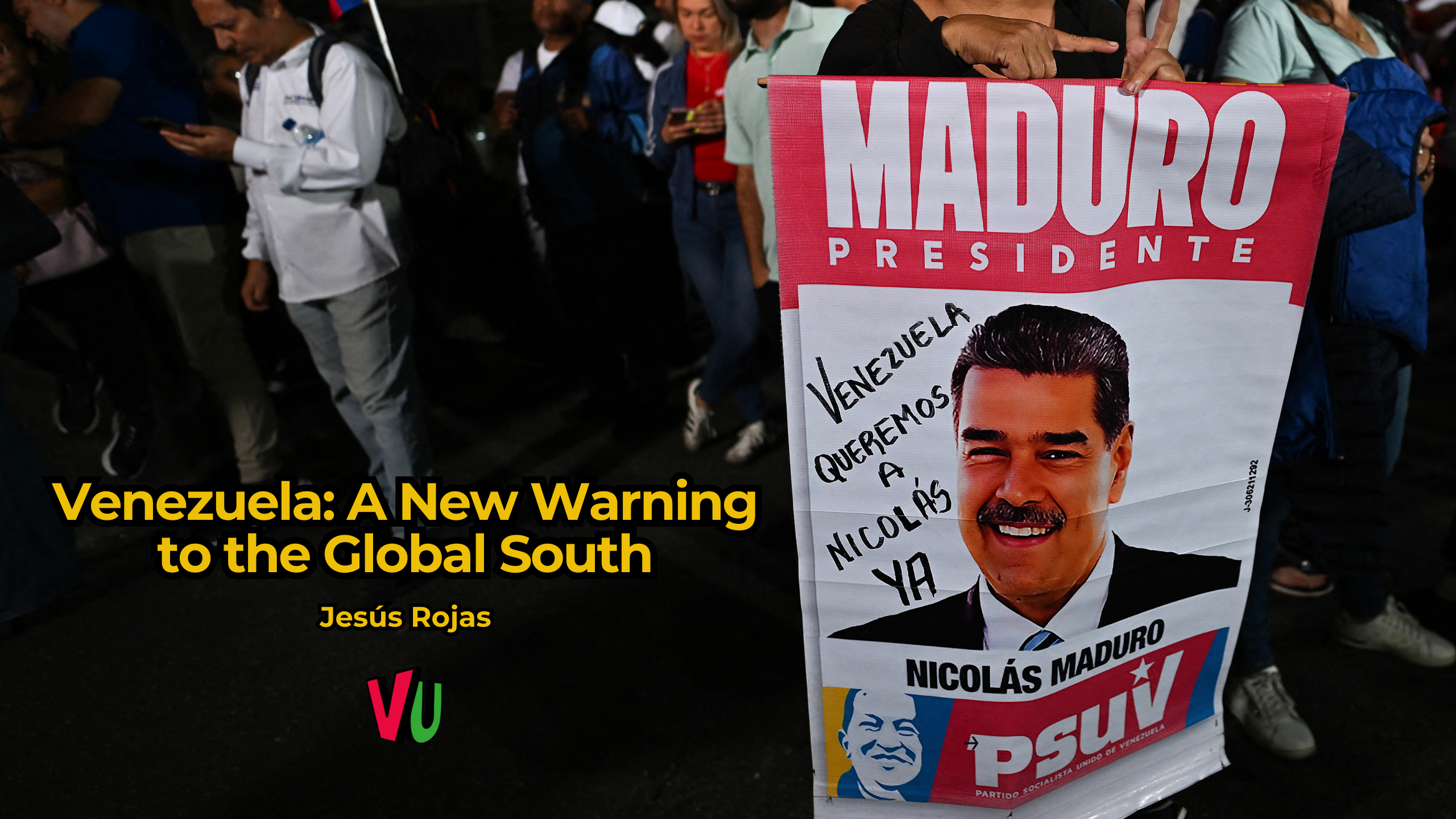
Jesús Rojas
The events that took place in Venezuela last January 3rd cannot be interpreted as an isolated incident or a simple strategic maneuver on the regional geopolitical chessboard. To reduce the facts—marked by an unprecedented military deployment that culminated in the kidnapping of President Nicolás Maduro and the First Combatant Cilia Flores—to just another episode of tension between Caracas and Washington would be a historical misjudgment.
To understand the magnitude of what happened, it is imperative to step back and observe the power dynamics that have characterized the 21st century. Since the end of the Cold War, it has been assumed that the world was moving towards greater institutionalization of international relations, in which law and diplomacy would arbitrate disputes. However, what we have witnessed in the last two decades, and particularly starkly in this event, is a return to practices reminiscent of 19th-century spheres of influence, but wielding 21st-century tools. The de facto disappearance of certain ethical and legal limits in geopolitics has opened the door to actions once considered exclusive to exceptional regimes or contexts of open warfare. The kidnapping of two heads of state in a foreign country, as part of what could be defined as a commando operation, is not a simple “stunt”; it is the normalization of extreme violence as a tool for regime change.
In reality, this incident constitutes a forceful and explicit message directed at the Global South as a whole. This warning transcends the immediate fate of the Caribbean nation and inscribes itself within a logic of global power reconfiguration. In this new scenario, the rules that governed international relations during the second half of the 20th century are being systematically eroded by a unilateral force that replaces diplomacy as the central practice of control.
This message has multiple recipients and is issued in various codes. For the elites of the Global South, the signal is clear: the accumulation of capital, macroeconomic stability, or even an alliance with secondary powers are not sufficient shields if the hegemon’s core interests are challenged. For social movements and progressive governments, the warning is even more somber: the democratic and peaceful path towards sovereignty can be cut short by brute force when conditions permit. And for global citizens, the message is that the principle of inviolability of heads of state—one of the few remaining sacred consensuses in international law—has been broken. This creates a dangerous precedent: if a president can be kidnapped while exercising their duties, what guarantees exist for any leader who dares to challenge the status quo? The reconfiguration of world power is not an abstract process; it is written with events like this, which redefine what is politically and legally possible.
The Venezuelan case starkly illustrates a reality where strategic, resource-rich countries become targets, not only for their intrinsic value but for what they symbolize as a challenge to traditional hegemony. The warning is clear: no state, however much it invokes the principles of non-intervention and self-determination, is exempt from suffering the weight of extreme coercion if its internal policies or international alignment contradict the interests of the dominant powers.
Venezuela is not an isolated case in this category. We can observe worrying parallels in other latitudes. The experience of Libya in 2011, where the NATO intervention, initially presented as a humanitarian mission to protect the population of Benghazi, ended with the lynching of Muammar Gaddafi and the destruction of the Libyan state, is a direct precedent. Syria, for its part, has suffered over a decade of hybrid war, with massive investments from regional and global powers to overthrow the government of Bashar al-Assad, using everything from terrorist groups to extraterritorial economic sanctions like the Caesar Act.
In all these cases, the pattern repeats: a country with strategic resources (oil, gas, water, geographic position) that adopts an independent foreign policy is subjected to a multidimensional destabilization process. The difference in the Venezuelan case, and what makes it particularly instructive for the Global South, is the duration and intensity of the siege, combined with a geographic proximity to the hegemon that turns it into a perfect laboratory for testing new technologies of domination.
Under this premise, the strategy of blockade and sanctions does not seek a conventional military victory with tanks and territorial occupation, but rather pursues a collapse induced from multiple fronts—a suffocation designed to generate social discontent and erode the State’s capacity to respond until it provokes an internal implosion.
This fourth-generation warfare, or hybrid war, uses financial sanctions and the seizure of sovereign assets not as humanitarian measures, but as tools of asphyxiation. Venezuela has thus become a laboratory.
Hybrid warfare is a contemporary conflict strategy where a state actor or coalition employs a synchronized combination of conventional, irregular, economic, diplomatic, and information tools. The objective is to destabilize and subdue an adversary government, operating in a “gray zone” below the threshold of declared war, to maximize damage and create confusion while minimizing one’s own political and military costs.
What makes the Venezuelan case unique is the combination of secondary sanctions that punish not only Venezuela but also any company or country that trades with it. This has generated an overcompliance effect, in which banks and corporations worldwide prefer to cut ties with the country rather than risk exclusion from the US financial system. The dollar and the SWIFT financial messaging system have been weaponized in a way the architects of Bretton Woods never imagined. Furthermore, the seizure of sovereign assets, such as gold held by the Bank of England or Citgo’s assets in the United States, has set an extremely dangerous legal precedent: the sovereign immunity of nations can be violated through political arguments masquerading as judicial decisions. For the Global South, this means their international reserves, their main financial safety net, are no longer safe in the metropolises if their policies displease the dominant power.
In the Venezuelan case, the Unilateral Coercive Measures (UCMs) are the economic battering ram of a broad-spectrum hybrid war. They do not operate in isolation. Their success depends on their synchronization with the communicational war (to justify them), the political war (to seek an alternative puppet government), and the irregular war (to wear down the state from within).
The ultimate goal is regime change, achieving what cannot be achieved on a conventional battlefield: the government’s surrender or collapse through total asphyxiation. At the same time, the aggressor country presents itself as an external actor merely seeking to “help” or “restore democracy.”
The synchronization of these fronts is key. While sanctions strangle the economy and generate shortages, a global communications machinery attributes those shortages exclusively to the government’s “ineptitude” or “corruption,” hiding the impact of the blockade. Simultaneously, opposition figures who present themselves as the democratic “solution” are financed and politically supported, even when some have publicly endorsed the sanctions. And on the irregular front, violent actions are stimulated and protected, from guarimbas (violent protests) to coup attempts and mercenary incursions, like the failed Operation Gideon. The objective is to create a reality so chaotic and hopeless for the population that any change, even one imposed from outside, seems desirable. It is a strategy of collective psychological attrition, designed to break a people’s will to resist.
This attack on Venezuelan sovereignty does not occur in a vacuum. Still, it is a key piece on the broader board where the global power balance is being shaped, raising uncomfortable questions about the viability of a multipolar order and the universal validity of self-determination when great powers decide to ignore international law.
However, one of the most revealing aspects of this crisis has been the passivity and fragmentation of the Global South. The inability to articulate a collective, effective response to the naval and air blockade underscores that, despite the rhetoric of a more balanced world, defense mechanisms against unilateral coercion are conspicuously absent. This lack of coordination sends a dangerous signal: powers can act with relative impunity, knowing that discursive condemnation rarely translates into actions that raise the costs of aggression.
Why does this paralysis occur? The reasons are multiple and complex. On one hand, structural dependency persists: many Global South countries remain tied to the financial, technological, and security systems led by traditional powers. Breaking those ties involves immediate costs that few governments are willing to assume. On the other hand, there is a diversity of interests and regimes within the Global South itself that makes building a common position difficult. A country with strong commercial ties to China faces a different reality than one whose main trade relationship is with the United States, or one dependent on humanitarian or security aid from NATO. The powers skillfully exploit this fragmentation through a “divide and conquer” diplomacy. The lesson for the Global South is bitter: the rhetoric of unity must be accompanied by the creation of alternative financial institutions (such as the BRICS New Development Bank), own payment systems, and mutual defense mechanisms that go beyond mere declarations. As long as there is no real cost for the aggressor, the aggression will be repeated.
Given the infeasibility of a classic invasion, the conflict shifts towards a new geometry encompassing security, culture, and economics. On the security front, the goal is internal attrition and institutional infiltration; on the cultural front, a battle of narratives is waged to delegitimize the adversary in the eyes of the world public; and on the economic front, total paralysis through blockade is sought.
For the Global South, the fundamental lesson is that sovereignty can no longer be a merely declaratory concept but a daily construction grounded in internal resilience. Survival in this hostile world requires strengthening one’s own productive capacity—achieving food, energy, and technological sovereignty—and fostering social cohesion to prevent external actors from exploiting internal divisions.
This internal resilience is the most important battlefield. Food sovereignty means not depending on importing basic grains that can be withdrawn from the market by political decision. Energy sovereignty means diversifying sources and ensuring internal supply regardless of global market fluctuations or sanctions. And technological sovereignty, in an increasingly digitalized world, means developing indigenous capabilities in communications, cybersecurity, and data processing to avoid being at the mercy of platforms controlled by adversarial powers. But no technical progress is sustainable without social cohesion. Hybrid warfare precisely seeks to erode this cohesion, turning neighbors against each other, generating distrust in institutions, and promoting a culture of individualism and hopelessness. Therefore, the defense of sovereignty is also a cultural and ethical battle, requiring the strengthening of community ties, historical consciousness, and the ability to discern between information and propaganda.
The construction of a multipolar world must be done from the ground up, through strategic intelligence and the creation of solid alliances, such as South-South cooperation and the strengthening of alternative financial circuits that reduce dependence on the dollar.
The blockade against Venezuela is not an isolated punitive measure but the enactment of a new paradigm in which sovereignty must be defended daily. Its experience offers invaluable lessons on the need for effective solidarity and organized resistance.
The future of the international system is built on present decisions, and the urgent question is whether the rest of the developing nations will learn this lesson in time, or whether they will wait for the warning to become their own reality.
The history of Venezuela is, in this sense, a prophetic warning. It is not a story of failure, but the chronicle of a resistance against a siege of biblical proportions. What is at stake is not only the future of Venezuelans but also the kind of world future generations will live in. Will it be a world where the right of the mightiest prevails without restraint, where the sovereignty of small and medium-sized nations is a fiction maintained only as long as it does not bother the powerful? Or will we manage to build a more just international order where political and cultural diversity is respected, and cooperation prevails over coercion? The answer will not come from the great capitals of the North, but from the capacity of the peoples of the Global South to articulate, resist, and build, in the face of adversity, the foundations of a common, sovereign, and dignified future. The clock is ticking, and the warning from Venezuela is, without a doubt, the final call to wake up.
Jesus Rojas is an English Professor, revolutionary, Bolivarian, Chavista, and anti-imperialist.
