
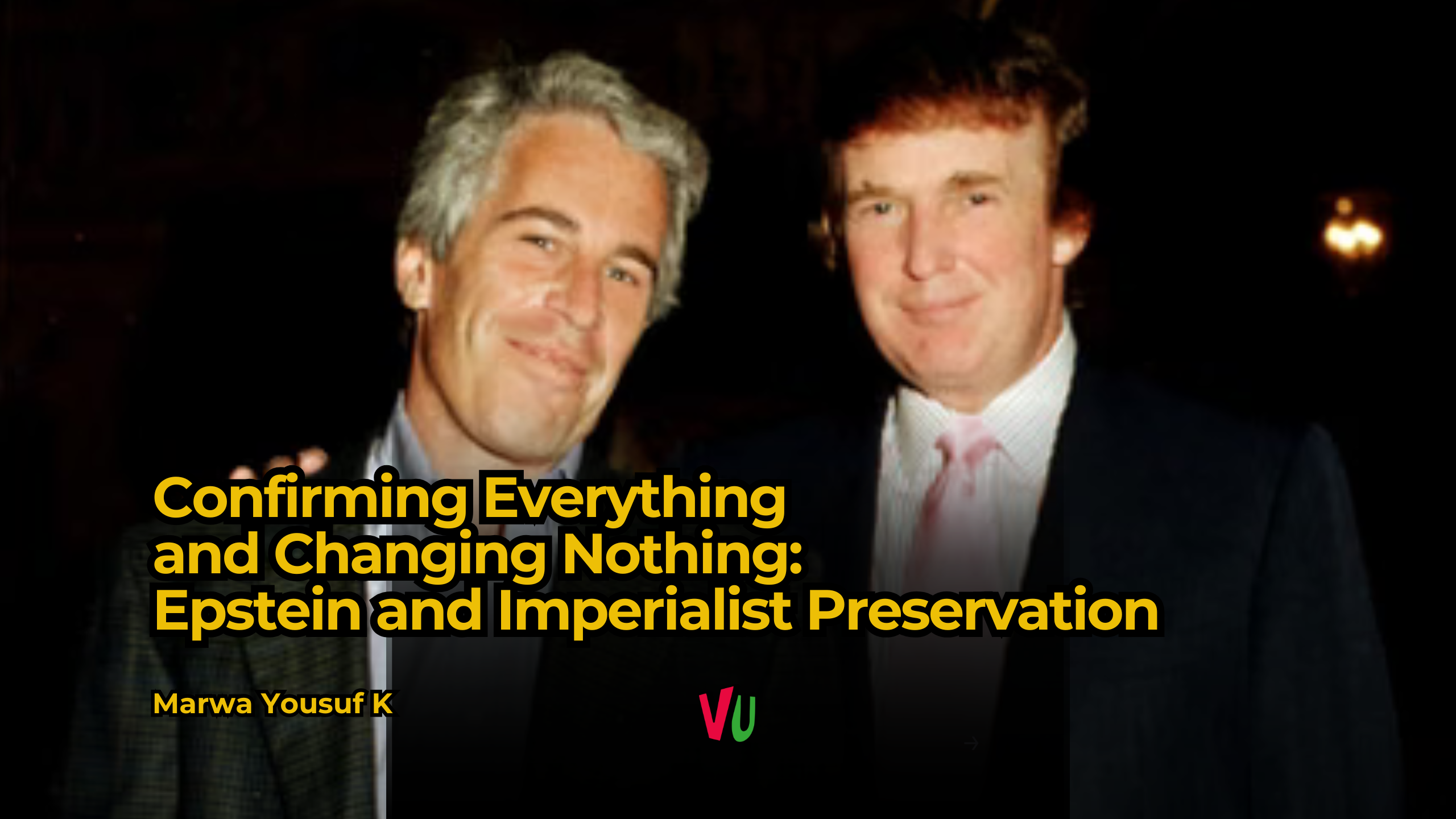
Marwa Yousuf K.
A billionaire traffics minors for other billionaires (and multi-millionaires), ferries them across borders in private jets, houses them on his private island buffered by ocean and law; the details are documented, leaked, litigated, archived, and still the shape of it feels structurally familiar. Not because the acts are peripheral but because the insulation is ordinary. Extreme wealth already lives behind sealed records, shell corporations, private airspace, diplomatic protection; so naturally, the scandal registers as grotesque, but not alien.
That distinction matters.
The Epstein files might’ve stunned the general public, but they did not destabilise the system that produced him. The files circulated through an information ecosystem trained to metabolise horror quickly. The files function as a window into how imperial power handles exposure, how systems absorb scandal without surrendering structure, how exploitation nests inside wealth concentration and geopolitical dominance, how outrage can be stretched thin with time, and how the extended timetable of disclosure can drain force from what would otherwise be intolerable.
The island was not some anomaly that dropped from the sky; it sat squarely inside a structure that centralises wealth, monopolises privacy and mobility, and births/exploits human vulnerability. It existed because a particular distribution of power makes such enclaves possible and sustainable.
The “afterlife” of the files has been choreographed through controlled release: unsealing in batches, clearly negotiated redactions, civil suits running parallel to criminal investigations, media cycles synced to each procedural development – the pacing itself is political, and each development sustains attention without forcing resolution. Imperialism doesn’t want a resolution, as it might easily spark a revolution. Sudden full exposure can create conditions for destabilization; gradual exposure, on the other hand, allows recalibration and dispersion. When information arrives in fragments, each fragment feels containable; so by the time patterns solidify, they no longer shock. They confirm suspicions already sedimented in public consciousness.
This is acclimatisation in motion, by design.
Legal procedure reinforces this (being a cog in the imperial machine, a very important one). Due process is real, and so is institutional self-interest – systems designed to protect property, capital flows, diplomatic relations, and elite continuity cannot easily prosecute networks that cut across those same domains. When a system that relies on elite cohesion is asked to process a scandal in ways that threaten that cohesion, it sees red and instantly commandeers its foot soldiers: Avoid Structural Indictment At All Costs.
In the Epstein case, early non-prosecution agreements limited scope, and subsequent investigations have widened it, but always within institutional guardrails. Prosecutors operate inside jurisdictions, judges weigh precedent, political actors measure fallout, and financial institutions assess exposure. Each decision can be defended procedurally. The aggregate effect is and has always been preservation. As for “exposure”, it has now clearly become a performance of accountability. Hearings signal seriousness, whereas indictments signal action. But the deeper environment remains intact, and elite social circuits function as before.
The files document abuse, but they also document the state’s (more than wilful) participation.
Repeated revelations without systemic consequences rewires expectations. The first wave of disclosures is usually the most horrifying, whereas subsequent waves are quieter and feel more like confirmation.
Desensitisation does not require explicit coordination; it emerges from repetition, delay, minimisation, and limited consequence. When the public observes that even extreme allegations against powerful figures result in protracted litigation rather than structural overhaul, outrage recalibrates, and each tranche of documents normalises the previous one, where redactions become anticipated and settlements predictable. The idea that “this is how it is” settles into common sense, and when cynicism replaces disbelief, it also stabilises power.
If populations assume that elite exploitation is endemic and untouchable, mobilisation becomes harder to sustain. Anger without a credible horizon for change exhausts itself. The files remain accessible, but their political edge dulls. The case goes from being a crazy conspiracy theory to an event where few deny details, and yet, the emotional register shifts from horror to commentary. When populations are presented with evidence of severe, unspeakable crimes at the highest levels and observe minimal structural consequence, a lesson is absorbed – futility.
Digital culture adds another layer – the island becomes shorthand, references circulate detached from context, jokes proliferate, reaction images compress something horrific into something digestible, and it is in this way that the unspeakable becomes remixable.
Humour often serves as a coping mechanism in the face of disturbing information. Dark jokes do not contest facts; they do, however, reformat them to such a degree that a case about the trafficking of minors becomes a meme template. On platforms driven by speed and shareability, the most portable fragments travel furthest. A phrase, a photograph, a sound, a list of names – the affect shifts from horror to knowingness. Users signal awareness through irony, and soon enough, awareness substitutes for depth. When a network built on the bodily, mental, and spiritual exploitation of minors becomes meme material, something changes in collective processing, and the gravity starts competing with the algorithm. The algorithm works by requiring outrage to be concise to trend, grief to be sanitised, complexity to be trimmed, and delivery to be dramatic yet devoid of any honesty. The result is the island sitting alongside countless other revelations in a feed that refreshes by the minute. The horror, while not denied, is diluted and absorbed into the flow of the content.
This does not trivialise the crimes, it just explains how they lose destabilising force; how memetic culture metabolises atrocity by compressing it into shareable reference, irony, and how that compression alters cognitive and moral processing so that information about severe abuse is registered as cultural content rather than ethical emergency.
To isolate Epstein as this singular monster obscures the soil that nourished him. Sexual exploitation at elite levels requires two conditions:
Funnily enough, the imperial political economy generates both.
War, sanctions, structural adjustment programs, debt conditionalities, privatisation waves – these are not abstract policies. They reorganise entire societies. Public industries collapse, social safety nets shrink, employment becomes precarious, migration accelerates, and whole populations are thrown into instability. In the aftermath of the Soviet Union’s dissolution, rapid privatisation dismantled state guarantees. Livelihoods evaporated, women entered informal and transnational labour markets under pressure, trafficking networks expanded into that vacuum, and tens of thousands were moved across borders into sexual markets serving wealthier regions. The vulnerability was produced through geopolitical and economic transformation.
Foreign military presence also reshapes local economies. Around overseas bases, informal sectors grow, service work expands, and jurisdictional ambiguities protect occupying forces—reports across decades document exploitation and abuse of local women in these zones. Legal recourse is limited by power asymmetry and diplomatic immunity. Sanctions regimes compress economies, devalue currencies, and constrict employment, so that when survival narrows, recruitment into exploitative labour becomes easier. It is vital to remember: poverty is a recruiting ground.
Imperial intervention also produces cultural hierarchies. The impulse to “liberate” women in targeted states often carries voyeuristic undertones. At the same time, fetishisation of submissiveness and poverty in countries destabilised by intervention feeds global sexual markets. The same power that claims to rescue can and does commodify.
Inside this structure, an enclave like Epstein’s island is not aberrant but a private node within a wider system that manufactures vulnerability and shields capital. The network that is documented in the files rests on global inequality structured by force.
The United States did not invent sexual violence. However, it did embed commodification of women’s bodies into its foundational economy. Settler expansion involved systematic violence against Indigenous women, their assault intertwined with territorial seizure. Chattel slavery rendered African women both labourers and reproductive property, their violation contributing to the accumulation and demographic expansion of the enslaved population.
The trafficking, rape, and forced reproduction of enslaved women were not side effects but economic mechanisms – capital formed through bodies treated as inventory.
Racialised control persisted long after legal “emancipation” in the form of convict leasing, sharecropping, segregation, and carceral growth. Modern imperial practice inherits this lineage, where the language changes but the framework (and its logic) remain. Certain populations are buffered by law, wealth, and diplomatic protection. Others are rendered disposable by economic restructuring, militarisation, austerity policies, and racial hierarchy.
Photographs of occupying soldiers posing with the intimate garments of women in bombed territories circulate as trophies.[1] These are expressions of dominance made banal. Against this history, Epstein appears less as “billionaire gone rogue” and more as business as usual. It is no secret that extreme wealth expands the scale and protection of abuse. Still, it is also worth noting that the permissive environment has existed far longer than any single offender. Imperial political economy stratifies whose bodies are shielded and whose are exposed, and the Epstein network exploited exposure manufactured by broader arrangements.
Networks of exploitation endure because they bind participants together. Shared secrets create mutual risk, and mutual risk fosters mutual protection. It’s simple maths.
Financial institutions handle transfers, attorneys draft settlements and nondisclosure agreements, politicians attend events alongside financiers, philanthropic boards overlap with corporate boards, and private jets fly between capitals and resorts – all of the parts of the imperial machine work in perfect unison. Investigators are therefore faced with a web rather than a single thread when accusations are made. How far can exposure extend without destabilising the networks that underpin political and economic order?
Elite networks cross electoral boundaries: Wealth concentration, deregulated finance, and global military reach. These are bipartisan projects. Framing the files as ammunition for one faction leaves the shared architecture untouched.
The abuse is not a deviation from an otherwise healthy system. It reflects incentives embedded in the system itself. Modern political culture treats disclosure as a remedy: Leak the documents, build searchable databases, and assume that knowledge compels change – the Epstein files have complicated that faith, as in this case, when information has circulated widely. Millions of documents have been released to journalists and independent researchers, who have documented and analysed each one extensively. The knowledge is very much public.
What is missing is leverage capable of confronting elite cohesion. Transparency without enforcement reduces something serious into a shallow spectacle, and exposure alone does not dismantle the conditions that produced it.
Real accountability would require confronting financial secrecy regimes, lobbying networks, revolving doors between state and capital, diplomatic immunities, and private arbitration systems. It would require asking whether extreme wealth itself is compatible with equal protection under law, and such confrontation threatens the stability of the very institutions tasked with prosecution. When people conclude that elite abuse is woven into the fabric of empire, resignation replaces outrage.
The Epstein Files document crimes and remain as an archive of what is known, but they also document a system confident in its durability. The point, therefore, is not to deny individual guilt but to refuse the comfort of treating Epstein as an isolated pathology.
Jeffrey Epstein operated within the imperial order of capitalism. Until this order is confronted (and dismantled) at the level of structure, further revelations will follow the same trajectory: disclosure, debate, dilution, absorption.
Marwa Yousuf K. is a writer exploring how politics and faith shape life in Occupied Kashmir and beyond, with contributions to local publications and community platforms.
