
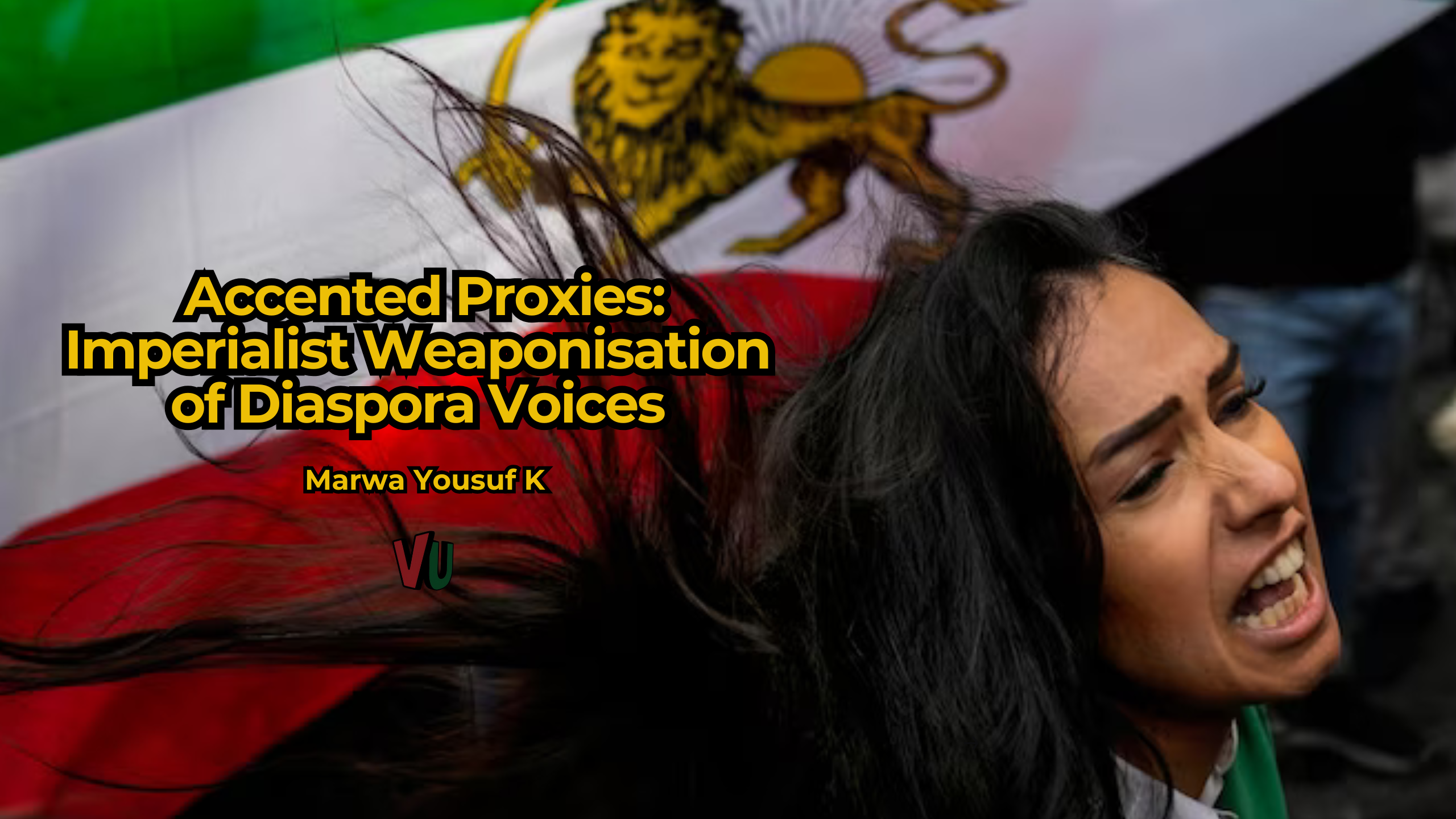
Marwa Yousuf K
“The master’s tools will never dismantle the master’s house.” – Audre Lorde
In the age of soft warfare, empire needs brokers, not boots on the ground. The battlefield is no longer limited to terrain; it has expanded to narrative, and the most potent weapons in this war are not drones or diplomats but proxies – and among the most potent are diaspora communities. These are not incidental populations; they are carriers of memory, capital, linguistic dexterity, and transnational networks. They hold sway in media, policymaking, academia, and cultural production. And imperialism knows it. These populations are not just spoken of or to but spoken through. Institutions increasingly platform English-speaking, upper-class diaspora voices, think tanks, and governments in the Global North, not because they represent the will of the people back home… but rather because they do not. The dislocation becomes an advantage: the farther one is from the realities of hunger and imperialism, the easier it is to convert anger into policy proposals that imperialism will accept.
These voices are carefully selected, often from the upper rungs of society: those who could afford exit, education, and entry into the halls of Western legitimacy. They are fluent, credentialed, well-mannered, and well-dressed in the language of empire, and it is that fluency that becomes legibility. It makes their politics not just heard, but platformed – in op-eds, conferences, sanctions hearings, “civil society” briefings… and the news (Piers Morgan Uncensored, in particular, has done irreversible damage, I believe),
Diaspora space is the contemporary theatre of imperial operations – a staging ground and a factory for manufactured consent.
It allows Western powers to:
– Narrate so-called rogue states without setting foot in them, curating which voices are heard and which are silenced.
– Amplify selective diaspora figures as native truth-tellers while erasing the homeland’s actual plurality
– Engineer moral panic, urgency, and human rights discourse; not to relieve suffering, but to soften the ground for economic or military coercion – Put pressure on host states through lobbying, demonstrations, and media spectacles led or supported by the diaspora
– Legitimise foreign operations (including blockades, sanctions, and regime-change plots) by portraying them as democratically requested and people-powered – Manufacture consent internally and internationally by washing imperial objectives via diaspora discourse, transforming inevitable coups into rescue missions
The strategic utility of diaspora has always existed, but what’s different now is the structural embedding of these voices within institutions of imperial power. The UN panels, the BBC features, the university lectures – the whole architecture of global opinion is being tilted to feature voices that, while marginal in the homeland, are central in the imperial echo chamber.
Diaspora is also now a tool of extraction. It is mined not for labour alone, but for political capital. An influential diaspora figure, groomed into a palatable politics, can do more to isolate a sovereign state than a battalion of troops. Because imperialism doesn’t need occupation, it needs consensus. And consensus is built in stages: first through discourse, then through policy, then through coups or international isolation. Most notably, through these voices, an illusion of consent is crafted; the idea that “the people” have spoken.
So what happens to sovereignty in this configuration? It is diluted, eroded not by bombs but by biography; by someone who “looks like us,” “comes from there,” and yet insists, from afar, that home must be saved by the same powers that have historically exploited it.
There is no neutral tongue in empire. In addition to being a language, English serves as a gatekeeper of legitimacy, a measure of class, and a tool of access. It determines who is heard (and who is permitted to talk in the first place). English proficiency becomes a passport to respectability within the framework of imperial geopolitics. Those who speak it well are assumed to be articulate and civilised, making them deserving of platforms, and those who don’t are portrayed as backward, irrational, or tragically voiceless. This linguistic hierarchy mirrors and sustains colonial ordering. In the colonial world, English was imposed as the language of administration, law, and discipline. Today, it is repackaged as the language of liberation and resistance – but only when spoken by those whose politics flatter imperial frameworks. The issue is not that diaspora figures speak English but that their fluency becomes the precondition for being believed. In contrast, those who speak the language of the oppressed are presumed to lack the capacity for analysis or self-determination.
This is why imperialism doesn’t quote the factory worker in Caracas, the mourning mother in Mashhad, or the stone pelter in Srinagar whose grief is too raw to translate. Instead, it reaches for the diaspora professor, the think tank consultant, the self-styled “global citizen” who says the right things in the right tone and, in doing so, it performs a sleight of hand: substituting classed, curated voice for collective consent. Language here is not just a medium but a border wall, and every syllable of accented English that makes it through is filtered through decades of proximity to whiteness.
As for dissent, it’s only welcome when it’s choreographed. Empire selects resistance; it curates opposition the way it curates art: choosing the palatable and English-speaking face of rage that can be folded into policy. The more fluent the fury, the more useful it becomes, and in this curation process, the diaspora becomes a showroom for representable dissent. Imperialism manufactures consent while claiming moral distance. It doesn’t say “we want to destroy Venezuela.” It says, “We are amplifying Venezuelan voices who want democracy.” It doesn’t say “we are sanctioning Iran to provoke collapse.” Imperialism insists “Iranians abroad are asking for pressure to support human rights.” And the diaspora voices who are chosen, elevated, retweeted, and quoted are often those who say just enough to indict their home country, but never enough to implicate imperialism. Their anger is permitted and their solidarity platformed, but only as long as it remains strategically valuable.
This curation is structural and happens in hiring decisions at think tanks and in the selection of “experts” for media appearances. It happens when fellowships, grants, and policy panels are awarded to exiles whose politics are sharp enough to cut their home country’s governments, but dull enough to leave imperialism untouched.
Modern empire doesn’t just extract resources, it extracts identity; it learns how to speak in the voice of the battered, the exploited, the brown, the displaced, and trains itself to say “as a Venezuelan” or “as an Iranian woman…” and then delivers a payload of analysis that perfectly mirrors Western foreign policy. And because the voice comes wrapped in pain and provenance, it becomes bulletproof… unquestionable. Because who are you to argue with someone who fled? Who are you to push back on a woman who says she escaped state violence? Who are you to challenge someone who says “my people” while holding a passport from the country bombing theirs?
This is how identity is weaponised and how empire learns to speak through the native. But the truth is: identity is not immunity from critique, and lived experience is not the same as principled politics. Being Venezuelan does not make your analysis of sanctions valid, and being Iranian does not mean your call for regime change is rooted in justice. Being from somewhere does not absolve you of the need to think historically, politically, and structurally.
Diaspora voices who invoke identity to shut down critique (“Listen to me,” “Don’t speak over me, I’m Palestinian”) often do so from a place of distance and insulation. They claim to represent “the people,” but when the people disagree, when poor Venezuelans say they oppose intervention, when Gazans under bombardment say they stand with their resistance forces, when working-class Iranians rally behind their supreme leader – those voices are dismissed as brainwashed, misinformed, or too oppressed to understand their own oppression.
This is not solidarity but a closed circuit of self-reference, where identity becomes both credential and bludgeon. Where the mic is handed not to the most vulnerable, but to the most fluent. The truth is this: Not all wounds speak truth, and not all suffering produces clarity. Sometimes trauma produces reaction, not revolution. Sometimes it curdles into resentment rather than resistance. and identity (especially diaspora identity) is not immune to class interest, ideological distortion, or imperial seduction. In fact, it is often more vulnerable to these things, precisely because of its need to belong somewhere. And imperialism offers belonging – and microphones. Empire gives you space – if your speech aligns with its strategy.
This is why “lived experience” can’t be the standard: the lived experience of one exile in Miami cannot override the political will of millions living under sanctions in Mashhad or Maracaibo. Because grief, unexamined, can be manipulated and because empire knows that the most effective justification for war isn’t a white house press briefing – it’s a brown face saying “my people need help.” Anti-imperial ethics demand that we hold our own communities to account, that we don’t outsource all villainy to the regimes we fled, while forgetting the empires we fled to. That we learn to sit with our pain without feeding it to the war machine. Because if you have the mic, and the missile follows your words, you should ask who handed you the mic.
[Author’s note: This is not a total rejection of lived experience. It is a rejection of its elevation into unquestionable truth. Because power can inhabit any voice… even yours, and as a principled human being, you should interrogate your own analysis with the same force you apply to others.
Both Iran and Venezuela are sovereign states with grounded revolutionary pedigrees, not empty caricatures fabricated by pundits or intelligence dossiers. The Islamic Republic of Iran emerged in 1979 as a rejection of Western dominance and monarchy. It was anchored in the principle of refusing to submit to foreign (mainly American) hegemony, and continues to articulate a neither East nor West posture in its foreign policy, rooted in anti‑imperial resistance. This stance, more than rhetoric, is a structural commitment to strategic autonomy, refusing to affiliate with any superpower and insisting on a strategy grounded in indigenous principles rather than external acceptance.
Venezuela’s Bolivarian project, catalysed under Hugo Chávez and maintained under Nicolás Maduro, likewise rejects subordination to imperial financial architectures and militarised diplomacy. It’s a project that nationalised key industries, claimed resource control for social redistribution, and insisted on sovereign policymaking even under extreme external pressure and punitive sanctions. The Axis of Unity between Tehran and Caracas is a strategic alliance forged from shared anti‑hegemonic commitment – an axis explicitly structured to counter U.S dominance in global energy and diplomatic spheres.
Iran: A Revolutionary State and The Politics of Reluctance
Iran’s anti‑imperialist credentials are systemic, not performative. From the moment of the 1979 revolution (which itself repudiated the CIA‑backed overthrow of Mossadegh in 1953), Iranian leadership has resisted the West’s geopolitical designs and insisted on autonomy in economic and foreign affairs. Sanctions reimposed in recent decades have not occurred in a vacuum; they are the material consequences of a state refusing to bend to Washington’s demands on nuclear policy, regional autonomy, and alliance formations. These measures, aimed at oil exports and financial flows, have directly contributed to economic strain. But the narrative that reduces Iran’s hardship solely to “mismanagement” erases the steady, long‑term external pressure that is itself a form of economic warfare.
Iran is also the political and logistical backbone of the Axis of Resistance, a coalition of states and non-state actors across West Asia that actively opposes Israeli expansionism and Western military involvement. Its support for groups such as Hezbollah, Hamas, and the Houthis is a geostrategic philosophy based on protecting regional sovereignty against settler colonialism and imperial expansion. This became undeniably visible during the 12-day war in June 2025. Though Iran did not fire the first shot, Western commentators rushed to frame it as the shadow puppeteer simply because it represents a sovereign model that cannot be subordinated.
And this is precisely why diaspora critics (especially those in proximity to empire) often dismiss Iran’s anti‑imperialist lineage. It doesn’t translate neatly into liberal, English-speaking protest language. They want resistance that looks like Western social movements, not a state asserting its right to self‑determination under extraordinary pressure. Voices that inhabit that aesthetic are then platformed as the “authentic” Iranian voice, not because they reflect the complex realities of Iranians under siege, but because their critique fits the empire’s comfort zone. Their fluency is rewarded, even if it betrays the realities on the ground.
Venezuela: Bolivarianism, Sovereignty, and The Refusal to Capitulate
Similarly, Venezuela’s Bolivarian Revolution was never designed to be palatable to imperial tastes. Chávez and Maduro insisted on redistributive economics, social investment, and rupture from neoliberal dictates, and they have paid for that insistence with sanctions and repeated external destabilisation campaigns. Sanctions targeting oil exports and financial transactions have crippled fiscal capacity and access to essentials, making the economic crisis a battleground directed at sovereignty itself.
Maduro’s refusal to acquiesce, to resign to external pressure, or to cede control of resources marked him in the eyes of empire not as a legitimate head of state but as an obstacle to power. This very refusal, not authoritarianism, is what made him unpopular among diasporic elites who prefer a politics that snaps to Western approval. Those diaspora figures who condemn Maduro often do so with a vocabulary of “freedom” divorced from a structural understanding of economic coercion.
In both cases, the fundamental issue is this: Khamenei and Maduro are not pawns of American imperialism. Their prioritising sovereignty and resisting external domination makes them unpopular in English-speaking media and diaspora populations… and because empire wants representation that is familiar, grammatical, and digestible, it promotes diaspora voices who speak English well and frame struggle in the vocabulary of liberal protest rather than sovereign autonomy.
This is political honesty about how empire chooses its spokespersons – and why those choices often exclude figures whose politics, though deeply rooted in anti‑hegemonic struggle, don’t conform to the scripts empire is willing to broadcast. Diaspora becomes a prism through which Venezuela is continuously distorted: Protest is aestheticised, class is erased, and the materiality of war – the kind that doesn’t drop bombs, only shuts down power grids and blocks insulin shipments is sanitised. And all the while, the state is expected to operate under siege while being judged as if it weren’t. Venezuela’s greatest crime was not socialism, but disobedience. That is what empire punishes. That is what it will always punish.
Suppose imperialism has learned how to weaponise diaspora (and it has), then the diaspora must learn how to disarm itself. Not through silence but through discernment and participating in ways that don’t feed the war machine, rather than giving up on the fight. The first stage in diaspora ethics is accountability: before speaking on behalf of the people, ask whether they asked to be spoken for. Before endorsing a policy, consider the system you’re legitimising and who will bear the cost. Before invoking home, ask whether your
The relationship to it is love or nostalgia, solidarity or projection, before becoming an imperialist mouthpiece, ask yourself whether it’s worth the price the people back home will pay.
An anti-imperial diasporic ethic demands that we speak with a backbone, memory, and consequence, not just with accent and access. That we refuse to become tools in someone else’s blueprint for conquest, and that we check whether our fluency has made us applicable to the very structures we claim to critique. Because if you live in a country that bombs, sanctions, invades, or economically bleeds your place of origin and your activism mostly flatters that country’s foreign policy, then your activism is active sponsorship.
This is a call to situate yourself and to recognise the weight of your distance. To remember that many of the leaders you dislike are disliked not because they are authoritarian or corrupt, but because they cannot be bought. Furthermore, the very people you claim to be grieving have been fragmented by many of the policies you fervently support… And lastly, if you claim to love your country, consider whether your affection is based on its sovereignty or on your ability to describe or manipulate it from a distance.
Remember this: an empire has always loved a native informant, and sometimes, all it needs is the proper accent.
Marwa Yousuf K. is a writer exploring how politics and faith shape life in Occupied Kashmir and beyond, with contributions to local publications and community platforms.
