
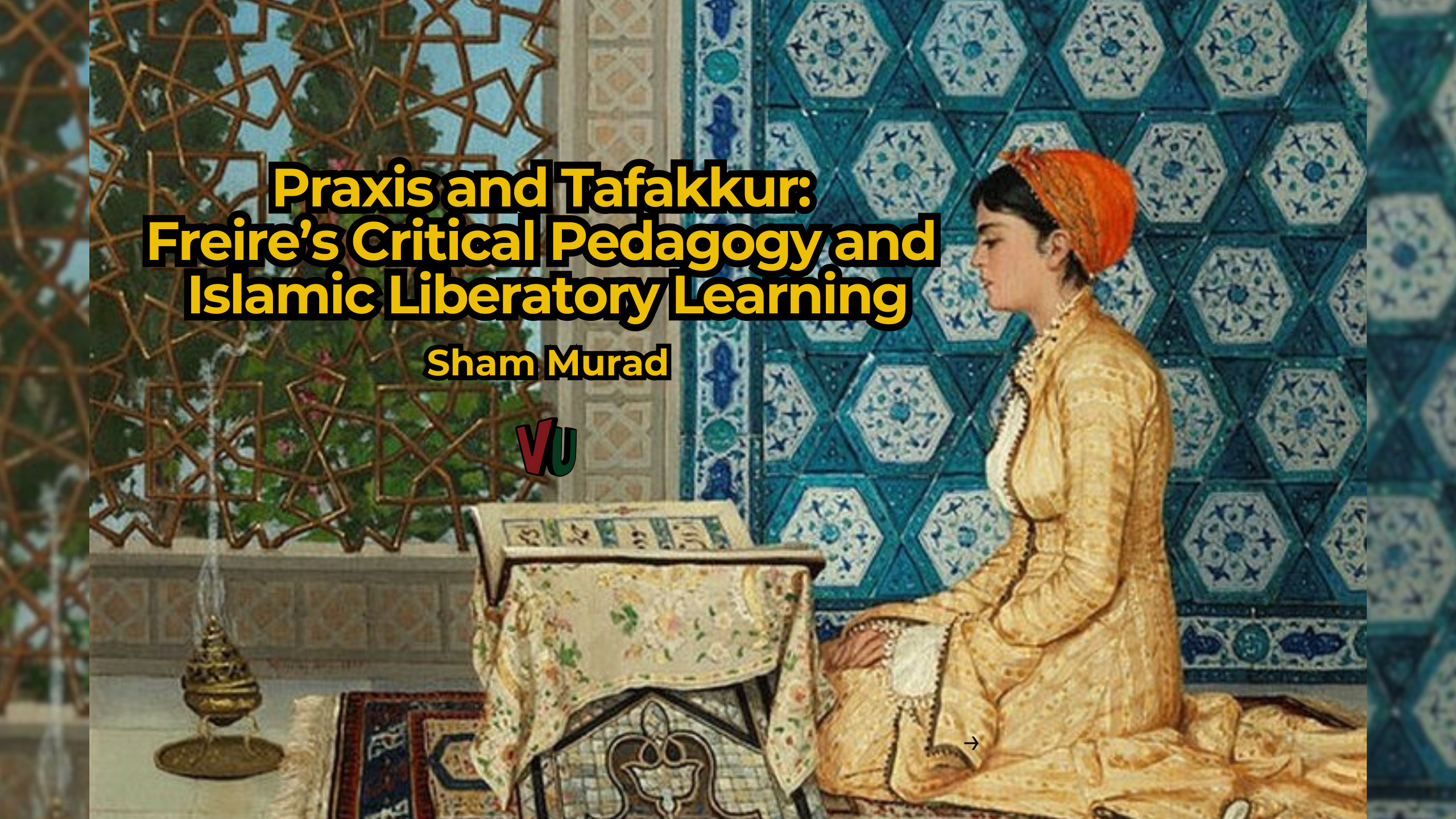
Sham Murad
I first read Paulo Freire’s ‘Pedagogy of the Oppressed’ long before I ever consciously entered the Islamic intellectual tradition, at a time when I was still trying to make sense of the world as an Iraqi asylum seeker growing up in the UK, navigating classrooms, languages, and the quiet dislocations that come with living between worlds. My family was not particularly religious, yet the Qur’anic ethos was always there in the way my mother spoke about justice, in the moral texture of our home, and in the subtle expectation that knowledge should elevate character rather than inflate ego. These sensibilities seeped into me without formal instruction. When I encountered Freire, something in his writing felt familiar. His insistence that education must awaken dignity and his belief that knowledge is inseparable from moral responsibility were not new ideas to me, even if I lacked the language to articulate them.
At the time, I did not have the vocabulary of ilm, taffakkur, or amal salih. I did not yet know what Islamic pedagogy meant, nor had I studied the Prophet’s teaching methods or the Qur’an’s epistemology. Yet, the more I engaged Freire’s text, the more the half-remembered rhythms of my upbringing began to echo. In his critique of the banking model, I recognised the same discomfort I had long felt with rote learning in school, the sense that something essential was missing. I also recognized in his call for conscientization the Qur’anic insistence on awakening and reflection, on seeing the world as a moral field charged with responsibility. As I later immersed myself more intentionally in Islamic thought, these parallels grew clearer. Without flattening their particularities, Freire and the Qur’anic worldview seemed to converge on a shared understanding of human dignity and liberation.
These resonances, shaped by personal memory as much as by intellectual study, ground my attempt to read Freire through the lens of the Quranic pedagogy or to put the two in constructive dialogue. What began as an intuitive recognition, rooted in a childhood shaped by quiet Qur’anic sensibilities, developed into a more deliberate comparative engagement. This meeting point between lived experience and theoretical reflection frames the exploration I undertake in this piece.
Building on this personal point of entry, the present work turns toward a systematic exploration of the relationship between Paulo Freire’s project and the Qur’anic and Prophetic vision of education. Although the two traditions emerge from distinct historical and intellectual contexts, their shared concern with human dignity, knowledge, and liberation creates a meaningful space for comparison. My aim is not to collapse these traditions into one another, nor to claim a direct line of influence, but to examine how their resonances illuminate central questions about learning, agency, and justice.
This paper unfolds in four parts. I begin by outlining the core ideas in Pedagogy of the Oppressed, focusing on conscientization, the critique of the banking model, dialogical education, and the unity of reflection and action. I then place these themes in conversation with key Qur’anic concepts such as ilm, taffakkur, and amal salih, as well as Prophet Muhammad’s pedagogical practices. From there, I examine where the convergences between the two traditions are strongest and where their differences open productive contrasts, especially regarding the foundations of moral authority and the metaphysical horizon of human transformation. Finally, bringing these voices together enriches our understanding of both, showing how Islamic thought offers an alternative grounding for educational liberation and how Freire sharpens our reading of Islamic ethics and learning. The aim is not to claim equivalence between Freire and Islamic thought, but to allow their meeting to generate new insights into the nature of education and the responsibilities of human beings in the struggle for justice.
Conscientization/Taffakur:
Paulo Freire begins his work with a call for conscientization: a critical consciousness that compels the oppressed to unveil the world of oppression and to commit themselves to its transformation through praxis, or action. Conscientization begins when individuals start to question the social, political, and economic contradictions that shape their lives. It is not only a matter of reflection; it demands action. Without the first stage, the oppressed remain unaware of the causes of their condition and are left to accept exploitation as fate.
Similarly, the Qur’an repeatedly calls its believers to taffakur (reflect), urging Muslims to raise awareness of structural injustice by pondering over society. It also encourages reflection on the natural world, on the heavens, the dunya, and the patterns of creation. This holistic approach inspired centuries of inquiry that later shaped disciplines such as medicine, astronomy, science, mathematics, and philosophy.
In Islam, revelation begins with learning. The very first word revealed to the Prophet ﷺ was” Iqra!” (read), a command that situates knowledge at the heart of the faith.
The pursuit of knowledge is seen as a religious duty. Prophet Muhammad ﷺ taught: “Seeking knowledge is an obligation upon every Muslim,” affirming that the pursuit of knowledge is not only a worldly activity but also a form of worship.
Rejecting the “Banking Model” of Education
Paulo Freire critiques the current ‘Banking Model’ of education, in which, as he writes, “education thus becomes an act of depositing, in which the students are the depositories and the teacher is the depositor. The more completely they accept the passive role imposed on them, the more they tend simply to adapt to the world as it is”.
When education is used as a mechanism of oppression, it relies on this banking logic, in which teachers speak of reality as if it were motionless, compartmentalised, and predictable. The purpose is to deposit information into students in ways that disconnect them from the structural totality that produces oppression. This knowledge is presented in fragments, obscuring the conditions that shape their material reality. Under this distortion, students become acclimatised to their reality and show no propensity to challenge inequitable conditions. The more students are forced to deposit this ‘knowledge’, the less likely they are to develop a critical consciousness and intervene as agents of change. They become people merely in the world, not with the world or with others.
If students are only concerned with classroom rote memorisation, they no longer believe that they are capable of creating change but only reproducing ideas already deposited in them. Prophet Muhammad ﷺ addressed this directly through a model of teaching that emphasised gradual revelation, attention to context, and encouraged active engagement. Islam did not overwhelm believers with rules, but instead introduced new teachings progressively and appealed to their moral and social awareness. A clear example of this was the prohibition of alcohol, which was revealed in stages, allowing people to adjust emotionally and socially before the final command.
The Qur’an does not treat its believers as blank slates; instead, it appeals to their intellect and lived experience. This gradualism reflects a pedagogical sensitivity that responds to people’s readiness, an approach largely absent from modern education practice.
Dialogue
So how can one reject this Banking Model? Paulo Freire answers this through what he calls the “problem-posing” model. In Pedagogy of the Oppressed, he emphasises that the pursuit of proper education must be dialogical – meaning it must be rooted in a mutual respect and rejecting the paradigm of the teacher-student relationship. For liberation to be genuine, this teacher-student hierarchy is transformed into a shared process in which each person teaches and learns in turn. Teachers cannot programmatically lead their students into liberation. To dismantle this false division, education itself must become mutual. It is here that the power embedded in the teacher-student relationship begins to wither, as both engage in the vocation of becoming more fully human.
This method was already practiced by the Prophet Muhammad ﷺ in 7th-century Arabia. The Prophet Muhammad ﷺ often taught through questions, stories, and dialogue rather than formal lectures. Prophet Muhammad ﷺ posed questions to stimulate critical thinking: “Do you know who is poor?” Such questions invited listeners to understand poverty not only in material terms, but also in moral ones. It is this dialogical quality of his pedagogy that values the active participation of the learner over passive reception. In both traditions, the purpose of knowledge is to empower human beings rather than to dominate.
Praxis: Reflection and Action
Freire maps out that liberation requires action informed by critical reflection. This call resonates strongly with the Islamic tradition, where knowledge and deed are inseparable. Both insist that true transformation: whether spiritual, political, or social – emerges from critical consciousness and ethical action.
Freire explains that reflection without action becomes mere verbalism, while action without reflection turns into activism without purpose. A word deprived of its dimension of action cannot transform reality, because when reflection is severed from practice, it collapses into idle speech. As Freire puts it, the empty word cannot denounce the world, since ‘denunciation is impossible without a commitment to transform and there is no transformation without action’.
Within Islam, faith (iman) and knowledge (‘ilm) are only valuable when they lead to just action (‘amal salih). The Qur’an repeatedly pairs “those who believe and do righteous deeds”, binding conviction to conduct. Its call to ‘taffakur’ is therefore never abstract. Reflection must culminate in conscious, ethical action, whether through jihad understood as moral striving, or through amr bil ma’rūf wa nahy’ an al-munkar, enjoining what is good and forbidding evil.
Conclusion
The significance of Paulo Freire’s book speaks for itself, with over a million copies sold worldwide. Its authentic and humanistic approach to education feels especially urgent in today’s culture of educational standards and high-stakes testing. If we are to cultivate a generation of educators who understand curriculum as a reflection of power, the Prophet’s educational model offers a compelling guide. Knowledge, in this model, is dialogical, reflective, transformative, and applied. Learners are active participants, and the ultimate aim is both personal transformation and social impact, as captured in the saying “the best of you are those who are most beneficial to humanity” – Hadith
In essence, both traditions share a vision of education and faith as tools for awakening the oppressed and fighting for justice and liberation, a path through which humans reclaim their God-given dignity by learning to read the world as it is and to act upon it as it might become. What unites Freire and the Quránic vision is this insistence that knowledge is never neutral, that it either reconciles people to the world as it stands or equips them to transform it. In pairing the Qur’an with Freire’s pedagogy, what emerges is a shared ethical demand that education remain rooted in responsibility, struggle, and the ongoing work of human freedom.
Sham Murad is a Baghdad-born refugee, activist, and community organiser. She holds a BA in International Relations and Development and an MA in Law, and works with A is for Activism supporting immigrant and refugee children.
