
Striking for Palestine: The Future of Resistance in Labor Struggles in America
Aminah Sheikh (Revised, and initially published in Spring Magazine)
In 1973, the United Auto Workers (UAW) purchased over $300,000 in Israeli bonds, enabling the ongoing Nakba of the Palestinian people. But in response, Arab American autoworkers from the Dodge Chrysler Plant in Detroit led UAW Local 1112 to walk off the job in a one-day wildcat strike for Palestine. Detroit was the heart of the automobile industry and had seen militant workplace organizing. This militancy from the Arab Workers Caucus successfully won local divestment from Israeli bonds.
Arab and Black workers organized in unity around issues in the workplace, including workplace deaths and injuries, racist hiring and segregation, wage theft, and the UAW’s enormous contributions to Israel bonds. To fight oppression on multiple fronts, these revolutionaries understood clearly that the first place of struggle was the workplace, where all workers spent most of their day, and that necessitated taking control of the shop floor and halting capital. The League of Revolutionary Black Workers (LRBW) organized workers and pushed them to fight back at the point of production to challenge capitalism, imperialism, and racism. The LRBW built coalitions with workers of all backgrounds, produced a local newspaper to amplify international and socialist struggles, and organized strikes. These strikes unified workers around issues of capitalism, imperialism, and solidarity with Palestine. This event symbolizes the contradictory history of US labour, with a conservative trade union bureaucracy that supports imperialism, and the history of militant rank-and-file that builds its solidarity with Palestine.
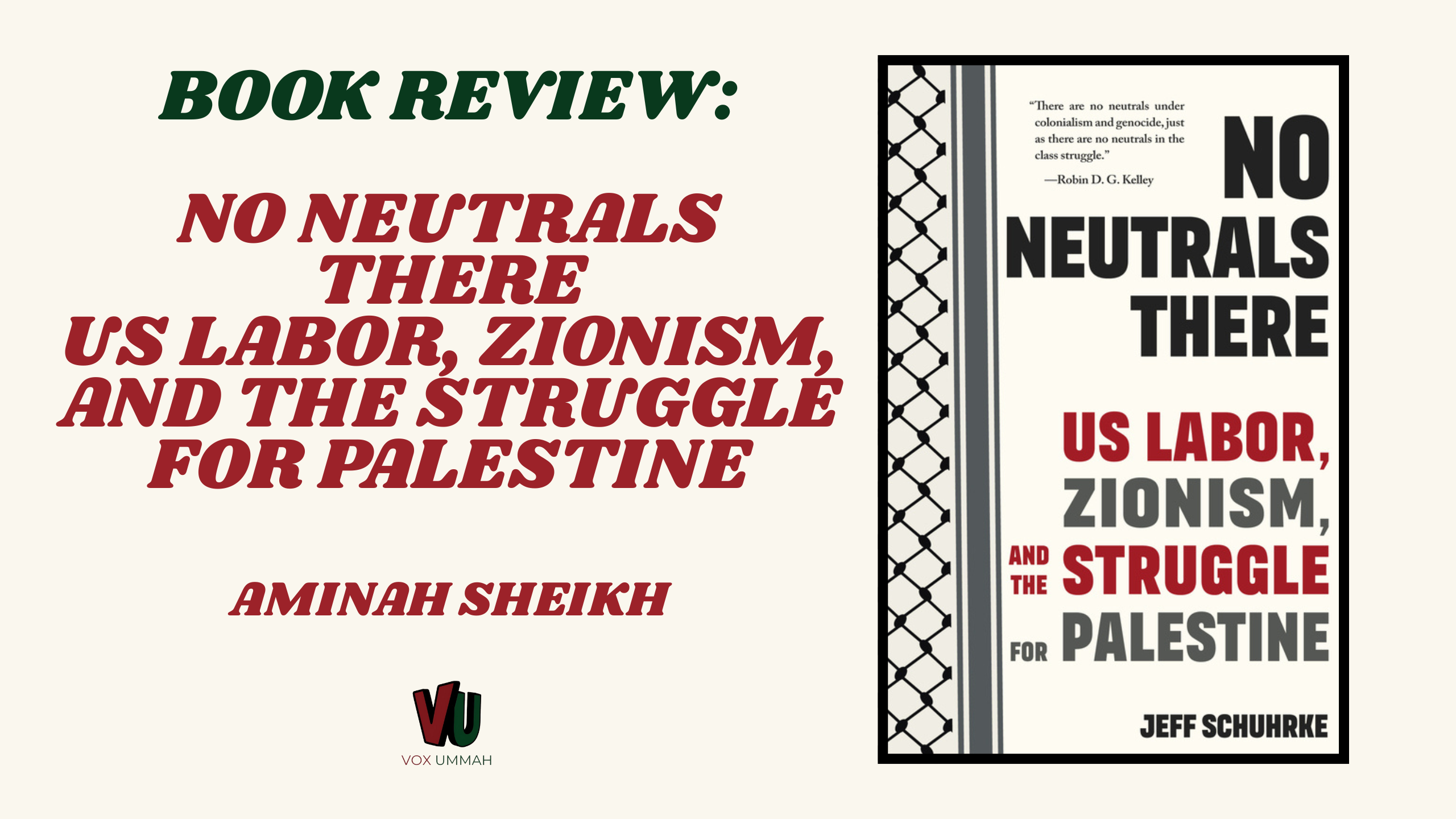
The history and success of organizing against racism and imperialism have been deliberately erased in America. That is why Labor historian Jeff Schuhrke’s work is always welcomed and a needed resource for international trade unionism. To propel and grow the labour movement, we need clarity amid deliberate obfuscation. Shuhrke’s new book, No Neutrals There: US Labor, Zionism, and the Struggle for Palestine, has been released by Haymarket Books and is essential reading to understand the depth of labour’s complicity in the ongoing genocide against the Palestinian people and the complicity of trade union leaders. It also serves as an account of historical victories for the Boycott, Divestment, Sanctions movement and of countless other strikes and successful actions taken in solidarity with Palestine by workers in America.
His book begins with a powerful quote from a Palestinian leader George Habash: “In today’s world no one is innocent, no one a neutral. A man is either with the oppressed or he is with the oppressors.” Habash founded the Popular Front for the Liberation of Palestine in 1970.
Europe’s response to anti-Semitism: from Socialism to Zionism
The book begins by addressing the early formation of Labor Zionism as a fringe ideology and elucidates the material forces that brought it into existence in the late 19th century. It began with a minority group of Jewish statesmen seeking to build a home, with possible destinations including Argentina, East Africa, or historic Palestine. Naturally, the majority of Jewish working people wanted to maintain living in their homes in Europe. Jewish socialist organizations, like the Jewish Labor Bund, reflected this evident sentiment of the right to live in one’s own homeland. Hence, the JLC rejected the early formations of political Zionism and was fighting the rise of fascism and anti-Semitism in Europe.
US Labor leader David Dubinsky was an example of this Bundist tradition. He escaped from a prison in Tsarist Russia and sought refuge in America. He and others in America formed the Jewish Labor Committee (JLC), one of the first organizations to fund and support the American Federation of Labor (AFL). The entire purpose of this labor body was to help trade unionists in Europe fleeing Nazi Germany, fleeing persecution, and the organization sought to protect all workers (Jewish and non-Jewish). The JLC was very adamantly Bundist, and that meant anti-Zionist, as it explained in its founding declaration: “the Jewish question must be solved in the countries in which the Jews live…” (page 71)
After the end of the British Mandate, the colonizers had to ensure that control was not acquiesced to by the native Palestinian population. Moreover, the rise of the United States as a world superpower after WW11 led to the cementing of political Zionism and further investments into the colonization of Palestine. Israel played a vital role in maintaining British hegemony in the colonies. Similarly, it continued to serve the rising US Empire. Importantly, for the imperialist core to continue its supremacy, it needed to plunder and expropriate the region and greater West Asia. Additionally, the region remained extremely important during the Cold War to contain the spread of communism and liberation movements.
With the backdrop of Nazism and settlers coming in from Europe, this justified the ongoing support for colonisation by the United States, the “world’s policeman”, and labor policies to be enforced through violence. In tandem, labor officialdom went from anti Zionist tendencies to officially pledging support for the newly founded apartheid state of Israel. During this early period, we see the power of the formation of the Histadrut- Israel’s largest trade union federation. This labor body’s significance is critical to understanding how Israeli labor policy is one aspect of Israeli Apartheid. Histadrut acts as an arm of industries and employers; moreover, the use of violence is central for it to maintain racial segregation and “Jewish only” policies in Israel.
Israeli Apartheid: “Depriving the worker of his job and the peasant of his land.”
Before settlers arrived from Europe, Palestine was indeed more like communal modes of production, or musha’a, with collective ownership and familial/clan-shared distribution. The colonization of Palestine began in the late 1800s, first by the British and later by Israel vis-à-vis the United States. Both occupiers ultimately intended to destroy their Indigenous systems, remove the Indigenous people, and make way for a new settler population.
From the 30s and the Holocaust, thousands of settlers arrived from Europe to Palestine. At the same time, thousands of Palestinians were made landless, jobless, and forced into poverty. The influx of Jewish settlers led to the expulsion of Palestinian laborers, both in industry and agriculture. Worker organizations like the Arab Worker’s Society denounced Zionist colonialism as two-fold as “depriving the worker of his job and the peasant of his land.” Immediately, these years 1936 to 1939 saw a revolt called across Palestine, including one of the most significant general strikes in the region, against British colonial rule and Zionism. British troops intervened to stymie these anti-colonial uprisings, violently breaking strikes, and Israeli labor body Histadrut played a central role in bringing in scabs.
What is crucially essential for readers to understand in labor, particularly, is that the political economy created by the British and the US Empire is both colonial in nature and an apartheid system. The end of a British Mandate did not mean an end to colonialism; the British ensured that Palestine and its indigenous inhabitants would remain under the thumb of neo-colonialism, the United States, and the political apparatus of the United Nations. De-development, aid dependency, imperialism, and a violent settler economy have always prevented Palestinians from having their right to their land, water, air, and labor. This is important for labor circles to contend with in their political education, to debunk and counter the idea that the “Israel-Gaza war” is some faraway issue that is about age-old religious conflicts.
Notably, the history of the Second World War also led to shifts amongst the international socialists and communists. As Nazism gained steam, a popular front had emerged as a strategy by Communists and the Soviet Union to fight fascism, thus formulating new alliances with social democrats and zionist allies that emerged in Eastern European satellite states. On the other hand, within Palestine, Jewish members of the Palestine Communist Party and Palestinian organizations also organized in unity, but this was against the terror led by both the Israeli’ Histadrut’ and the British Mandate.
Readers involved in international trade unionism must understand that Palestinians have sought to maintain independent trade unions since the early 1900s, including the Palestine Arab Workers Society and various others. However, political participation and freedom of association have never fully flourished in the presence of colonial forces in their region. Histadrut, from the very beginning, used anti-Palestinian hatred to create division, scabbed Arab and non- Arab workers, asked employers to fire Palestinians, and to hire “Jewish only .” These years led to a significant reconfiguration of the labor supply and to land grabs, backed by the United States. Thus, human rights organizations, including international bodies like the International Labor Organization and its global counterparts, have always attempted to officially state that Israel is an apartheid state that upholds racial segregation. The Israeli economy and Israeli labor policy continue to maintain segregation and Jewish-only policies, racial hierarchies, surveillance, workplace violence, dues and wage theft, violent extraction, child labour, etc. The Histadrut, which is really a corporate state entity, undermines the entire purpose of a union: the freedom to collectively bargain and for workers to have control over their lives.
Zionism and the decline of US unions and worker rights
Shuhrke’s previous work, Blue Collar Empire: the Untold Story of the US Labor’s Global Anti Communist Crusade, and current book illustrate how the trade union bureaucracy has supported US imperialism, to the detriment of the American working class. In response to a powerful labor movement at the time, President Franklin D. Roosevelt made concessions that led to labor reforms. This meant that labor leaders, particularly in the AFL, wanted to maintain “labour-management peace” and “wartime peace”, and accrued privileges and prestige with the “labor-friendly” government. This time period really fostered the dominance of business unionism, a hegemonic practice in the United States.
The history of the 30s to the 50s saw the real rise and strength of the US labor movement as a whole. In particular, the 30s saw mass strikes and worker militancy, paving the way for legislative and electoral gains. This put the United States as a powerful country on the world stage to counter the rise of fascism. During this time, the labor movement was more powerful than the American Israel Public Affairs Committee. Thus, Histadrut leadership lobbied and built sustaining relationships with labor officials. These relationships were the foundations of Israel’s legitimacy in the hearts and minds of US labor officialdom. Former President of the United Auto Workers Walter Reuther referred to Israel as “the country in the free world nearest to Democratic Socialism.” (pg. 104)
Over the decades, the corporate state, driven by neoliberal logic, increasingly sought speed-ups, automation, outsourcing, and the offshoring of production to the detriment of the labour movement. The nail in the coffin was a set of legal attacks on worker rights, like the Taft-Hartley Act and other anti-strike laws, including McCarthyism, that continue to see ramifications for American workers to this day. The worst was yet to come, under the Cold War terror, the reactionary Congress of Industrial Organizations expelled 11 unions and with that about 1 million members from their membership because of the threat of Communist leadership. Raiding, expulsions, and the creation of company unions became prevalent, accelerating the decline of militant organizing, strikes, and material gains. This shift to more liberal leadership, along with the expunging of radicals, led to the rapprochement for Labor Zionism.
Schuhrke’s historical research illustrates that the AFL-CIO and major unions became obsessively involved in strategic political positioning and settler expansionist foreign policy. The result of decades-long, unabated anti-Communist purges and imperialist foreign policy fueled the decline in domestic union growth. Dues and taxes were being funnelled over to building Israel and maintaining war coffers. As former AFL-CIO President Kirkland said, “America stands against the creation of a Palestinian state”, which “would injure and endanger economic, political and strategic interests of the United States.”
Israel’s settler population received millions of dollars through the United States labor movement. Endless examples of public institutions built, purchasing of housing bonds, loans named, and unapologetic leaders maintaining Israel union members’ dues. This depraved history includes the former President of the International Brotherhood of the Teamsters, the notorious, corrupt labor racketeer leader Jimmy Hoffa, who was known to be “running guns” illegally to terrorist organisations in Israel in 1948. He helped hide guns inside commercial washing machines en route to Israeli militias. This mob leader formally worked with Israeli leaders like Ben-Gurion and helped solidify lasting relationships between Histadrut and US labor.
However, amid years of repression, the overall decline in union membership, and a hollowed-out labor movement, strikes and union organizing continued, particularly because of the organizing against the Vietnam War and the Black liberation movements’ impact on labor in America. The urban rebellion in Detroit was not an isolated event; on the contrary, the decades that followed would show the growth of solidarity among American workers for the Palestinian people.
Palestine solidarity and the revival of labor militancy
Political consciousness has been lifted in the moment of a harrowing televised genocide; the world cannot forget Palestine. What’s clearer now for workers reactivated in their unions is that their taxes and union dues fund the Israeli Apartheid and genocide. This moment has reignited an international movement and, with it, solidarity with the Palestinian people. Labor institution pundits and AFL-CIO leaders continue to side with elites and Labor Zionism, shamefully and explicitly exposing how antiquated their positions are. These misleaders continue to marginalize themselves, rendering themselves irrelevant. With that, new possibilities emerge, new leaders, and the belief in trade unionist internationalism once again. Workers with vigour are attending union meetings, pension board meetings, school meetings, community meetings, city council meetings, and so forth with concrete demands. They understand they need to show full solidarity with the Palestinian General Federation Trade Union. It has never been clearer that their own material needs are at stake, as well as the lives of the Palestinian people.
This is why Schuhrke’s review is essential to us in labor. This account illustrates how the first Intifada, coupled with coordinated strikes, was felt worldwide and captivated the hearts of the American labor movement. The second Intifada also had a significant impact on the global labor movement; in fact, it ushered in new organizations supporting Palestinian resistance, such as the Palestine Labor Action Network and the Labor Committee on the Middle East. The events of the 21st century, including the Second Intifada, the Oslo Accords, the formal end of the Cold War, and the ‘Global War on Terror’, sparked an anti-war movement among American workers. Although a new set of global relations emerged, in which the US became supreme, its labor movement weakened. This formal decline in labor’s power gave the rank and file room to organize at the workplace and in communities. Schuhrke suggests that the decrease in “white male” leadership advanced the struggles of a more diversely reflected labor movement, including, but not limited to, the peace movement, feminist demands, and environmental justice in America. These shifts even reflected the AFL-CIO’s official partnership, funding, and training with the Palestine General Federation of Trade Unions in 2003.
In this climate, diverse workers participated more actively in worker-to-worker delegations. This became a powerful tool to combat the Zionist lobbyists in America. For example, in 2015, David Roche, the President of the Connecticut Building and Construction Trades Council, was invited on a delegation to the occupied West Bank with other union leaders. He said thereafter, “I went on this trip as what I considered the least informed person on this journey…As a unionist, it didn’t take long to realize the mistreatment of Palestinian people… I would challenge all labor leaders to take this journey and do as we did.”
Subsequently, Roche, with the help of other labor leaders, led a successful divestment campaign. They won divestment from Israel bonds at the Connecticut AFL-CIO and brought a delegation from Palestine to continue this solidarity work. This and many other achievements paved the way for the legitimacy of the Boycott, Divestment, Sanctions work.
The Strike Back
This moment did not arrive spontaneously; it happened because of manufactured crises shouldered by the unhoused, poor, and working class. The global pandemic exposed how useless and greedy corporate governments were, capable of endless violence, and exposed that everything was at stake. Millions of people took to the streets in unprecedented numbers, and uprisings occurred across the world. The demands became more transparent and coherent from the grassroots: “ defund militarism at home and abroad.” The analysis became sharper for American unionists; the same militarization used at home was directly connected to the American government’s complicity in Israeli Apartheid and a genocide against the people in Palestine. In 2020, labor organisations began receiving endless calls from unorganized workers who wanted unions and wanted to organize. At the same time, millions of workers took to the streets to protest against the murder of black people at the hands of the racist police system, and concurrently, the ongoing, escalated attacks on the people in Palestine. This overall reinvigoration of labor militancy includes the renewed use of general strikes.
History has shown that strikes have always played a significant role for working people, peasants, farmers, and even the landless around the world. Furthermore, the strike as a tactic and tool continues to be utilized by Palestinian people, too, and trade unionists know we must respect their picket lines. The strike is a transcendent act that moves through time, space, borders, and laws, solidifying internationalism. We have to stop listening to experts in the field who are not on the ground. Workers are ready for strikes; they were prepared yesterday.
More recently, Delta Association of Flight Attendants President Sara Nelson and even the Mayor of Chicago, Brandon Johnson, a Chicago Teachers Union member, have called for the urgency of a general strike.
Mayor Johnson recently said at a No Kings Protest in Chicago this October:
“If my ancestors, as slaves, can lead the greatest general strike in the history of this country, taking it to the ultra-rich and big corporations, we can do the same thing. I’m calling on Black people, white people, Brown people, Asian people, immigrants, gay people throughout this country to stand up against tyranny. To send a clear message, we are going to make them pay their fair share in taxes, to fund our schools, our jobs, health care and transportation!”
This week, Starbucks Workers United is leading strikes in over 40 cities across America against the coffee giant, called the “Red Cup Rebellion.” CEO Howard Schultz was notoriously known for his union-busting tactics, including the weaponization of Holocaust language in captive audience meetings. The movement for Palestinian solidarity is deeply intertwined with the labor movement. The symbolism is glaring at anyone passing by; we can see the Palestine flag being carried high and proud at picket lines, and workers draped in colourful kuffiyees.
Earlier this year, 1,400 attendees from chapters across the country attended the national convention of the Democratic Socialists of America. From this ideologically “big tent” organization emerged two significant themes that surfaced in countless resolutions: labor and Palestine. The most talked about was the Anti-Zionist Resolution, which was passed by over 50 chapters across the country and successfully passed at this year’s national convention. The hopes of reaffirming principles and preventing shallow endorsements of elected leaders who do not meet DSA standards. This year, the delegates also voted to focus on building labor rank-and-file power and working closely with labor activists, and to pass General Strike 2028.
Just this fall, Italy led a general strike for Palestine, with an estimated 2 million people withdrawing their labor across the country, demanding an end to the genocide and a blockade on Israel. The ongoing genocide ignited a series of direct actions, and to protect the Global Sumud Flotilla, civil society and trade unions across the world launched it. It exposed how the public overwhelmingly disagreed with Prime Minister Georgi Meloni’s unwavering commitment to Israel with weapons and aid. Of course, workers in Europe have been in constant turmoil over threats to their pensions and budget plans that lead to further cuts in public spending. So the strikes have been motivated by domestic policies, but again connected to the imploding budgets of European countries’ support for Israel. Dockworkers, railworkers, nurses, educators, students, and workers across 80 cities and regions in Italy called to “Block Everything with Palestine in our hearts.” The strike shook the entire world and sent a message to the world, including their own fascist leadership, that Italians overwhelmingly support the people of Palestine. Moreover, it proves that a general strike for Palestine is not only possible but has happened, and can happen again.
To resist Zionism in tandem with imperialism, we must understand our history to contend with the present. For decades, labor officialdom made the same old arguments “workers are not ready for strikes, young workers are not ready for this, workers don’t care about Palestine..” They constantly third-party “the union” and belittle the rank and file. Their attempts to stymie any resistance to the status quo and to perpetuate bosses’ low expectations of workers are all too familiar. Schuhrke’s book explains how labor officials have sabotaged solidarity towards Palestine under the guise of “neutrality” while continuing to support Israel. This book helps every reader understand how we got to where we are, and how we move forward in our organizing for solidarity with the people of Palestine. As trade unionists, we have to build strategies that understand how power operates, and this analysis will inform our efforts to fight back.
Schuhrke’s work presents an objective analysis with a principled intent. He shows one can write with morality, integrity, and for the people with the people. I really appreciate his commitment to the global working class and the poor. In this moment of genocidal denialism and erasure of knowledge, this work, like many others, is essential for us in the field. The accounts give a clearer picture of the victories achieved by labor and Palestine in the past; the weapon of the strike; and the impact of worker-to-worker solidarity. As people resisting this war and the military machine within the empire, we have a lot more work to do for our own freedom from exploitation, for peace, and for unity.
Aminah Sheikh is a union organizer and socialist
