
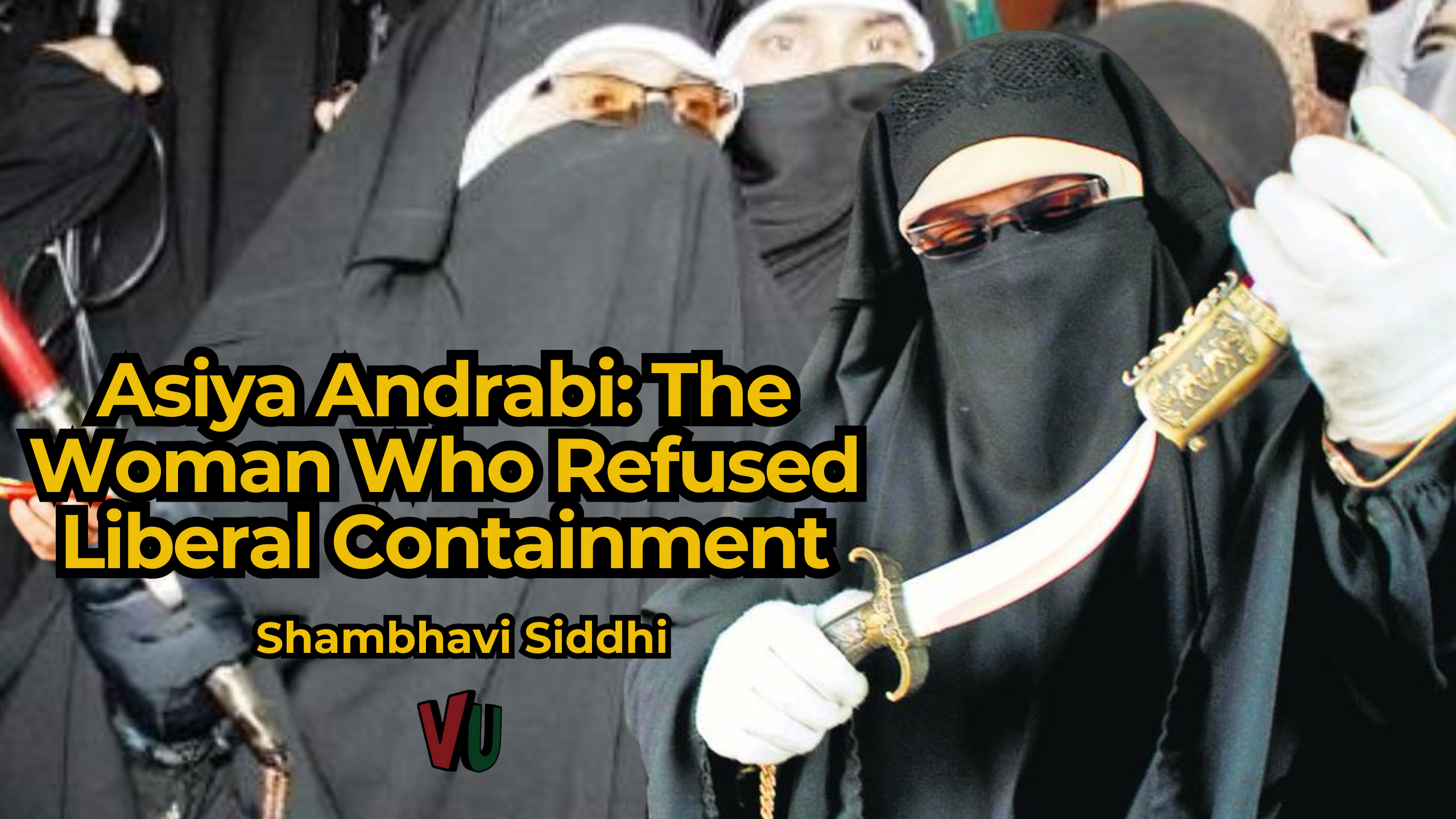
Shambhavi Siddhi
In Kashmir’s protracted conflict with Indian occupation, Asiya Andrabi emerges as a figure both feared and respected, a devout Muslim woman who chose to make faith the foundation of her resistance. Born in Srinagar in the early 1960s, she possesses a BSc degree in Biochemistry and an MA in Arabic from the University of Kashmir. Her political awareness was initially sparked through theological study: after reading “Khawateen ki Dilon ki Baatein” by Mayil Khairabadi, which presents the life of Maryam Jameelah, an American-Jewish convert to Islam, Andrabi commenced studying the Qur’an with tafsīr and organized women into study circles (halaqahs).
In 1987, she established Dukhtaran-e-Millat (“Daughters of the Faith”), a socio-religious organization that integrated women’s education, social reform, and anti-colonial awareness. “We were informed that being educated equated to adopting Western standards. I came to the realization that we must delineate what it signifies to be an educated Muslim woman,” she recollected in an interview with Kashmir Lit (2018). ( https://kashmirlit.org/asiya-andrabi-a-lifetime-of-fighting-for-freedom )
Under her guidance, Dukhtaran-e-Millat evolved into a movement in which the spiritual development of women became intertwined with political resistance. It aimed to establish social reform rooted in faith, promoting modesty as dignity, education as a duty, and self-determination as a divine entitlement. Before the outbreak of Kashmir’s insurgency, Andrabi’s initiative had already challenged the secular imagination: a woman capable of mobilizing through the Qur’an rather than the ballot box. This woman refused to be rescued by the very order that occupied her homeland.
Dehumanized by Liberal Secular Models
Andrabi is often the target of reductive stereotypes, such as “the veiled extremist” or “the jihadi wife,” by “secular” media outlets like The Print, which tend to prioritize sensationalism over a substantive engagement with her political ideas or agency. (https://theprint.in/india/governance/asiya-andrabi-kashmirs-first-woman-separatist-who-also-dreamt-of-marrying-a-mujahid/160138/)
This reductive portrayal exemplifies what Gayatri Spivak describes as epistemic violence, whereby the capacity of marginalized groups, particularly subaltern women, to articulate their own identities and beliefs is systematically erased. The liberal-secular worldview tends to define freedom within the confines of the modern state, making it difficult to accept a woman who finds empowerment through her faith, portraying her instead as a threat. As a result, Andrabi is not only physically imprisoned but also metaphorically confined within a narrow interpretive framework that renders her merely dangerous rather than a thinker or leader.
Her extensive activism, including founding religious institutions, fighting social issues such as dowry and caste discrimination, and advocating for modesty, is deemed a security threat. While her Dukhtaran-e-Millat movement marks a pivotal moment when Kashmiri women embraced Islam as both a moral and political discourse, this accomplishment remains unacknowledged or overlooked within secular narratives.
Faith as Political Praxis
Andrabi’s politics are deeply anti-colonial. She locates the struggle for Azadi (freedom) not only in territory but in epistemology, arguing that India’s occupation imposes a liberal-secular model that alienates Kashmiris from their religious identity. For her, Islam is not a private faith but a public ethic that structures resistance, community, and womanhood.
Through Dukhtaran-e-Millat, she endeavored to educate women in Qur’anic interpretation, Arabic literacy, and social activism. Her organization campaigned for reserved seats for women on buses and condemned Hindu practices that have infiltrated Muslim traditions—such as dowry and casteism—with a particular focus on the Kashmiri context, all within the framework of Islamic principles.
Much of Asiya Andrabi’s work is deliberately ignored by those who claim to defend human rights, precisely because it is grounded in Islamic thought. Within the liberal imagination, faith is not seen as a site of agency but as evidence of regression. As a result, her decades of teaching, organizing women’s Qur’anic study circles, and mobilizing for social reform are dismissed as negligible, even dangerous. This selective blindness exposes the conditional nature of liberal empathy: Muslim women are celebrated only when their politics mirror secular expectations.
In reality, Andrabi’s vision aligns closely with Saba Mahmood’s description of “the politics of piety,” in which agency does not arise from rejecting norms but from consciously inhabiting them. Her understanding of freedom does not depend on detaching from religion but on embodying it as an ethical and political framework. Andrabi refuses to conceptualize liberation through the vocabulary of secular liberalism, because she recognizes that such a vocabulary is itself a colonial inheritance that discredits the spiritual as irrational.
By centering Islam as the foundation of her resistance, she reclaims moral authorship from both the state and the Western human-rights establishment. Her defiance unsettles the liberal order that can only recognize the Muslim woman as either oppressed or rescued, never as self-determining through faith. Andrabi insists that belief, when lived as conviction, can itself be a form of rebellion.
The Price of Refusal
For rejecting the liberal order, Andrabi has paid with her freedom. The Indian state has invoked the Public Safety Act against her more than twenty times, and she remains imprisoned under the Unlawful Activities (Prevention) Act. Her detention is seldom mentioned in global forums that otherwise celebrate Muslim women’s rights. Justice for All documents how her imprisonment functions as political silencing. (https://www.justiceforall.org/freeasiyaandrabi )
By criminalizing her politics, the state transforms a woman’s ideological dissent into an issue of “national security.” She is not engaged as a political subject with a coherent worldview but as an anomaly requiring containment. This mirrors the colonial habit of dehumanizing those whose resistance is articulated in religious idioms.
Despite championing free speech in theory, many secular liberal voices have willfully ignored Asiya Andrabi, dismissing her not as a thinker or a political actor but as an extremist caricature. In doing so, they reaffirm a hierarchy of knowledge where only secular-approved voices are humanised, and any woman whose framework is faith-grounded is silenced.
Her younger son, Ahmed Bin Qasim, has consistently drawn public attention to her treatment in prison.
“I woke up to the news that my mother and her two aides have been shifted to the ‘Punishment Ward’. The condition of this award is terrible, and the routine is extremely stringent.” app.com.pk
This plea from her family cuts through the secular noise of liberty and freedom; it exposes the colonial silencing and erasure that violently oppresses and dehumanizes Muslimness.
What Her Politics Represents
Andrabi’s life and viewpoints challenge numerous traditional and widely accepted societal hierarchies. She does not conform to a singular identity, such as that of a Western-style feminist or a conservative cleric. Still, she presents herself as a woman who believes in Islam’s potential to establish a distinctive and equitable framework. Her perspective interrogates and complicates the binary debates frequently encountered in discussions concerning religion and modernity, including the dichotomy between liberal and fundamentalist attitudes, or between victimhood and militancy. She advocates the idea that faith can be a source of freedom, that community is vital to facilitating political participation, and that submission to divine principles can be a form of empowerment for both women and men.
Her critics perceive her as a threat, while her supporters regard her as a symbol of dignity. Nevertheless, both groups ultimately respond to the central question: Is a faith-driven Muslim woman considered to be a deserving participant within the secular-liberal human rights discourse?
Reclaiming the Narrative
Engaging with Asiya Andrabi necessitates moral clarity. Her discourse elucidates how liberal secularism enforces discipline upon Muslim women’s viewpoints by delineating which voices are considered rational and which are dismissed as fanatical. To articulate oneself as a believing woman within a colonized Muslim nation constitutes, in effect, an act of defiance, as the liberal international order recognizes reason exclusively when it adopts the lexicon of unbelief.
Her life, from halaqah to prison cell, marks an ongoing conversation about how Muslim women imagine freedom amid colonial modernity. Through her, we are reminded that political subjectivity in the Muslim world does not emerge solely through Western models of activism or democracy. It is also cultivated in worship, collective memory, and the intimate spaces where women assert their moral authority. Andrabi’s journey demonstrates that piety is not equivalent to submission to authority; it is a refusal to surrender one’s soul to colonial modernity. Her life invites us to perceive faith not as a retreat from political engagement but as a revolutionary act of self-determination.
The question that lingers is simple yet unsettling: can the conscience of liberal modernity accept the Muslim woman who resists not despite her faith, but because of it?
Shambhavi Siddhi is a PhD candidate and Graduate Teaching Assistant at Gender, Sex and Women’s Studies (GSWS)- University of Western, Ontario, researching the epistemic resistance of Kashmiri women in Indian Occupied Kashmir. Drawing on the work of Sarah R. Farris and Lila Abu-Lughod, Shambhavi’s research further examines the femo-nationalist discourse that the Indian State formulates to further its occupation in Jammu and Kashmir. Shambhavi holds a master’s in French literature from Jawaharlal Nehru University, New Delhi, India.
